

This resource discusses the history of the Native American residential boarding school system and includes themes of cultural trauma and forced assimilation. Additionally, topics related to violence against Native people like the hanging of the Dakota 38 and death of children within residential schools are discussed.
It’s important to acknowledge the diversity of Indigenous Peoples‘ cultures, traditions, and languages globally. When teaching about a particular tribe, nation or Indigenous community, learning and using accurate terms specific to the community can prevent stereotypes and encourage cultural understanding and sensitivity among your students. Throughout this resource, the author uses endonyms or names chosen by communities themselves to refer to specific Indigenous groups whenever possible. For example, rather than Winnebago, Chippewa, and Fox, they say Ho-Chunk, Ojibwe, and Meskwaki respectively. The words “Indigenous” and “Native” are used to be inclusive of all peoples who are the original inhabitants of the land. These words encompass more specific terms like “American Indian,” “First Nations,” “Pueblos originarios (Original peoples)” and others referring to Indigenous people in specific regions.
American Indian, Native American, Native or Indigenous are acceptable and often used interchangeably in the United States; however, Native Peoples often have individual preferences on how they would like to be addressed. To find out which term is best, ask the person or group which term they prefer. When talking about Native groups or people, use the terminology the members of the community use to describe themselves collectively. There are also several terms used to refer to Native Peoples in other regions of the Western Hemisphere. The Inuit, Yup’ik, and Aleut Peoples in the Arctic see themselves as culturally separate from Indigenous People. In Canada, people refer to themselves as First Nations, First Peoples, or Aboriginal. In Mexico, Central America, and South America, the direct translation for “Indian” can have negative connotations. As a result, they prefer their respective endonyms or the Spanish words/phrases Pueblos originarios (Original communities), Comunidad (community), and pueblo (people).
Manifest destiny represents a belief that originated in the 19th-century United States that American settlers were destined to expand westward across North America, and that this expansion was both obvious (“manifest”) and certain (“destiny”). The belief is rooted in American exceptionalism and Romantic nationalism, implying the inevitable spread of the Republican form of governance. It’s use in the 19th century was one of the earliest expressions of American imperialism in the United States of America. Like settler colonialism, the ideology of Manifest Destiny has inspired a variety of measures designed to remove, replace, and destroy the Indigenous population.
When discussing engagements between Native people and settlers, the author uses the term settler colonialism to describe both past and ongoing efforts to dispossess Indigenous communities, nations, and peoples of their homelands and ultimately replace them with new settler societies. This term was coined by scholars in reference to the actions of many countries globally, including the United States, which continues to occupy Indigenous land around the world.
Analú María López (Huachichil/Xi’úi) is the Ayer Librarian and Assistant Curator of American Indian and Indigenous Studies at the Newberry Library. As the Ayer librarian and Assistant Curator, she helps steward the Indigenous studies collection while guiding library users through, connecting them with, and interpreting materials linked to the Indigenous Studies collection. She is interested in uplifting historically underrecognized Indigenous narratives, preservation and revitalization of Indigenous languages, decolonial theory (within Libraries), and intentional community collaborations for access to materials within colonial institutions. She holds a Master of Library and Information Sciences with a certificate in Archives and Cultural Heritage Resources and Services from Dominican University and a Bachelor of Arts in Photography with a minor in Latin-American Studies from Columbia College Chicago. Ms. López began her career with the Newberry in 2004. After working for other libraries and museums in Chicago for thirteen years, Ms. López returned to the library in her current role in September 2017.
When we think of “Native American/Indigenous Photography,” it is rarely associated with Native American or Indigenous photographers; instead, we often think of photographs created of Native People by white photographers. Native people and photography did not get along for many years. In fact, cameras were, and one can argue, continue to be, an intrusion on Indigenous life. Tourists visit Native and Indigenous communities and immediately take out their cameras to photograph them. In Tuscarora photographer Rich Hill’s essay, “In Our Own Image: Stereotyped Images of Indians lead to New Native Art Form,” he writes, “Photography and Indians have gone hand in hand for over a century, creating cultural stereotypes in our minds every time we hear the word “Indians” (9). Hill further elaborated in this essay how many photographs from the nineteenth to twentieth centuries were taken for outside interests, by people outside of the communities of Indigenous people. Images from these centuries continue to make their way into popular media today; but we are seeing more contemporary Native-produced photographs creating historical interventions and flipping negative narratives into positive, critical ones.
Photographs and the photographic process—as well as illustrations based on photographs—both disclose and conceal, shaping the image and obscuring the relations between the photographer and the subject. Photographs are complex and suggestive by nature; they have the ability to appropriate the world. It is important to keep its very nature in mind when looking at photographs. Historian Martha Sandweiss once said that photographs “should not be taken at face value…they need to be understood as constructions of the human imagination, as the result of selective attention to a particular subject” (“Posing the Indian,” 585). In the case of Indigenous people, this was often a complicated relationship affected by the actions and desires of the photographer and sitter. However, historians argue that some images created of Indigenous people were created in collaboration with the sitters and input was given by them. For example, in 19th century paintings created by the artist Elbridge Ayer Burbank of Mescalero-Chiricahua leader Goyaałé—or Geronimo— we see the interactions between, in this case, painter and sitter:
“…But even while Geronimo was apparently happy with Burbank’s portraits, he also pushed back repeatedly against the painter’s intentions. Though Burbank reported that Geronimo “has signed his name to both of the pictures I painted of him,” he also admitted that he “had a hard time to get him to do it.” And while Geronimo ultimately agreed to sit for Burbank in regalia, he also drew a line: after finishing the first two portraits, Burbank reported that “’I was going to paint a third profile of him in war paint he promised to paint his face up, but he backed out.’ Finally, though Burbank’s assignment was to depict the war chief in regalia, Geronimo seems to have convinced Burbank to let him sit for one of the portraits in the soldier’s uniform he then commonly wore.”
Even though there are several examples of this collaboration throughout the history of art and photography, it is critical to analyze the extent to which Native people were granted visual sovereignty. We cannot and should not deny the fact that white photographers had the privilege and opportunity to photograph Indigenous people, hence favoring their work above that of Indigenous photographers.
At its invention in the 1820s, the making of photographic images involved a complex and laborious process with limited application. However, with the creation of the wet-glass negative in the 1840s, one could produce a limitless number of prints by exposing the negative image onto paper that was made light-sensitive through a coating, or “emulsion,” of sodium chloride. This dramatically invented a new format for disseminating an image on a social and cultural level. However, prior to the invention and popularity of photography, painted portraits of Native people, particularly chiefs—often labeled problematically by non-Native people as “Noble Savages”—were a well-established genre by the late 1830s. Even while these painted portraits are exquisite, they frequently contribute to the “vanishing race” theory—that is, the belief that Indigenous People would physically vanish due to forced relocation, disease, and war. Americans also held the belief that Indigenous people would “culturally” vanish through contact with whites and forced assimilation.
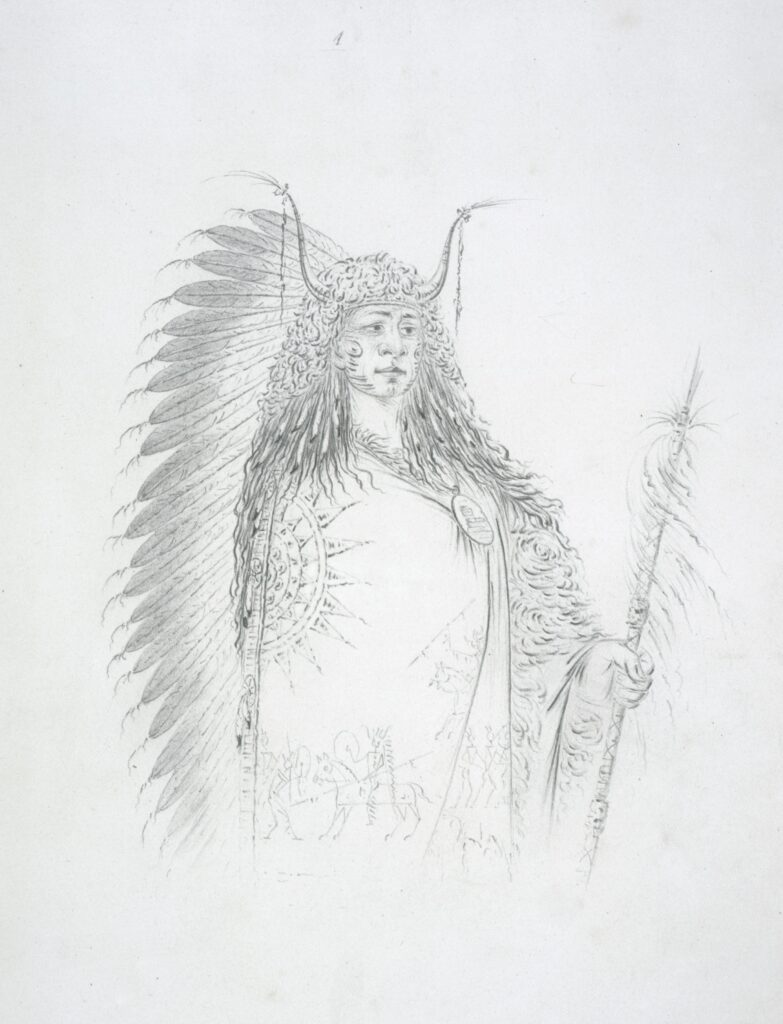
The artist George Catlin, for example, painted hundreds of portraits of Native people (figure 1.1) to document and preserve, in Catlin’s words, “an interesting race of people, who are rapidly passing away from the face of the earth” (Letters and Notes, 3). We know this statement to be untrue: Native people continue to exist and resist. Catlin’s paintings, among many others, inspired tourism, while the advent of photography led to many government-hired photographers travelling West. However, the romantic, nostalgic image of Native people obscured a painful history and made it difficult for Native artists and photographers to gain recognition, something that persists to the present day. As Hulleah Tsinhnahjinnie wrote “If we juxtapose the history of photography and Native American History, you will understand why Native Photographers are just being exhibited at this late date.” (“Compensating Imbalances”).
Photography accomplished, perhaps, what a painting could not: a new way of disseminating an image to the masses. But photography also had its challenges. As Osage photographer Ryan RedCorn said in an interview for National Geographic, “Photography has a long voyeuristic and exploitative relationship with Indigenous communities” (Brown, “For this Native Community…”). One cannot ignore the fact that the beginnings of photography are rooted in the exploitation of Native, Indigenous, and People of Color. In the beginning, photography was not an easily accessible medium due to its prohibitive cost, but we still know Native people were actively participating in creating their own images via photography. There are examples of Native and Indigenous people practicing photography throughout history, especially after being trained by non-Native photographers. One example discussed below is the work of Puyallup photographer John Leslie, who took up photography while enrolled at the Carlisle Indian Industrial School.
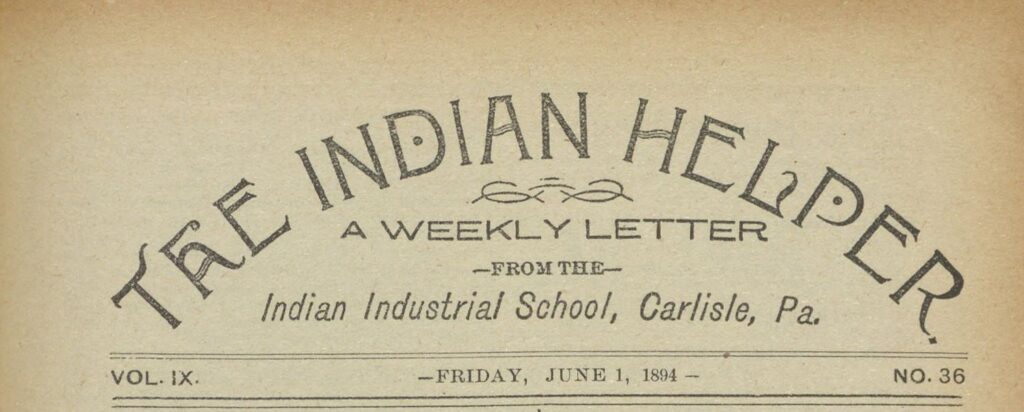
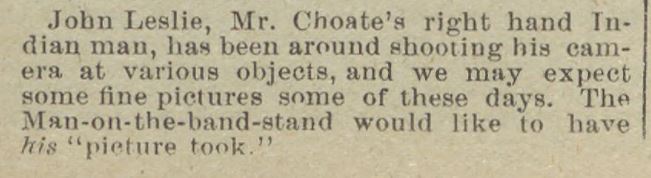
John Leslie worked as a photography student assistant for the photographer John Choate while at Carlisle Indian Industrial School under the “Outing System,” which was essentially one of many apprenticeships available and intended as another “civilization” program. As seen in the following images (figures 1.2 and 1.3, courtesy of Dickenson College) he is described as Choate’s “right hand Indian man, has been around shooting his camera at various objects…” We will discuss more of Leslie’s work below in the section focused on Carlisle Indian Industrial School.
Much of the success of photography in the nineteenth century is due to the public’s obsession with seeing the previously unseen. Celebrities, “exotic lands and peoples,” and international events that used to be out of reach for the middle classes could now be purchased for a few cents (Turner, “John Nicholas Choate…”). For example, the celebrity and souvenir photograph market were extremely successful and accelerated the photography craze of the nineteenth century. This set the stage for the manufacturing and marketing of many types of photographs, especially those of Native people and of scenes from places such as government run assimilation boarding schools like the Carlisle Indian Industrial School. The propaganda photos from such boarding schools, which often showed Native children in before and after style photographs, suggested that Native people were “uncivilized” and in need of saving by white culture. By casting them as less than human, these depictions helped justify westward expansion and violence against Native communities. In the nineteenth century, such photographs and artistic depictions of Native people as “uncivilized,” left behind by modernity – or as “savages” disrupting progress – reinforced popular ideas about manifest destiny, that is, the belief that American settlers were destined to expand westward across North America. This was one of the earliest expressions of American imperialism in the United States of America. Like settler colonialism, the ideology of Manifest Destiny has inspired a variety of measures designed to remove, replace, and destroy Indigenous people.
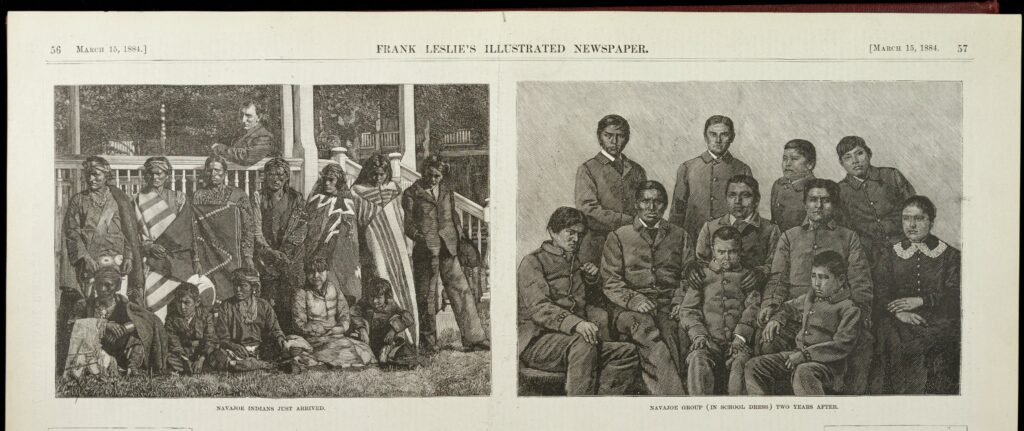
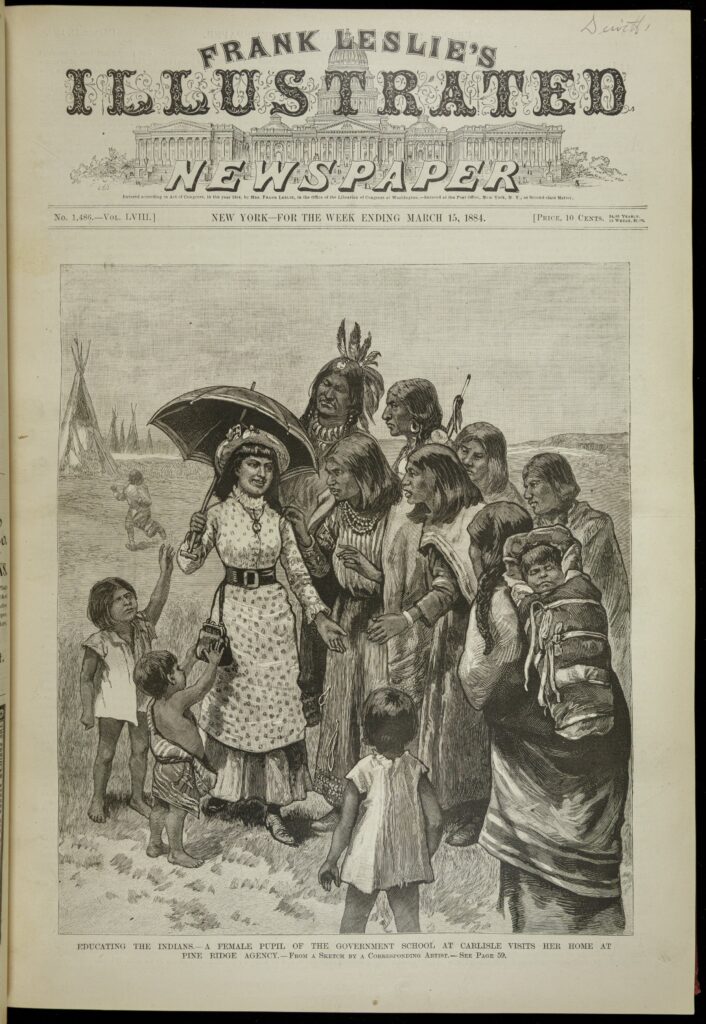
Indigenous people were the subject of a fascination that led to the popularization and broad availability of a wide variety of inexpensive Native literature. Photographs and illustrations derived from photographs depicting Native people published in popular newspapers of the time, such as Frank Leslie’s Illustrated Newspaper, were many times one of a few ways, aside from cheap literature, white people were educated about Native people. Frank Leslie’s Illustrated Newspaper, later renamed Leslie’s Weekly, was a popular American illustrated literary and news magazine founded in 1855 and published until 1922. It was one of several magazines started by publisher and illustrator Frank Leslie. Throughout its decades of existence, it provided illustrations and reports—first with wood engravings and daguerreotypes, and later with more advanced forms of photography.
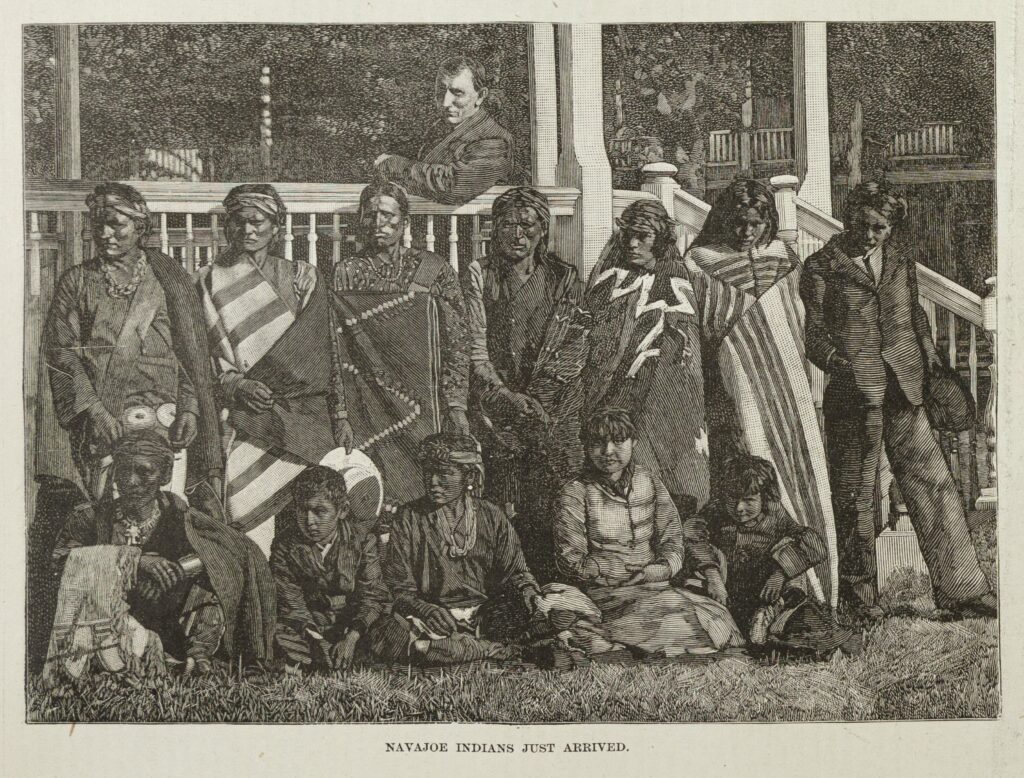
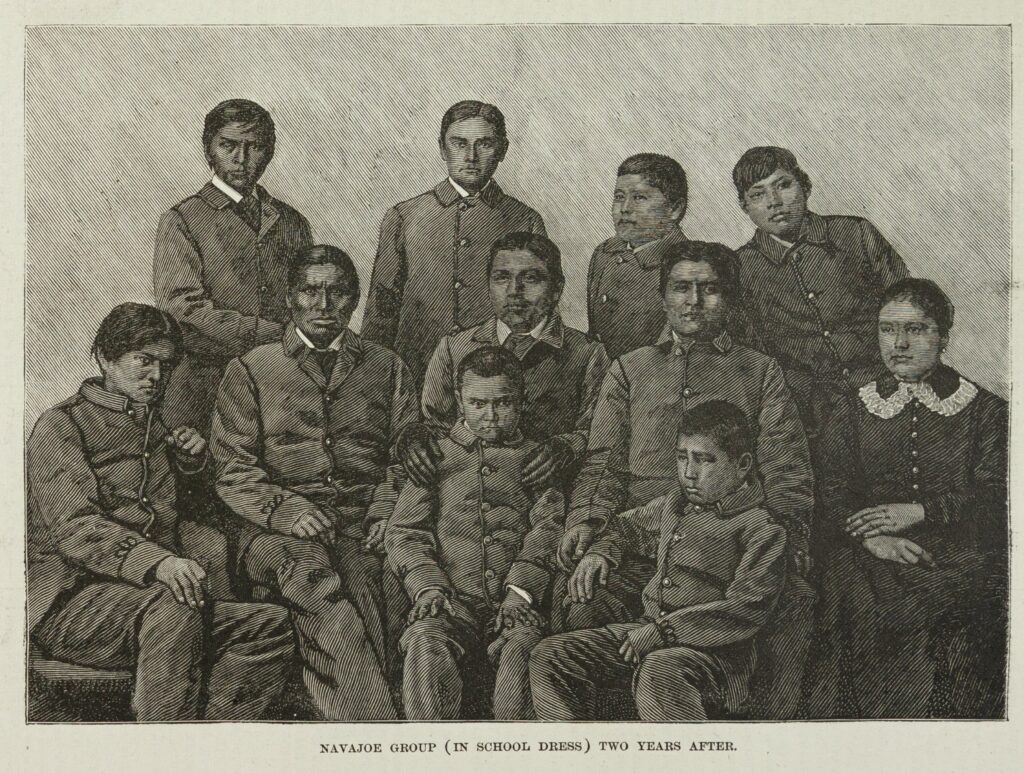
As an example, see figures 1.4 below, the original black and white photograph on the left and the illustration based off the photograph published in Leslie’s on the right, given the captions “Navajoe Indians just arrived,” and “Navajoe group (in school dress) two years after.” Here we see portraits of Native people arriving at Carlisle Indian Industrial School. In figure 1.5 we see an image of a student returning to her reservation after being “successfully assimilated” into European-American culture at the school. The caption reads, “Educating the Indians— a female pupil of the government school at Carlisle visits her home at Pine Ridge Agency.” This image, along with the caption, reinforces problematic ideas of the “uncivilized savage” and promotes the idea that the only way to become civilized is to assimilate into Euro-American culture.
Like photographs and illustrations, such as the ones mentioned above from government-run boarding schools, Native delegation portraits and other kinds of portraiture can be used to begin discussions about the impacts of settler colonialism on Indigenous communities, along with broader societal discussions on institutional racism and class dynamics (e.g. Who writes the stories? Who benefits from the stories? Who is missing from the stories? Who had access to photography and who didn’t?) in the United States. As Cass Fey mentions in “Exploring Racism through Photography,” “Representations such as photographs shape how we view people and the world and can also be used to enable students to think about race and race relations” (44-51). However, we should remember though Native people have been racialized and experience racism, unlike other racial groups, Native nations have a unique relationship with the federal government.
Ask Students
Thomas Martin Easterly (October 3, 1809 – March 12, 1882) was a nineteenth-century American daguerreotypist and photographer. He was one of the more prominent and well-known daguerreotypists in the Midwest United States during the 1850s. Born in Guilford, Vermont, he was the second of five children born to Tunis Easterly and Philomena Richardson. He began practicing photography in 1844 and was the first and only daguerreotypist to identify his work using engraved signatures and descriptive captions.
In the fall of 1845, Easterly traveled to the Midwest and toured the Mississippi River with Frederick F. Webb as representatives of the Daguerreotype Art Union. Easterly and Webb then went their separate ways while Easterly traveled on his own to St. Louis. Easterly soon became popular for his portraits of prominent residents and visiting celebrities, which were displayed in a temporary gallery on Glasgow Row. One of these portraits was that of Sauk Chief Keokuk (figure 2.1). John Ostrander, founder of the first daguerreotype gallery in St. Louis, brought Easterly back to Missouri in early 1848. Preparing for an extended “tour of the south.” Ostringer asked Easterly to manage his portrait gallery. Easterly continued running the gallery when Ostringer died a short time later.
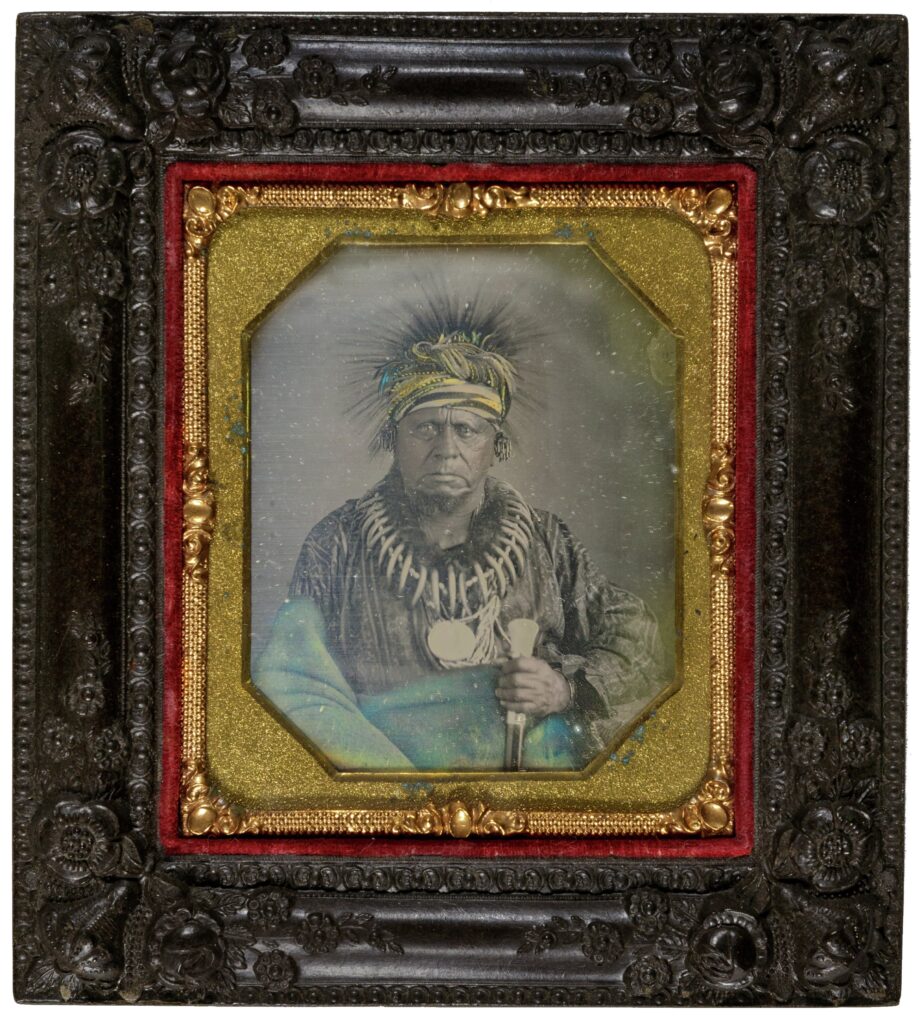
Thomas Easterly’s chance meeting with his Thakiwaki and Meskwaki visitors occurred in the spring of 1847, when they left their reservation in present-day Kansas to journey by steamboat to St. Louis. On March 24, under the heading “Distinguished Visitors,” a local newspaper reported: “Keokuk, the well-known Sac and Fox Chief, arrived last evening from the Missouri river, on board the Amelia—He is accompanied by ten of his people. The location of the tribe at present is south of the Missouri river, near the mouth of the Little Nemaha” (quoted in Kilgo, 129). Keokuk was principal leader of what the government officially recognized as the “Sac and Fox band of the Mississippi,” a designation that differentiated this tribal division from a much smaller and politically distinct group known as the “Sac and Fox of the Missouri.”
In a series made two years after his Thakiwaki and Meskwaki sittings, Easterly also documented a group of Báxoje (Iowa) Peoples, a much smaller tribe. He made at least five exposures to record Nacheninga (figure 2.2), also known as Notchimine or No Heart, who was recognized by government agents as the “second chief” of the Iowa Nation. One of the portraits held at the Newberry within the Edward E. Ayer Collection as part of a set of fifteen daguerreotypes by Thomas Easterly has an annotation on the back that reads: “Every Indian name has a meaning. Na-che-ninga means no heart of fear or a heart that fears nothing.”
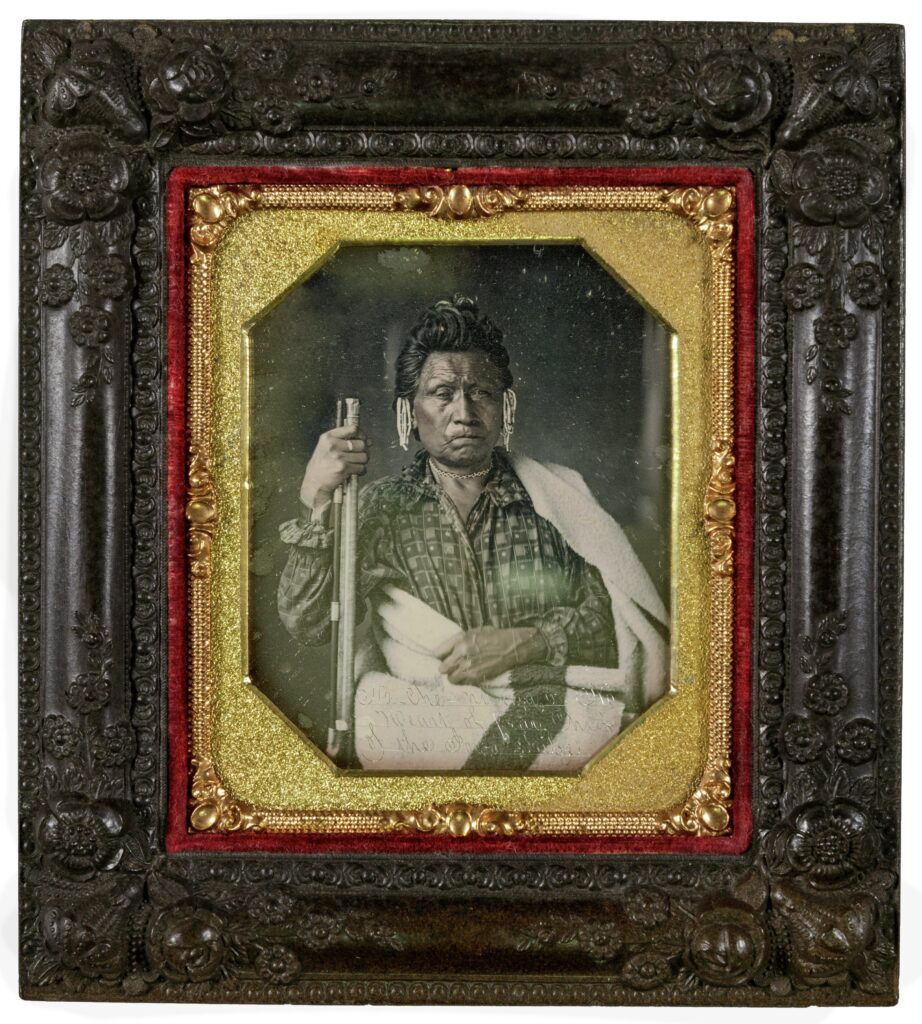
Nacheninga, who would become the principal leader of his tribe in 1850, was the acknowledged business head of the Iowa Nation, a responsibility that may account for his trip to St. Louis in 1849. As was customary, a Nemaha Reservation agent, Colonel Alfred J. Vaughn, who held this position for the Iowa tribe in 1848 and 1849, escorted him and his group on their journey. From notes that Easterly penciled on the verso of the frame, it seems that the agent was more than a silent observer on his sittings. Explaining his subject’s intense grimace, Easterly wrote: “The expression of Nacheninga’s mouth is unnatural. It was put on to represent their look of wisdom in Council, at the request of the Agent” (quoted in Kilgo, 129).
Ask Students
Interactions between Indigenous people and European Americans have focused frequently on land. Treaties, laws, and violence pushed Native people from their ancestral homelands to reservations on less desirable lands. Through this systematic dispossession, the United States government aimed to make Native land available for ownership, settlement, and economic development by settlers. For the Chicago region, this map shows the eight treaties that either ceded land in what is now northeastern Illinois or were negotiated at Chicago. It also highlights land that was never ceded by treaty. Treaties are nation-to-nation agreements, in this case, made between the United States and tribal nations. While some treaties were made to end conflicts, others were coerced, made on an unequal footing, and later broken. But it’s too simple to say that Native nations didn’t know what they were signing or didn’t understand land ownership. Indigenous communities had long-standing practices for recognizing territorial boundaries that pre-date colonization, and they made difficult decisions that considered the interests of future generations. Treaties are binding agreements that uphold legal obligations still intact today.
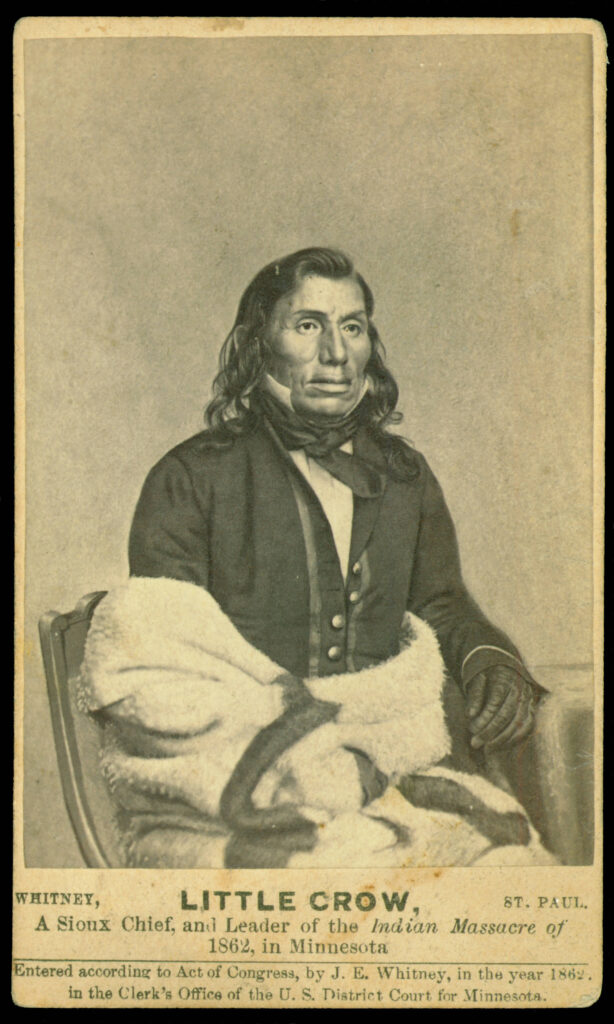
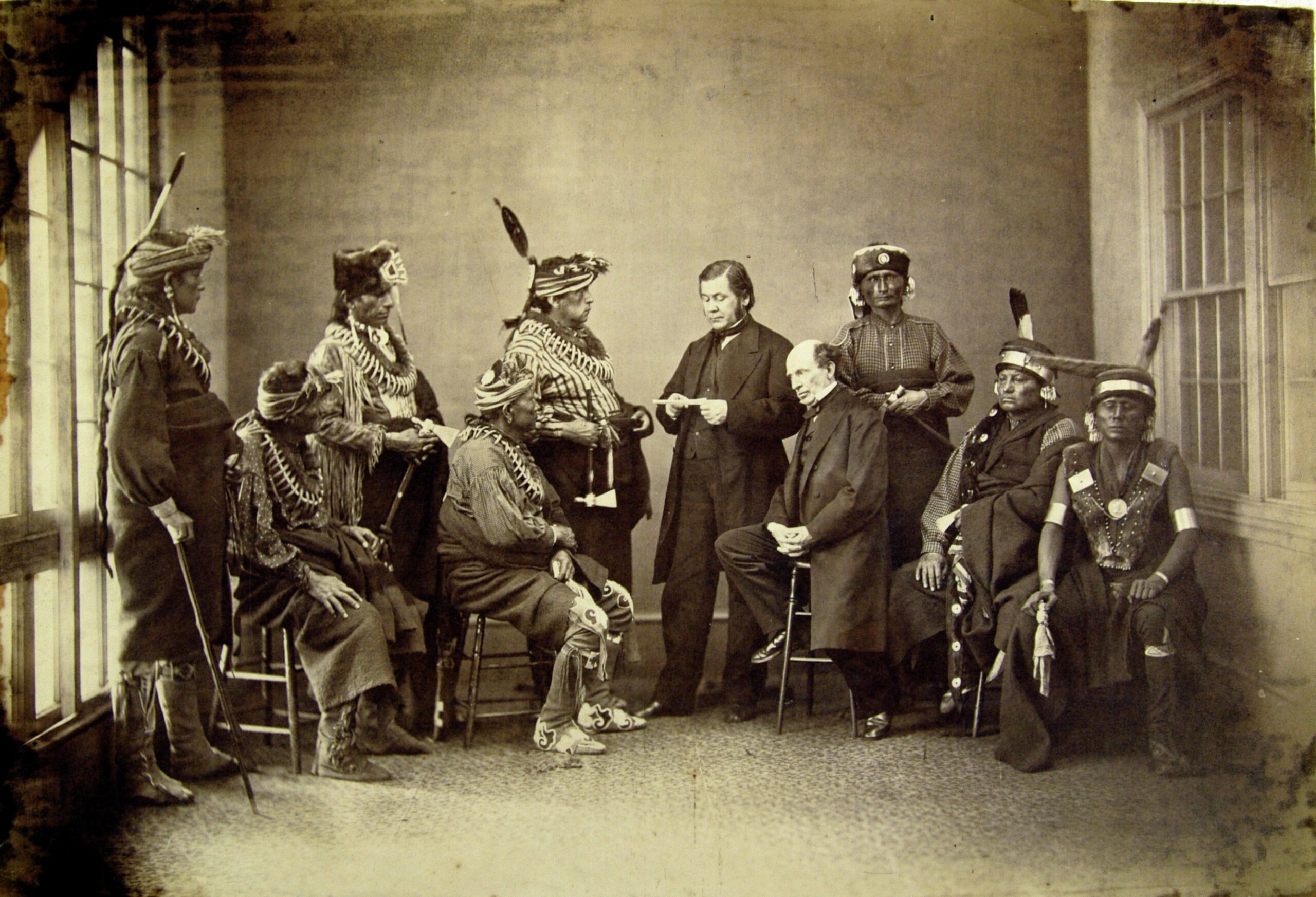
During this time, many tribes sent delegations to Washington, DC to conduct treaty negotiations, seek compliance with existing treaties, or resolve disputes with Indian agents or other state and federal authorities. As official diplomatic delegations to Washington, these delegates were photographed in their meetings with government officials. These official photographs were often a routine part of many Native people visiting mostly Eastern cities. Tribal delegates were photographed in their regalia or European-American suits such as in the photograph in Figure 3.2 of Little Crow. Such group or “delegation” portraits became one of the staples of documenting Native peoples’ interactions with governmental officials. Oftentimes these photographs were used as illustrations within newspapers of the time and gave insight to the public into Native culture and people.
What many of these delegation photographs omit is the consequences from these treaty negotiations. Native culture has been severely disrupted by the westward expansion of settlers, who sought to replace the original population of the land with a new American society. Oftentimes, throughout history, violent clashes with European American settlers had become increasingly common. To resolve these conflicts, the United States government adopted a policy of trying to keep the two groups separate by forcibly and often violently removing and relocating Native people onto reservations while trying to “civilize” them. In other words, they tried to convert them to European American religion and lifestyles through assimilation policies shown below in the next section, “Carlisle Indian Industrial School Portraits.”
While on reservations, the US government appointed traders and other individuals, often with Indigenous language skills, as agents to carry out the removal process. As official intermediaries between the US government and Native nations, these agents were responsible for delivering communications and payments of money and goods, as dictated by treaties, and overseeing the reservations. The government neglected to enforce the treaties and agents often pocketed payments intended for Native people and refused to distribute food. The government also allowed the unauthorized occupation of settlers on Native land. Broken treaties frequently led to violence between Native people and settlers, and at times escalated to war such as the US Dakota War of 1862 This war erupted in Minnesota after many treaty violations (What is the Midwest?, The Newberry Library, exhibition wall text, 2019).
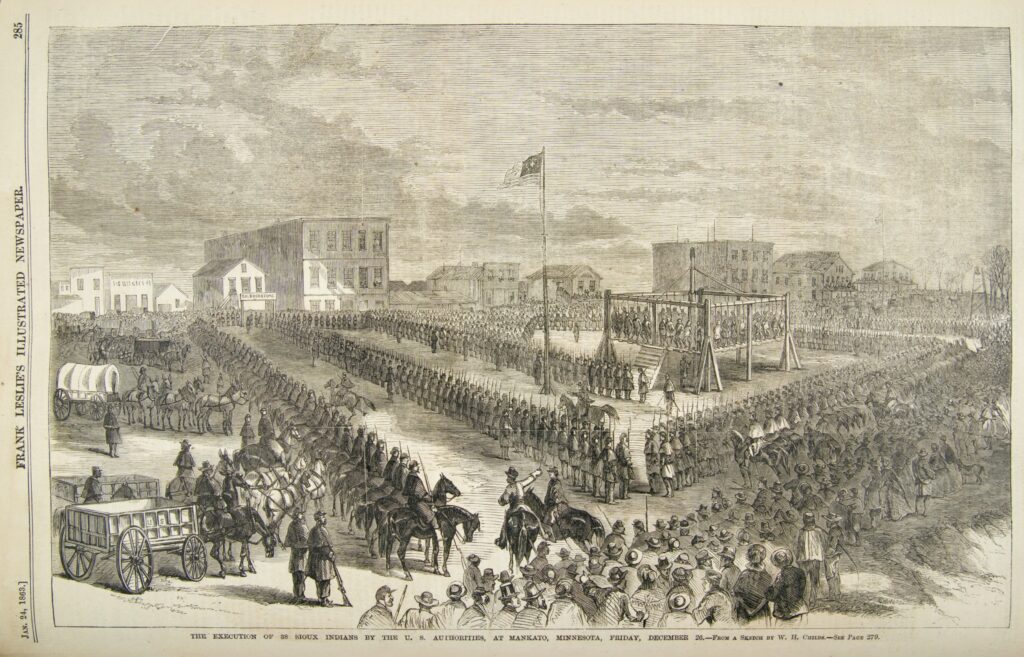
Following the war, the US Army tried 393 Dakota men—without representation by attorneys—at Fort Snelling, Minnesota, for alleged rape and murder. After 303 were sentenced, President Abraham Lincoln authorized the hanging of thirty-eight, the largest mass execution in US history. The public hanging on December 26, 1862, attracted crowds and reached wide audiences through published images within Frank Leslie’s Illustrated Weekly Newspaper (Figure 3.1). This illustration is also based off a photograph taken at the time showing Dakota men being hanged. (The author has chosen not to include the photograph, out of respect for the descendant family members and community.)
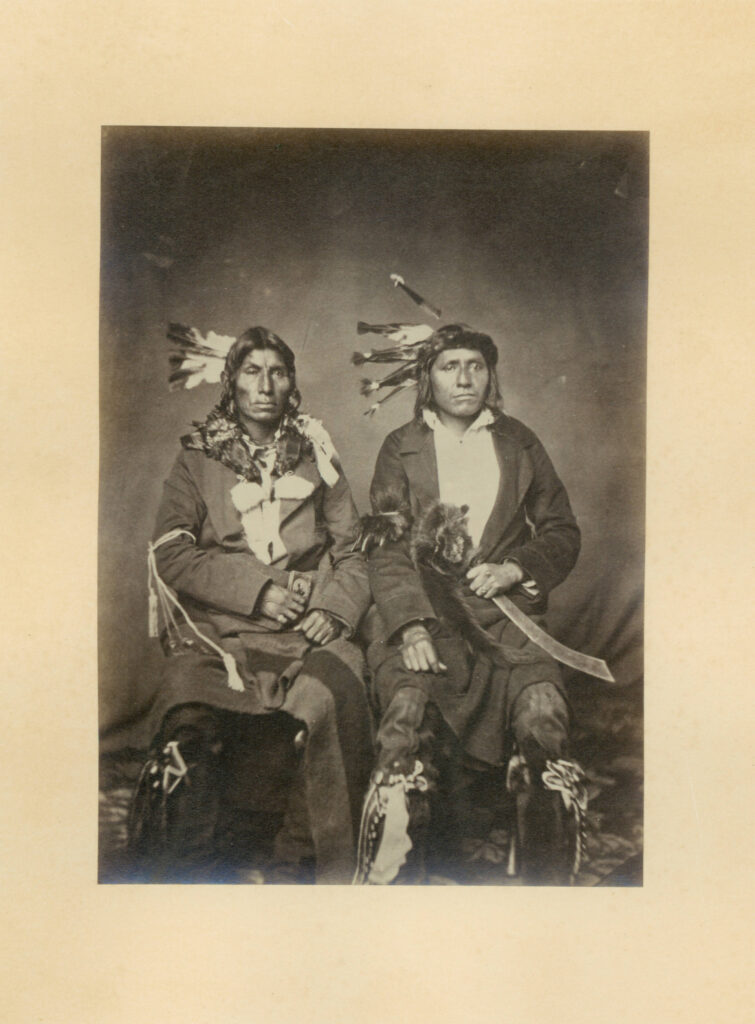
The first son of Chief Wakenyantanka and his wife Minneakadawin, Taoyateduta or Little Crow (in Figure 3.2 and on the left in Figure 3.3) traveled to Washington, DC, in 1858 to discuss broken treaties. During the Dakota War, Taoyateduta is said to have led several attacks in opposition to settler encroachment and oppression. He is quoted saying to the Indian Agent Thomas Galbraith just prior to the Dakota War: “We have no food, but here are these stores, filled with food. We ask that you [the agent] make some arrangement by which we can get food from the stores, or else we may take our own way to keep ourselves from starving” (Barton 1919, 48-49).
His Own Thunder, on the other hand, was on the opposite side, helping to alert the settlers. A settler killed Taoyateduta (Little Crow) after the war near Hutchinson, Minnesota, who collected the bounty given to any person who killed a Dakota in Minnesota. Taoyateduta (Little Crow) had been picking raspberries with his son, Wowinape (Comes in Sight). In 1879, the Minnesota Historical Society (MNHS) placed Taoyateduta’s (Little Crow) remains on display at the Minnesota State Capitol. In 1915, MNHS removed the remains from display at the request of Little Crow’s grandson, Jesse Wakeman. In the 1960s, Wakeman requested that the remains be returned to the family for proper burial. The request was granted in 1971. MNHS’s chief archaeologist transported the remains to a cemetery, where the Wakeman family buried them.
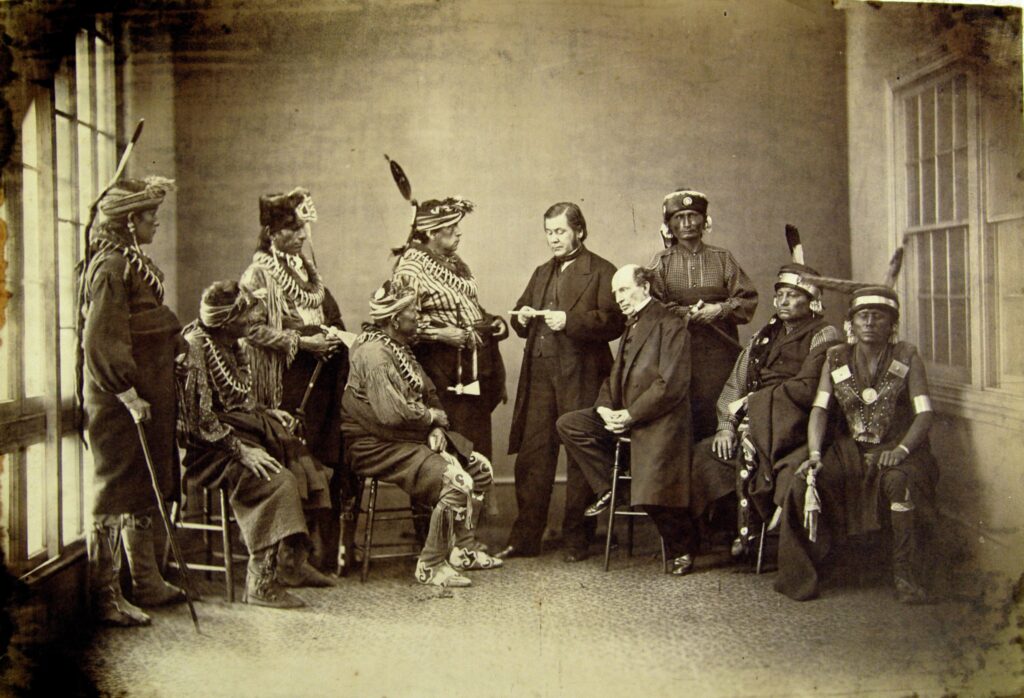
After a fire at the Smithsonian damaged and destroyed many paintings depicting Native people, the museum replaced them with photographs of Native delegations visiting Washington (see Figures 3.4 & 3.5). The photographer Alexander Gardner was hired as the official photographer for the Office of Indian Affairs in 1872 to create these photographs after he closed his gallery. Gardner also traveled to the West to document signing ceremonies and individuals in their camps. Today his work is considered a “priceless historical record” but when critically viewing them, we see how Gardner’s privilege as a white male allowed him to gain access to these spaces (Davis, Civil War Journal, 356-357). For example, during the period when photography was gaining popularity, Native people were being forcibly dispossessed from their lands while being photographed by mostly white photographers. Native people were rarely extended agency or visual sovereignty to compose, let alone, practice photography to create their own images. However, as literary scholar Samantha Majhor reminds us: “I also think about the way these photographs help to confer and reaffirm tribal sovereignty as part of documenting the treaty-signing process. Native leaders are serving a role and enacting treaties as sovereign heads of their respective Nations and are worth the expense (in the settler-frame of mind) of photographing in this period as dignitaries. That many of these leaders (one of my relatives among them) were paraded around as ‘site’ in their ‘tour’ of the east coast certainly complicates my point above and speaks to much of the analysis, here. Nonetheless, they furnish evidence (as Susan Sontag would say) of the way the U.S. regarded Native Nations and leaders and the treaty-signing of the moment” (quoted in correspondence with the author).
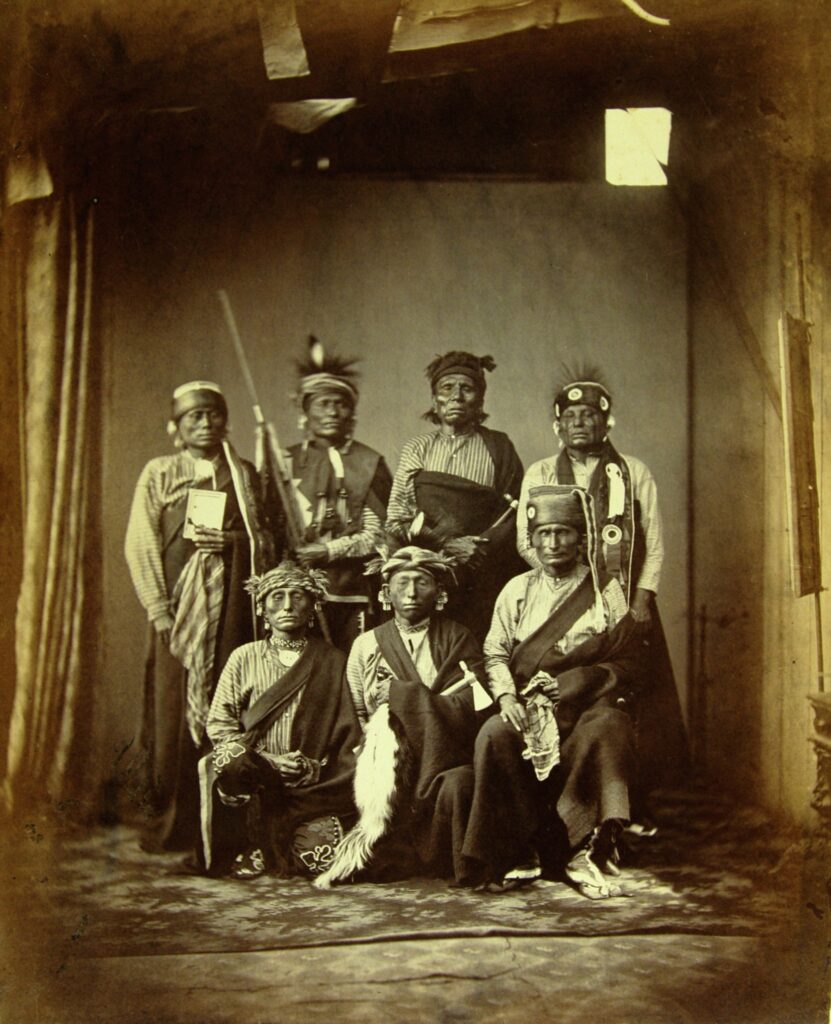
Of the 367 Indian treaties that were ratified, sixty-nine were negotiated and signed in Washington, DC. Tribal delegates, together with interpreters and agents, came to the capitol to speak with the “Great Father” (President) and to negotiate agreements with the government. On such occasions they usually had pictures taken in their best attire, such as in figure 3.5. In the image entitled “Group of Sauk and Fox Native Americans,” a staged photograph, in figure 3.4 is the Thakiwaki and Meskwaki delegation with the Commissioner of Indian Affairs, Lewis V. Bogy, standing in the center. Bogy signed the treaty as principal commissioner for the United States, but the Senate, in March 1867, refused to approve his appointment to the office of commissioner of Indian affairs (Purcha, American Indian Treaties 209).
Ask Students
Founded in 1879 by Captain Richard Henry Pratt, under the authority of the United States federal government, the Carlisle Indian Industrial School in Pennsylvania was the first federally funded off-reservation Native American boarding school. It had enrolled over 10,500 students by its closing in 1918. Pratt believed Native people could be the equals of European Americans, and that Native children immersed in mainstream Euro-American culture would become assimilated. His slogan at Carlisle was “kill the Indian, save the man” (quoted in Pratt, 260-271).

Native American boarding schools were important centers for photography at the turn of the century. Photography was included in the teaching curriculum at the Carlisle Indian School. It is well documented in public media that the school boasted about having “One of the finest and best equipped photographic studios in the state.” By 1906, the Carlisle Indian School built a state-of-the-art photography studio and taught photography classes to its Native students. Official school photographers took photographs of Native American students, and these propagandistic images were produced to emphasize the “civilizing” benefits of the boarding school system. Although some Native students obtained cameras and recorded their own boarding school experiences, the visual history still relies primarily on the institutionally produced images.
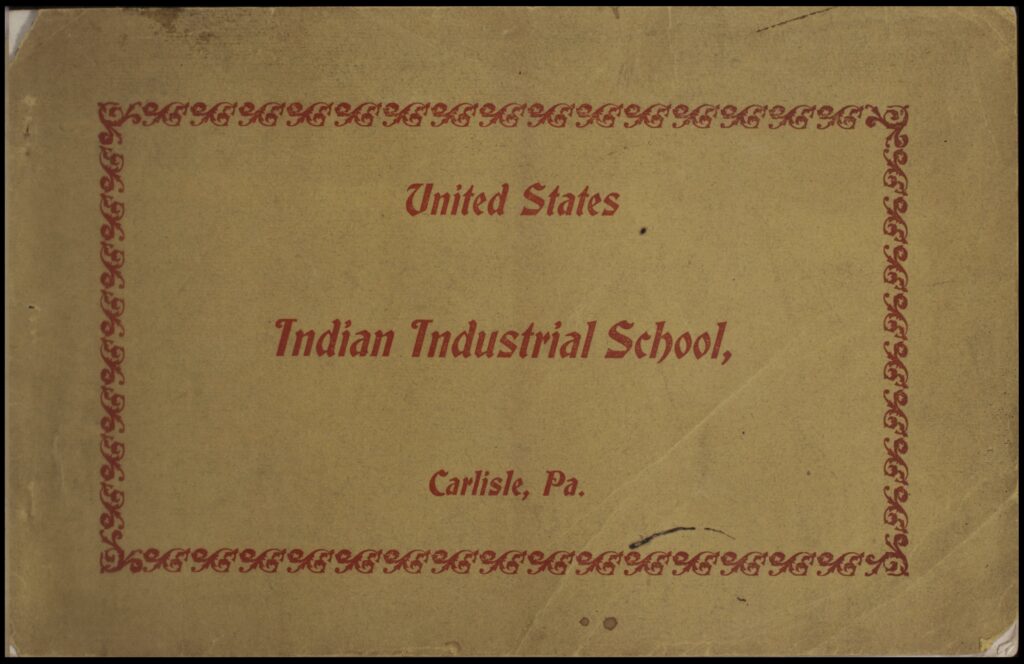
John Leslie (Puyallup) learned photography at Carlisle Indian School after Choate employed him as a student apprentice. In 1895, Leslie published a book of his photography and exhibited his photographs at the 1895 Atlanta International Exposition. Leslie also worked as John Choate’s photography assistant and Leslie took many of the landscape photographs published in Carlisle’s catalogs. In 1895, Leslie produced a souvenir booklet (figure 4.1) of the school, and he took most of the sixty-one photo views. The Indian Helper promoted this booklet in December 1894 with the notice, “Remember this is Indian work and the first sent out from the Carlisle school” (The Indian Helper, 10, no. 12, December 14, 1894). After his graduation in 1896, Leslie returned to his home in Tacoma, Washington where he continued to practice photography. The Indian Helper reported that he was “doing well in the photography business. In three weeks, he took in $40.00.”
While at the school, students were also forbidden to speak their own languages. Their hair was cut; they were dressed in suits and ties and corseted dresses. They did not go home for years at a time. The students were taught trades, like baking and blacksmithing, which were meant to give them a foothold in the white world after graduation. To document his experiment, and what scholar David Wallace Adams referred to as “Education for Extinction,” Pratt commissioned John N. Choate to take before and after “contrast” photos to document the school’s progress in “civilizing” Native children. Since Pratt’s mission was to show that Native people still had a place in a world that was destroying their homes and cultures, he was eager to hold up examples of students succeeding according to his standards. These photographs were then sent to officials in Washington, to potential charitable donors, and to other reservations to recruit new students. In some instances, these same photographs and catalogs were sold at John Choate’s studio for profit.
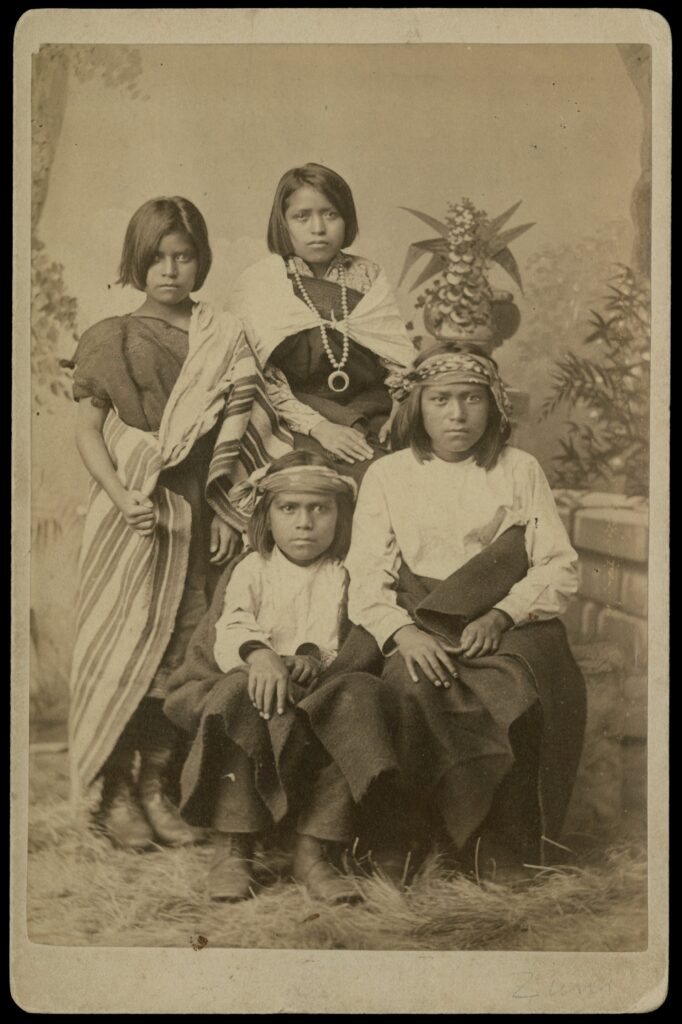
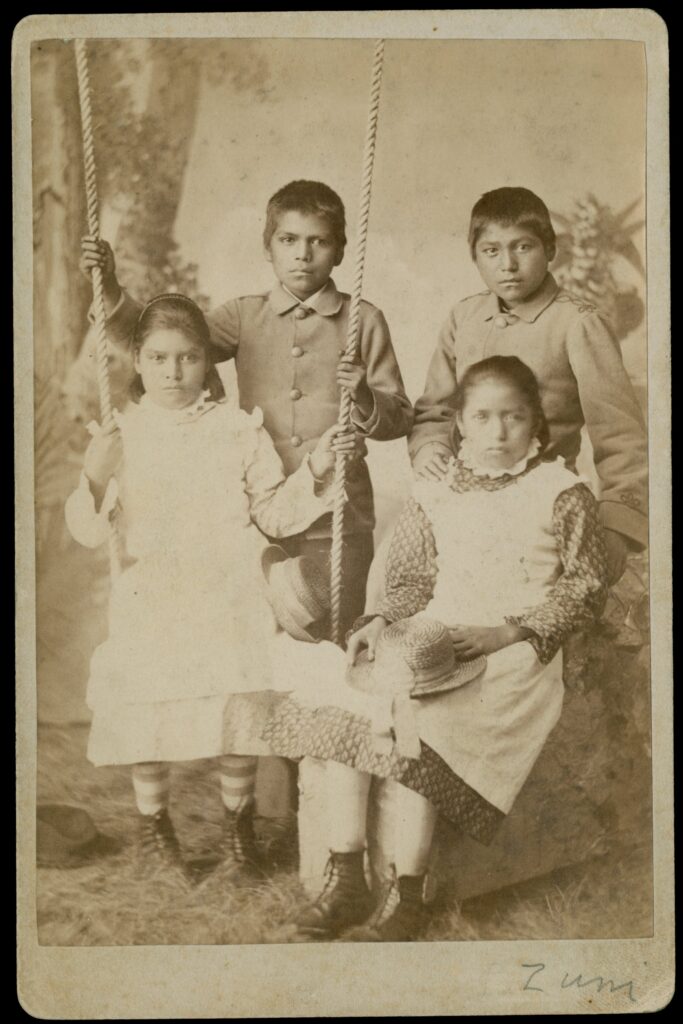
The photographs below (Figures 4.2 & 4.3) show four Zuni children and are one of the few studio portraits that include both girls and boys. The images depict the before and after assimilation practices at Carlisle Indian Industrial School. They were taken in 1880, just a year after the school opened. The first image was taken upon arriving at Carlisle Indian Industrial School and the second shortly after.


The names of the children are on the reverse side of the after photograph but only their assigned Christian names are written on the before image: Teai-e-se-u-lu-ti-wa (Frank Cushing), Tra-wa-ea-tsa-lun-kia (Saylor Ealy), Tsai au-tit-sa (Mary Ealy), and Jan-i-uh-tit sa (Jennie Hammaker). The student Taylor Ealy is incorrectly identified as Saylor Ealy. Two of the four children died while at Carlisle Indian Industrial School. Teai-e-se-u-lu-ti-wa (Frank Cushing), a member of the Pueblo (Zuni) Nation, entered the school on July 31, 1880, and died on July 22, 1881. He was buried in the cemetery on the school grounds. Tra-wa-ea-tsa-lun-kia (Taylor Ealy), also a member of the Pueblo (Zuni) Nation, who entered the school on July 31, 1880, died on July 10, 1883, while on an outing in Schellsburg, Pennsylvania. Tsai au-tit-sa (Mary Ealy), left the school on July 10, 1883, and reports indicated she was living in Zuni, New Mexico in 1910. Jan-i-uh-tit sa (Jennie Hammaker), left Carlisle February 6, 1882.
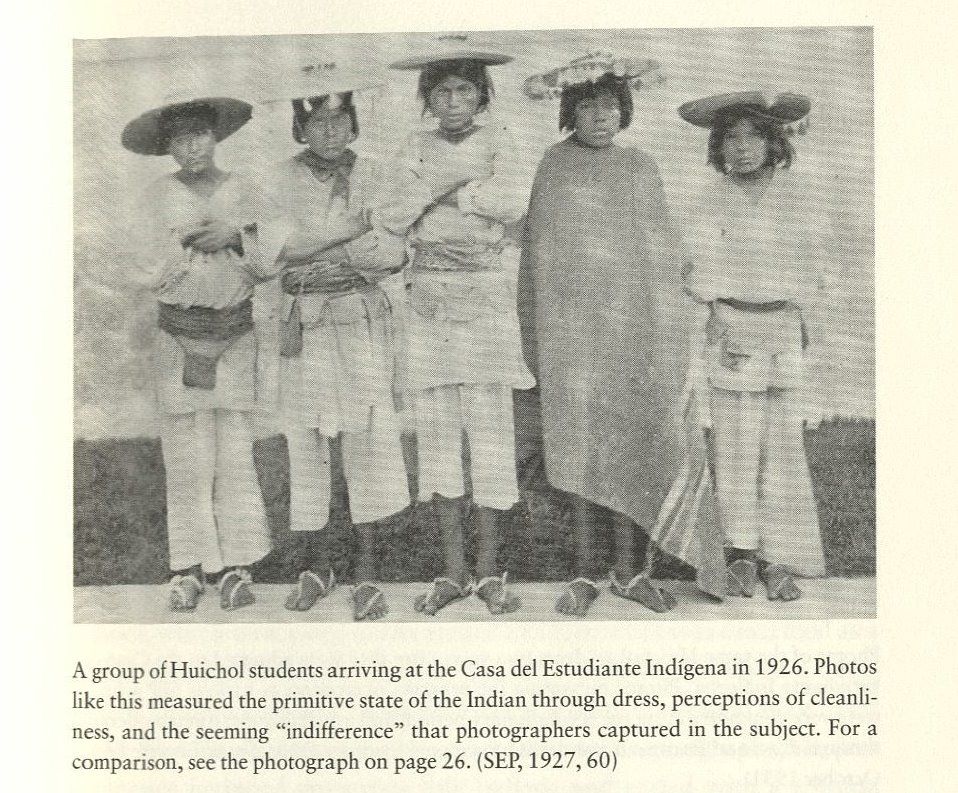
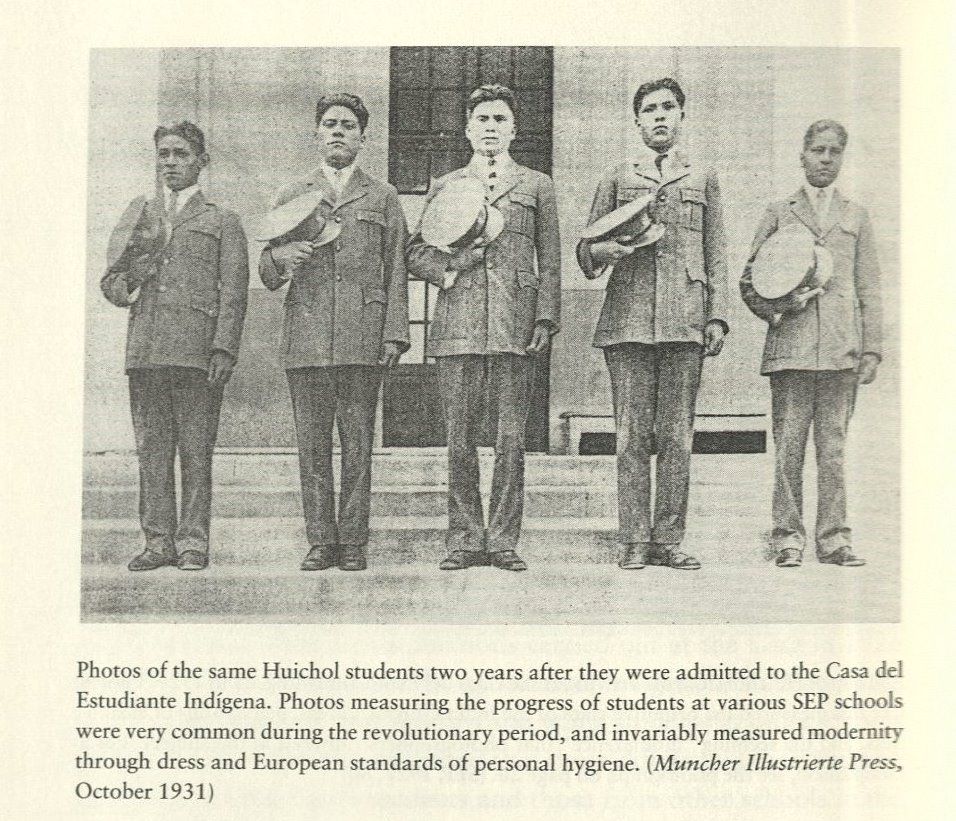
It’s important to note though Carlise Indian Industrial School is the most well-known of the boarding schools in the US, there were many others, including ones operating in Mexico well into the twentieth century. The Casa del Estudiante Indígena (House of the Indigenous Student) in Mexico City, operated from 1926 to 1932. The before-and-after images are eerily reminiscent of those taken at the Carlisle School for Indigenous children in the U.S. The Casa del Estudiante was part of the Mexican state’s efforts to modernize Indigenous youths by taking them out of the pueblos and assimilating them into urban Mexican society. They were taught Spanish and prepared to become rural teachers, in the hope that they would bring lessons of modernity back to their pueblos. However, most of the children found it difficult to return to their pueblos after being exposed to city life—deeming the program a failure (see Figures 4.4 & 4.5).
Ask Students
Santo Domingo/Jemez Pueblo writer Theresa Harlan once said, “When Native people do pick up the camera, often their image making is greeted with a patronizing welcome. The ‘Indian’ no longer sits passively before the camera but now operates the camera—a symbol of the white man’s technology.” (quoted in Ross and Hart, “Editors’ Introduction,” 3) Likewise, Seminole-Muscogee-Diné photographer Hulleah Tsinhnahjinnie also points out, “No longer is the camera held by an outsider looking in, the camera is held with brown hands opening familiar worlds. We document ourselves with a humanizing eye, we create new visions with ease, and we can turn the camera and show how we see you” (“Compensating Imbalances”).
In previous sections, we have seen how the federal government used the work of white photographers to support settler colonial policies, whether it has been through government-hired expeditions or independent projects. Photographs created by white photographers throughout the history of photography continuously perpetuated problematic stereotypes held about Native people. However, despite the use of the camera as a symbol of intrusion and oppression, there have been many Indigenous photographers producing photographs since the inception of photography. As noted, Puyallup photographer John Leslie learned photography at Carlisle Indian Industrial School and published a book of his photography. Leslie is not the only earliest-known Native photographer. Native and Indigenous People were always creating their own images of their communities, but we rarely see these uplifted or reflected within the historical record much less within the history of photography. In fact, Native and Indigenous people embraced photography early in the nineteenth century. Some even owned and operated their own photography studios, such as Purépecha photographer Antonio Calderón Sandoval (ca. 1847–death date unknown), the grandfather of Frida Kahlo, and Tsimshian photographer Benjamin Haldane (1874–1941), of Metlakatla Village on Annette Island, Alaska, just to name a couple.
Today there are many Native photographers, such as Nadya Kwandibens, a Toronto-based Anishinaabe (Ojibwe)/First Nations photographer, who has spent years capturing the spirit of today’s Indigenous People. Her powerful photographs highlight the unique way Indigenous identities intersect with contemporary life. Kwandibens’ photographs are more accurate contemporary portrayals of Indigenous People that confront the viewer to acknowledge Indigenous People in all their complexities.
The powerful imagery present within Kwandibens’s photographs is exemplified by her technique; she specializes in natural light portraiture. Her images pull Indigenous identity out of the reservation illuminating the way real, Native people balance heritage with the realities of contemporary life.
In 2008, Kwandibens founded her own touring photography company, Red Works Photography, and immediately began the process of creating her photo series, “Concrete Indians.” She traces the title of her series to a term the older generation from her community uses as a nickname for youth living and working in the city; you will also sometimes hear the term “Urban Indian,” when referring to Native people living in the city. One image that powerfully illustrates the intention behind this project is the one of Dancer, Tee Lyn Duke inside a Toronto subway station. (Figure 4.1).
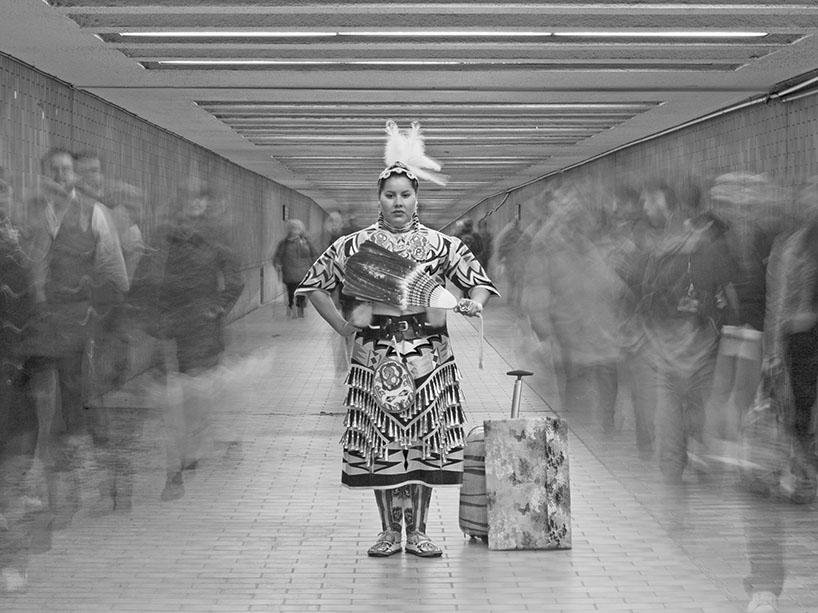
Her photographs feel like an unveiling of Native presence, an assertion that Indigenous peoples do not exist exclusively in the pages of antiquated textbooks or problematic American Western films but are the people sitting next to you on the subway and working with you in the office. To quote Kwandibens in an article from 2014 by Sophia Mitrokostas:
Indigenous people are often portrayed in history books as Nations once great; in museums as Nations frozen stoic; in the media as Nations forever troubled. These images can be despairing. However, my goal seeks to steer the positive course. If our history is a shadow, let this moment serve as light. We are musicians, lawyers, doctors, mothers, and sons. We are activists, scholars, dreamers, fathers and daughters. Let us claim ourselves now and see that we are and will always be great, thriving, balanced civilizations capable of carrying ourselves into that bright new day.” Her series “Concrete Indians” exposes these antiquated notions about the place of Indigenous Peoples by weaving Native stories and identities into the fabric of contemporary urban life.
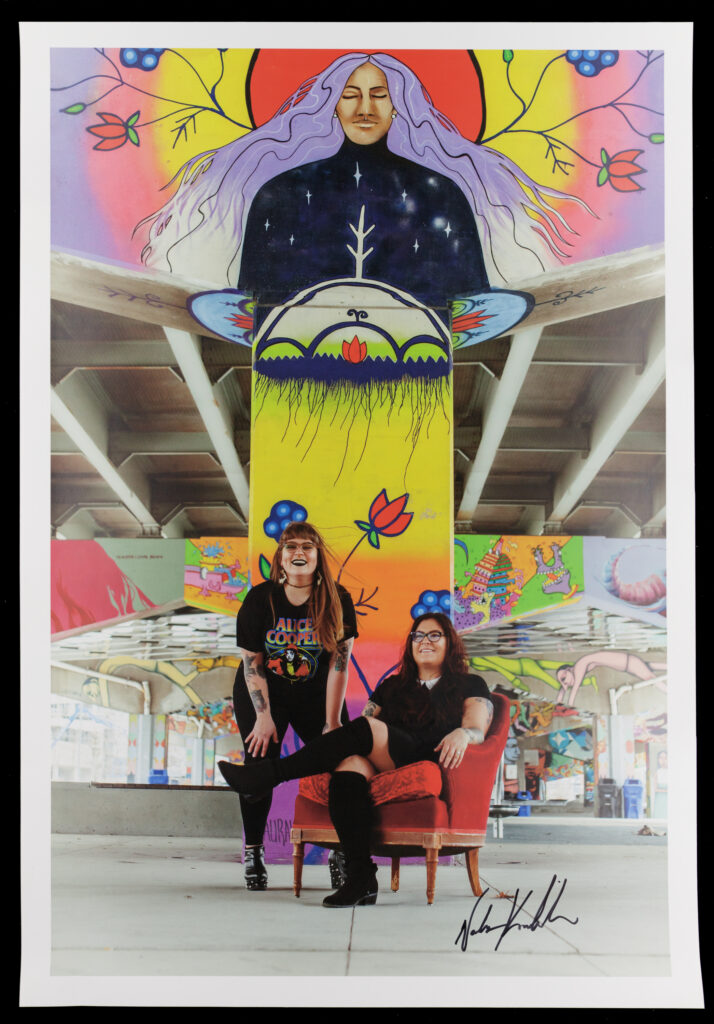
The second image shown here from her “Red Chair series,” started in 2018, depicts two talented artists, Chief Lady Bird (Ojibwe/Potawatomi), whose work we also hold within the Newberry’s collections, is an illustrator, educator and community activist, and Monique Aura, Onyota’a:ka (Oneida) and French is a neurodiverse art-maker and visual storyteller (Figure 4.2)
The “Red Chair Series” places importance on reclamation of Indigenous spaces, places and languages. The Newberry purchased this print along with three others from the series to add to its Indigenous Studies collection. To quote Kwandibens: “Imagine a single red chair in the middle of the bush or city sidewalk/intersection. The red chair represents “we ain’t going anywhere” and “this is Indigenous land.”
Additionally, Chemehuevi photographer Cara Romero (b. 1977, Inglewood, CA) is a contemporary fine art photographer whose identity informs her photography, a blend of fine art and editorial photography, shaped by years of study and a visceral approach to representing Indigenous and non-Indigenous cultural memory, collective history, and lived experiences from a Native American female perspective. An enrolled citizen of the Chemehuevi Indian Tribe, Romero was raised between contrasting settings: the rural Chemehuevi reservation in Mojave Desert, CA and the urban sprawl of Houston, TX.
The Newberry is fortunate to have a series of photographs created by Romero and one speaks volumes about the stereotypes about Native people within popular culture. A photograph created in 2017 titled TV Indians we see Puebloan people sit atop a cliff overlooking the Galisteo Basin (Figure 4.3). The man in the center looks away from the camera and into the distance. Unlike him, the three women in the photo lean casually against the pile of dated television sets behind them. TV Indians was initially conceived of in thinking about the ruins in the New Mexico landscape of adobe bricks and the mission that have fallen into just remnants and fantastic geometric shapes. Simultaneously, thinking about American consumerism and the ideas of new ruins and the landscape.
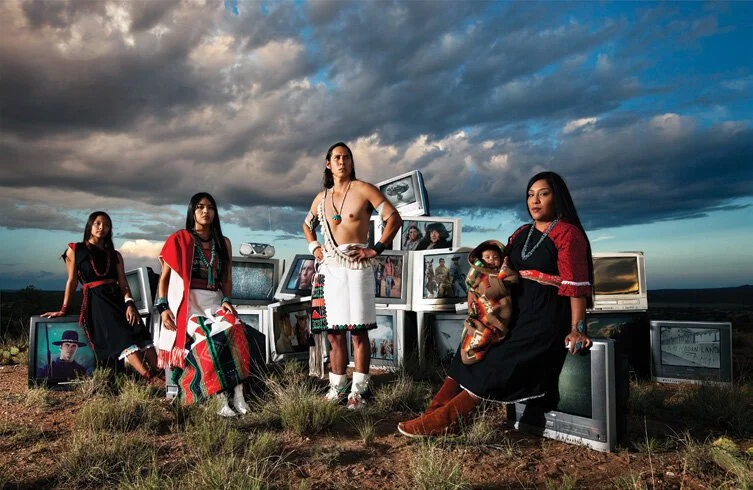
Romero gathered 40 TVs from a nearby recycling center to create the setting. Displayed on these screens are a series of images, some iconic and others not as familiar, illustrating how Native people are portrayed in media directly confronted with their source of inspiration and vice versa. Images include cultural references to events that have affected Native communities, like the test detonation of the atomic bomb in New Mexico in 1945 or the raising of the American flag at Iwo Jima, but also stereotypical selections, including Keep America Beautiful’s “Crying Indian” ad campaign and a shot from the 1990 film Dances with Wolves. The expressions of subjects appear defiant. The contrast between the Pueblo people and the images on the screens reveals how nonsensical the old stereotypes are.
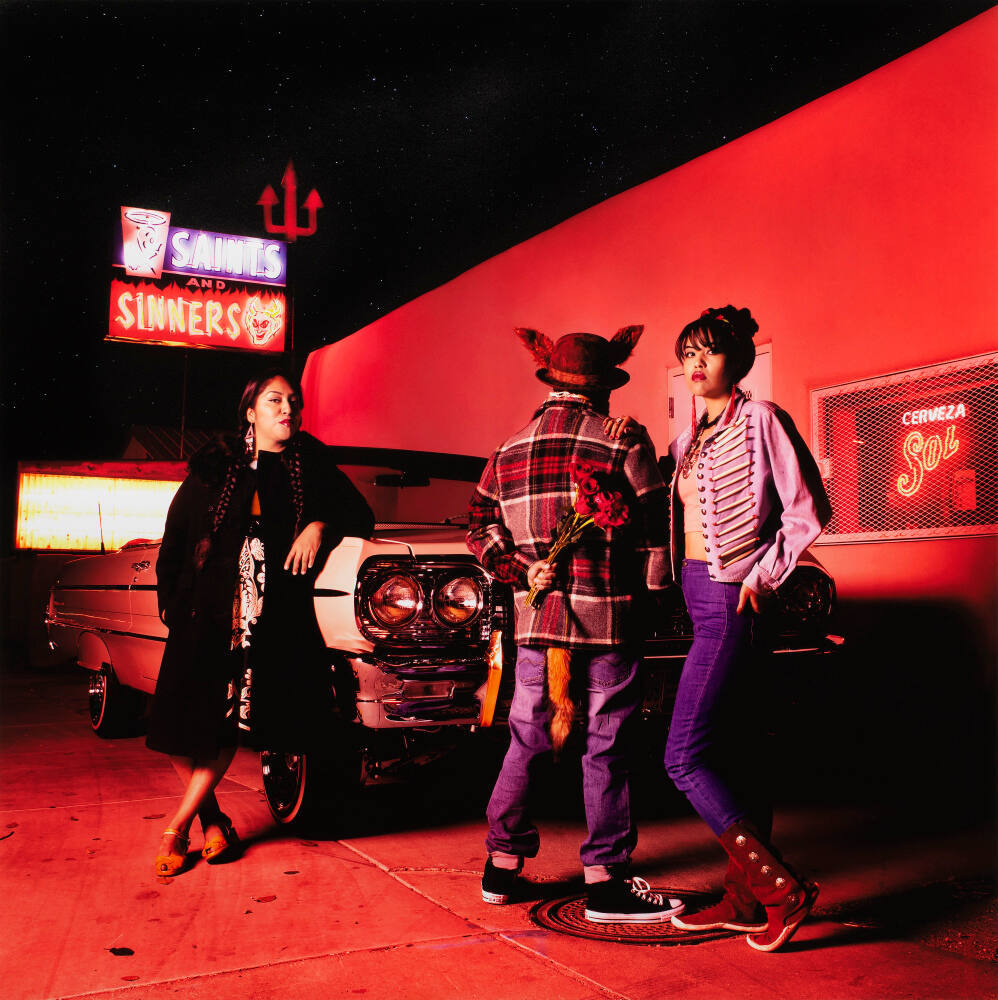
Additionally, within Romero’s theatrically staged photograph Coyote Tales, no. 1 (Figure 4.4) we see Romero position Native people and traditional Native storytelling as alive and well in contemporary life. Derek No-Sun Brown (Shoshone-Bannock and Bois Forte Band of Chippewa) portrays Coyote, a mythological being revered in Native creation stories for its intelligence but also acknowledged to be a somewhat impatient and cunning trickster. Brown/Coyote turns away from us, standing in front of Kaa Folwell (Santa Clara Pueblo) and Dina DeVore (Jemez and Kewa Pueblo). The scene occurs in front of Saints and Sinners tavern in downtown Española, New Mexico. Romero added red lighting in post-production to heighten the sense of visceral conflict and added stars to the night sky to evoke cosmology, the supernatural, and the always-already connectedness between everyday situations and stories. The location is meant to elucidate a crossroads and a heightened moment of indecision.
Ask Students
Indigenous people continue to work to be included at all social levels in our society; histories are very rarely, if ever, reflected within school curricula, history books, and popular media. “In practicing photography, Native peoples have been able to harness the power of images to assert their own visual voices to tell their own stories,” Wrote Cf. David Freedberg in 1989 (cite). Yet, as Hulleah Tsinhnahjinnie reminds us, “the power of the image is not a new concept to the Native photographer—look at petroglyphs and ledger drawings. What has changed is the process. (201) That is, Indigenous people have always been creating images and documenting their own histories prior to photography.
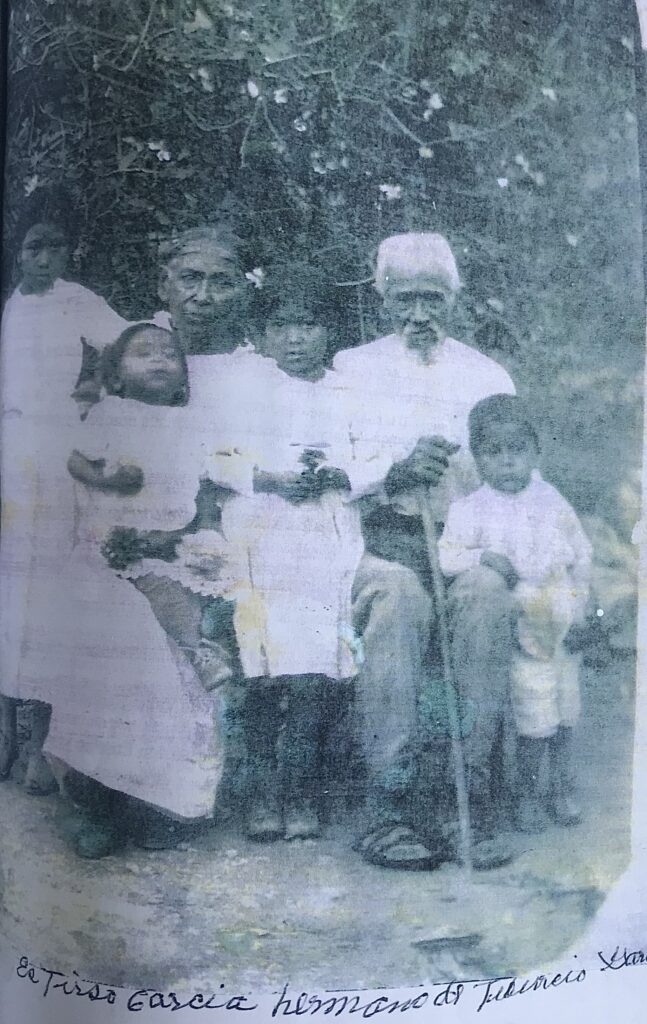
I have always had an interest in visual culture and specifically photography. Many of my own family members practice photography, and mostly all women. When looking at photographs I always ask myself, “what is the person being photographed thinking? How did they feel about being photographed?” I often wonder how my own family felt being photographed in their community by an unknown photographer. One image that come to mind in specific is from three generations ago, taken circa the mid-1800s. It speaks volumes to me yet is silent to the untrained eye. Did my family choose their poses? Did they choose what they wanted to wear? If they could change something about how they were photographed, what would it be?
The writer Lucy R. Lippard once wrote, “As we peruse old photographs from a century’s distance, we are looking not only at but for something. That something varies among Euro-American and Native people. It is often necessary to pry up the surfaces of apparent pathos, as well as apparent pride, and to dig out from beneath something less accessible…only through personal and historical contextualization can we fill in the blanks left by incomplete and mythologized histories.” (19) We must listen to these stories, and include them within our history books, exhibitions, teaching curricula, and, as this collection demonstrates, the study of art and photography.
Nineteenth-century white artists like George Catlin and Thomas Easterly drew, painted, made daguerreotypes, and eventually photographed Indigenous people. While many of these images were created with the racist intent to document a ‘vanishing’ people, they also begin discussions about impacts of settler colonialism and the ways historical sources are created.
These official photographs were often a routine part of many Native people visiting mostly Eastern cities to negotiate treaty and land rights. Such group or “delegation” portraits became a staple way of documenting Native Peoples interactions with governmental officials. What these delegation photographs omit is the consequences from these treaty negotiations: the ongoing imperial pressure to submit to western expansion and the violence that accompanied it.
Native American boarding schools like the Carlisle Indian Industrial School were important centers for photography at the turn of the century. Official school photographers took photographs of Native American students, and these propagandistic images were produced to emphasize the “civilizing” benefits of the boarding school system. Some Indigenous students, like John Leslie (Puyallup), embraced photography and used it to document their experiences, though most images of these schools were institutionally-produced.
When we think of “Native American Photography,” it is rarely associated with Native American photographers; instead, we often think of photographs created of Native People by non-Native photographers like the ones we discussed above. But many contemporary Native artists use photography to explore issues impacting their communities today.
Addams, David Wallace. Education for Extinction: American Indians and the Boarding School Experience, 1875-1928 (1997).
Breaking the Silence – Nineteenth-Century Indian Delegations. Peabody Musuem of Archaeology & Ethnology. Accessed September 2025.
Brown, Rachel. “For this Native Community, Photography has Harmed–and Healed.” National Geographic (May 2020).
Catlin, George. Letters and Notes on the Manners, Customs and Condition of the North American Indians. Vol. 1 (1841).
Cooper, Megan. “This Rare 1894 Photograph Show a Young Indigenous Woman Smiling at the Viewer.” My Modern Met (June 9, 2020).
Davis, William C. Civil War Journal: The Legacies (1998).
Dawson, Alexander. Indian and Nation in revolutionary Mexico (2004).
Fey, Cass, Shin, Ryan and et al.” Exploring Racism through Photography,” Art Education 63, no. 5 (September 2010), 44-51.
Hill, Rich. “In Our Own Image: Stereotyped Images of Indians Lead to New Native Art Form.” Exposure magazine: Native American Photography, 29, no. 1 (Fall 1993).
Irvine, Taylor. “Being Native: Showing the Consequences of Non-Natives Defining Who is An American Indian.” American Indian 21, no. 2 (Summer 2020).
Kilgo, Dolres A. Likness and Landscape: Thomas M. Easterly and the Art of the Daguerreotype (1994)
Lyman, Christopher M. The Vanishing Rase and Other Illusions: Photographs of Indians by Edward S. Curtis. (1982)
Pratt, Richard H. “Kill the Indian, and Save the Man.” Reprinted in Richard H. Pratt, “The Advantages of Mingling Indians with Whites,” Americanizing the American Indians: Writings by the “Friends of the Indian” 1880–1900 (Cambridge, Mass.: Harvard University Press, 1973), 260–271.
Prucha, Francis Paul. American Indian Treaties: A History of a Political Anomaly (1997).
Ross, Luana and Daniel Hart, “Editors’ Introduction.” Wicazo SA Review 16, no. 2 (Fall 2001).
Sandweiss, Martha. “Chapter 1: Posing the Indian: Native American Portraits in the Illustrated Press,” in Indians Illustrated: The Image of Native Americans in the Political Press edited by John M. Coward (2016).
The School News. United States Indian Industrial School, Carlisle, Pa. (October 1880 issue).
Tsinhnahjinnie, Hulleah J. “Compensating Imbalances.” Exposure Magazine: Native American Photography 29, no. 1 (Fall 1993).
Turner, Laura. “John Nicholas Choate and the Production of Photography at the Carlisle Indian School.” Visualizing a Mission: Artifacts and Imagery of the Carlisle Indian School, 1879-1918. Exhibit catalog (2004), 14-18.
Williams, Ashley. “‘Out of the Photograph’: Indian Resistance Against 19th Century (White) Photographic Portrayals.” (2011)