


Themes
Family
Transportation

Periods & Events
20th Century
World War II

Skills & Document Types
Guided Inquiry
Image Analysis
Photographs

Overview and Instructional Use

In this lesson, elementary school students will examine a photograph to learn about family and transportation during World War II while practicing image analysis. 

This lesson can be used:

  • To practice guided inquiry skills. 
  • As part of a unit on World War II. 
  • To practice image analysis skills.

Materials

Procedure

  1. Display the image. Lead the students through a guided discussion of the image using the questions below.  
  2. (Optional) Display more images from the Newberry’s collection and lead a similar guided discussion
Step 1: Display the Image and Discuss with students.

You and your students are going to look at a photograph taken in Union Station in Chicago in 1948 by the photographer Esther Bubley. Tell your students that, together, you’re going to figure out everything you can about the picture. Then ask some of the questions below.

Click on the image for a high-resolution version that can be displayed for your class.
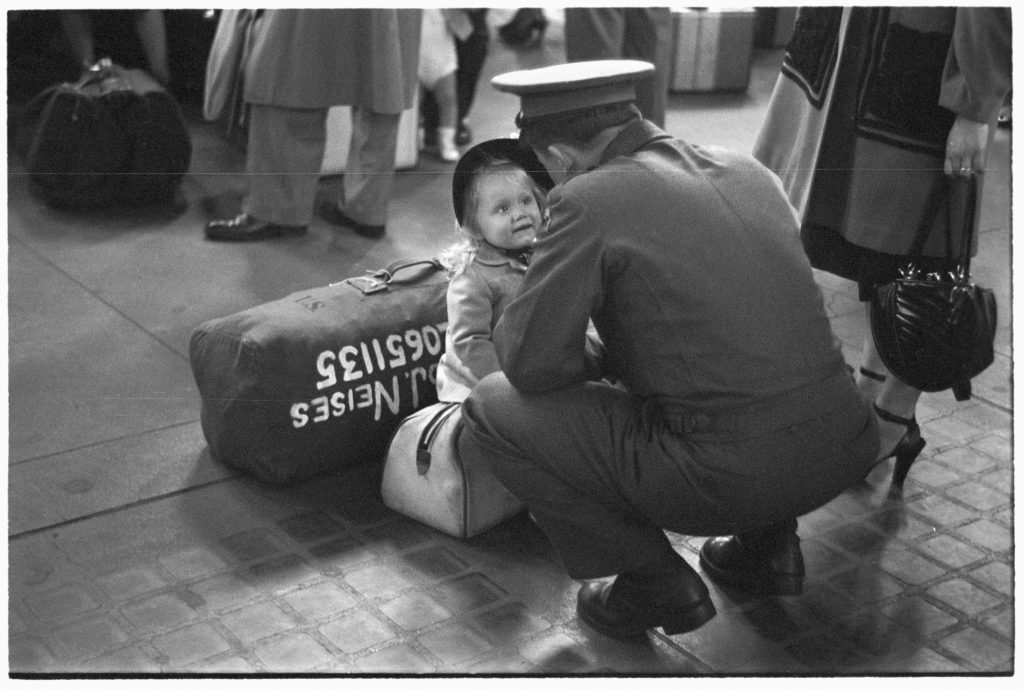
  • Who is in the picture?
  • Are they inside or outside?
  • Do you think someone is going somewhere? Why do you think that?
  • What time of year is it? Why do you think that?
  • How old do you think the child is?
  • Who do you think the child is looking at?
  • What is that person wearing? (for older students) What does that mean?
  • Who is standing next to them?
  • What do you think the child is feeling?
Step 2: (Optional) Extension Activity

Find more photographs of train travel in the Newberry’s Chicago, Burlington and Quincy Railroad Collection.

Illinois Social Science Standards

This lesson supports the following standards from the Illinois Learning Standards for Social Science:

History
  • SS.1 H.2. Generate questions and investigate diverse individuals and groups who have shaped a significant historical change.
  • SS.2.H.1. Identify main ideas and changes that have occurred in the local community over time and retell how these changes impacted diverse groups in the community.

Common Core

This lesson supports the following Common Core Literacy in History/Social Science standards:

English Language Arts: History/Social Studies
  • CCSS.ELA-LITERACY.RI.K.1: With prompting and support, ask and answer questions about key details in a text.
  • CCSS.ELA-LITERACY.RI.3.7: Use information gained from illustrations (e.g., maps, photographs) and the words in a text to demonstrate understanding of the text (e.g., where, when, why, and how key events occur).

The College, Career, and Civic Life (C3) Framework

This lesson supports the following C3 Framework standards:

Dimension 2, History
  • D2.His.2.K-2. Compare life in the past to life today
  • D2.His.12.K-2. Generate questions about a particular historical source as it relates to a particular historical event or development.
  • D2.His.14.K-2. Generate possible reasons for an event or development in the past.
  • D2.His.16.K-2. Select which reasons might be more likely than others to explain a historical event or development.
  • D2.His.2.3-5. Compare life in specific historical time periods to life today.

Download the following materials below:

  • A copy of the “In the Train Station” activity