

Themes
Arts
Chicago History
Counterculture
Literature
Periods & Events
20th Century
Bohemianism
Dil Pickle Club
College of Complexes
Skills & Document Types
Close Reading
Visual Analysis
Flyers
Photographs
Poetry
Syllabi
Use this essay and source set to:
In 1958, a reporter for the Chicago Tribune, strolling the 800 block of North State Street, saw a gaggle of college students choking the doorway of Bill Smith’s twenty-four-hour bookshop, a brand new “rallying place” for the Beatnik styles blowing in from San Francisco.1 Next door, a raucous party was spilling out from an “intellectual bistro” called the College of Complexes, which had been running since 1951 under the zany ownership of its “janitor” and impresario Slim Brundage. Erstwhile hobo, labor organizer, and housepainter by trade, Brundage had started the College of Complexes after a fall from an elevated train platform earned him “six thousand bananas from Workmen’s Comp.”2 The College was “a fully discredited institution whose academic standards are far below normal,” according to the North Central Association of Colleges, but for ten years, it operated as “an adult education center where the matriculation fee is the price of a bottle of beer,” and the highest degree granted the “Bachelor of Complexes Maximum-rum-Laudanum.”3 The reporter William Leonard dubbed this colorful area “Chicago’s New ‘Left Bank’” in deference to the old one, which was not in Paris but in fact right underfoot. Several years earlier, Alson J. Smith had argued in a book called Chicago’s Left Bank that “[i]n the years between 1912 and 1924,” the northside neighborhood then called Towertown had been “the geographical center of…perhaps the most vital literary and artistic upsurge in the history of the country.”4 Smith refers to what is sometimes called the first Chicago Renaissance, a moment when literary lights like Sherwood Anderson, Carl Sandburg, and Theodore Dreiser, and prominent institutions like Harriet Monroe’s Poetry magazine, Margaret Anderson’s Little Review, and the Chicago Little Theater were putting Chicago on the cultural map. By 1920, HL Mencken could say, and not without reason, that Chicago was “literary capital of the United States.”5
But to get a sense for what this purported Renaissance felt like on the ground, it’s worth looking beyond the anthology pieces and textbook accounts to the seedy beating heart of Towertown. In this raucous, utopian haunt Anderson and Sandburg rubbed shoulders and traded ideas with a working-class intellectual set that was in many respects the foundation for Chicago’s distinctive achievements in the arts. This was the Dil Pickle Club. In his youth, Brundage had waited tables at the Pickle, and the College he founded years later “served as a tenuous bridge between the working-class bohemianism of the Dill Pickle and the emerging youth radicalism of the 1960s,” blowing on the embers, as it were, of a counterculture everywhere imperiled by the staid 1950s.6
Though the Dil Pickle is long gone, its memory lives on in the nearby Newberry Library, which holds a marvelous collection of materials related to the operations of this bohemian hothouse. In spring 2025, I had the good fortune to spend some time with this treasure trove. Perusing the poetry and prose of Picklers, their programs, posters, and photographs, I worked to re-conjure the intellectual thrill of an evening on Chicago’s “Left Bank.”
With the help of the Newberry Library’s digital collections, this essay attempts to ferry some of the Pickle spirit into the twenty-first century. The first section offers a sketch of the club, its context and character. The second section samples the ideologies of free love that found exuberant expression therein, while the third highlights the Pickle’s parade of literary spectacle and invention. The essay concludes with a return to the College of Complexes, where we find Brundage doing his level best to preserve Towertown as America’s “playground for people who think.” 7
In 1920, new worlds were in the offing. The First World War had decimated Europe’s great powers, their citizens reeling in uncertainty of the age to come. New maps were drawn up as the smoke cleared around the rubble of dissolving empires. The Russian Revolution ushered in the first socialist state. Intense urbanization, the proliferation of new sexual mores, bounding technological advancements, and novel ways of understanding history, society, mind, and nature were transforming the texture of everyday life. Self-consciously ‘modern’ experiments in artistic expression sprang up to register the tumult. It was as if the twentieth century, deferred by the catastrophe of the war, was at last beginning in earnest, its denizens as eager as they were beleaguered.
In the United States, the nation best poised to assume the mantle of global power, perhaps no city encapsulated this mood of anxious transformation better than Chicago. Certainly “[n]o American city grew so fast.” Rising up from marshland in the nineteenth century and then again from the ashes of the Great Fire in 1871, Chicago’s strength was its enormous industrial capacity. Poised at the crossroads of the country’s rail networks, a place of “constant renewal and transformation,” Chicago was the place “where one thing” — “grain, lumber, cattle, and hogs” — “changes into something else,” namely, capital.”8 While the city was “home to some of the country’s most profitable, and most virulently antiunion, employers,” it was also the storied epicenter of the US labor movement, with a host of union headquarters (chief among them the International Workers of the World, or “Wobblies”), pioneering radical publishers, and a vibrant working-class intellectual culture.9 In other words, the famous ones of Sandburg, the “Hog Butcher of the World” was also the “City of Big Shoulders.”
North of the river, Towertown was the locus for this working-class public sphere, and its central meeting place was a spit of park called “Bughouse Square” (otherwise known as Washington Square Park). There, in the shadow of the Newberry Library, “every night in the week when it wasn’t storming,” speechifying renegades like Clarence Darrow, Emma Goldman, and Ben Reitman would set the walls of surrounding buildings resonating with fiery invectives on everything from “crackpot health panacea[s]” and home-grown philosophies to the platforms of women’s emancipation, socialism, anarchism, and the African Blood Brotherhood.10 The best soapboxers could draw weekend crowds in the thousands. In a city charged by the labor movement and other programs for reform and revolution, open forums of the kind that animated Bughouse Square were the organizational genre of the day.
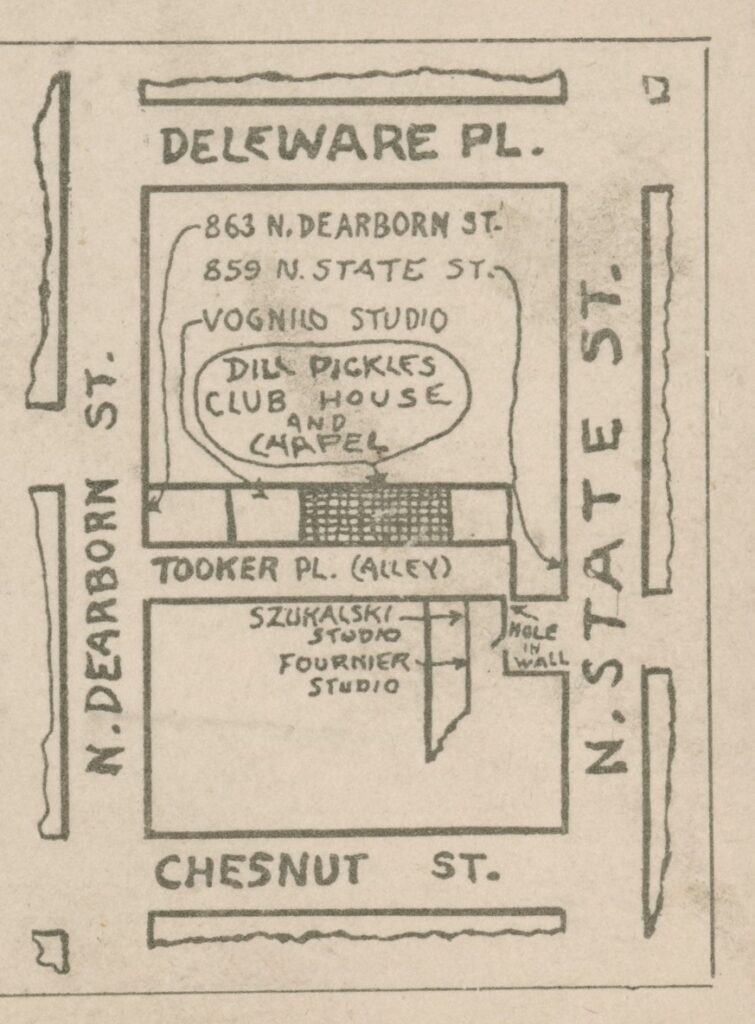
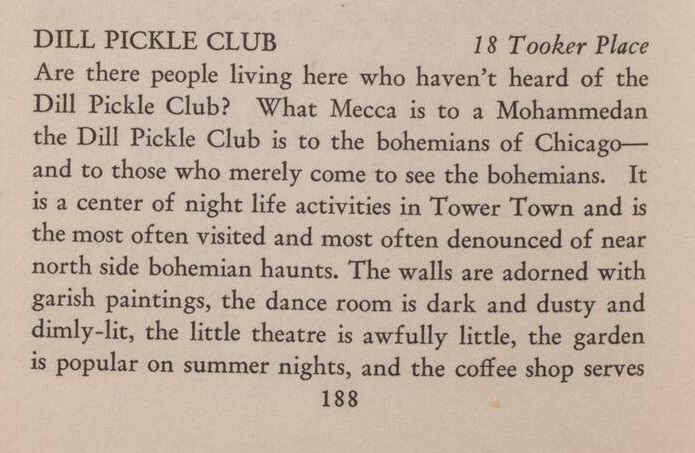
When the speechifying was done, the revolution would move indoors to the Dil Pickle Club, which occupied the brick barn at 10 Tooker Alley, just one block away. Part teahouse, part arts center, part debating society, the Pickle was a “free-for-all-place” for free-thinkers of all stripes, and “the most often visited and most often denounced of near north side bohemian haunts” (see Fig. 1 above).11
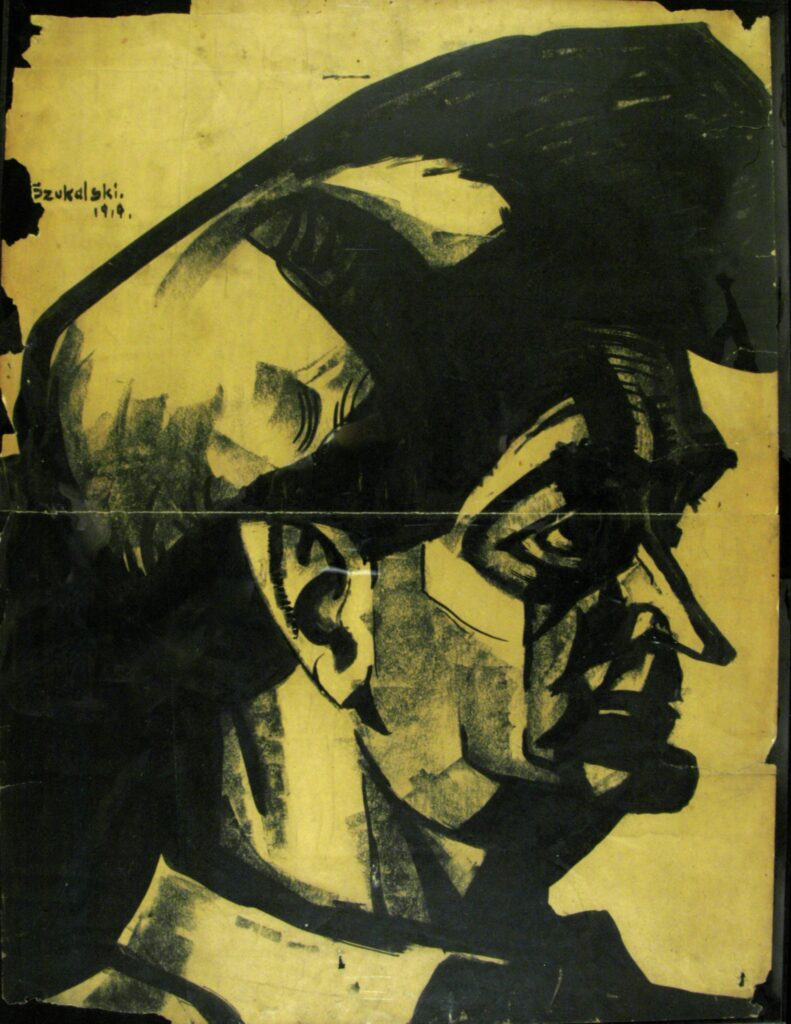
The club was chartered in 1917. Legend has it that Jim Larkin, an Irish union leader, inspired the Dil Pickle’s name when he discovered his own love of the briny snack. (Picklers eventually dropped the second “l” to avoid trademark infringement.) The spirit of the Pickle, however, was the gift of Jack Jones, the club’s founder and tireless manager. A militant labor organizer, Jones had served ten years in prison on arson charges, was rumored to have made sabotage bombs for the IWW, once cooked up a scheme to fund the Pickle by manufacturing toy ducks (the “Du-Dil-Duk”), and — when he wasn’t organizing events at the Pickle — spent long hours in the Newberry researching and writing his manifesto on social organization.12 The engraving pictured here (Fig. 2), by the Polish artist Stanislaw Szukalski whose studio sat across the alley from the Pickle, captures the visionary intensity of this jack-of-all-trades, a cross between a Renaissance Man and a circus barker. Sherwood Anderson, one of the Pickle’s most famous regulars, called him “The P.T. Barnum of the Revolution.”13
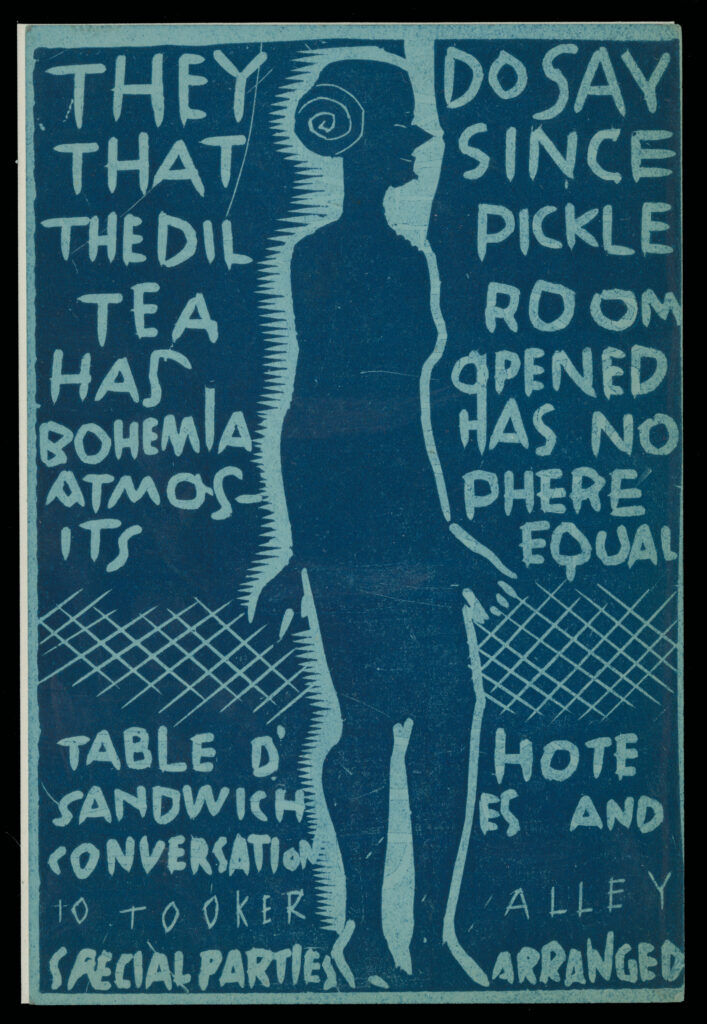
By the end of World War I, the club was the gathering place for the “lunatic fringe of radical Chicago”: anarchists of many stripes, Wobblies, hobos, criminals, social workers, free-lovers, poets, playwrights, journalists, and free-thinkers from across the professional classes. As flyers for the club testify, “since the Dil Pickle Team Room has Opened, Bohemia has No Atmosphere Its Equal” (see Fig. 3). The word “bohemia” had been used since the mid-nineteenth century to describe urban enclaves of struggling artists and other countercultural types. The original bohemias were in Paris: the Left Bank’s Latin Quarter and Montmartre across the Seine. In the United States, in the days of the Pickle, New York’s Greenwich Village was the leading reference point. And yet poet Kenneth Rexroth recalled of Chicago’s Pickle that “[a] world less like Greenwich Village or Saint-Germain would be hard to imagine.” What set the Pickle apart was its distinctive cast of characters, what we might call its unique demographic profile. At the Pickle, criminals, sex workers, and militant radicals could be found shoulder-to-shoulder with the more usual suspects of bohemia, the artists and intellectuals: “This leaven of the underworld and of the toughest operators in the labor movement gave the Dill Pickle society a worldly character of a sort never found in bohemia.”14
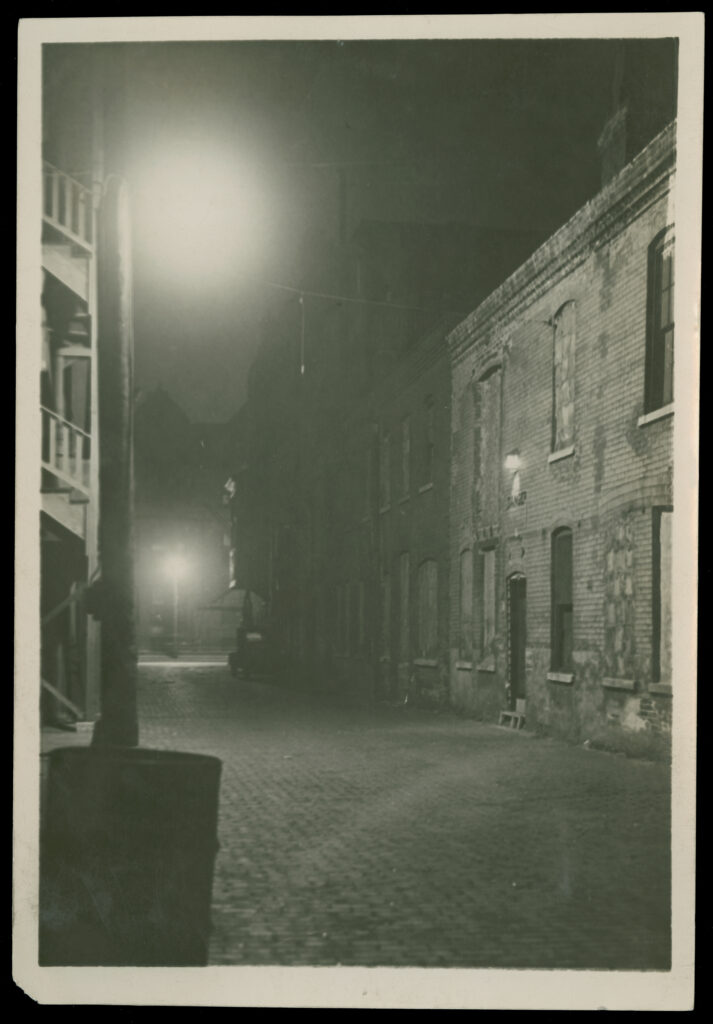
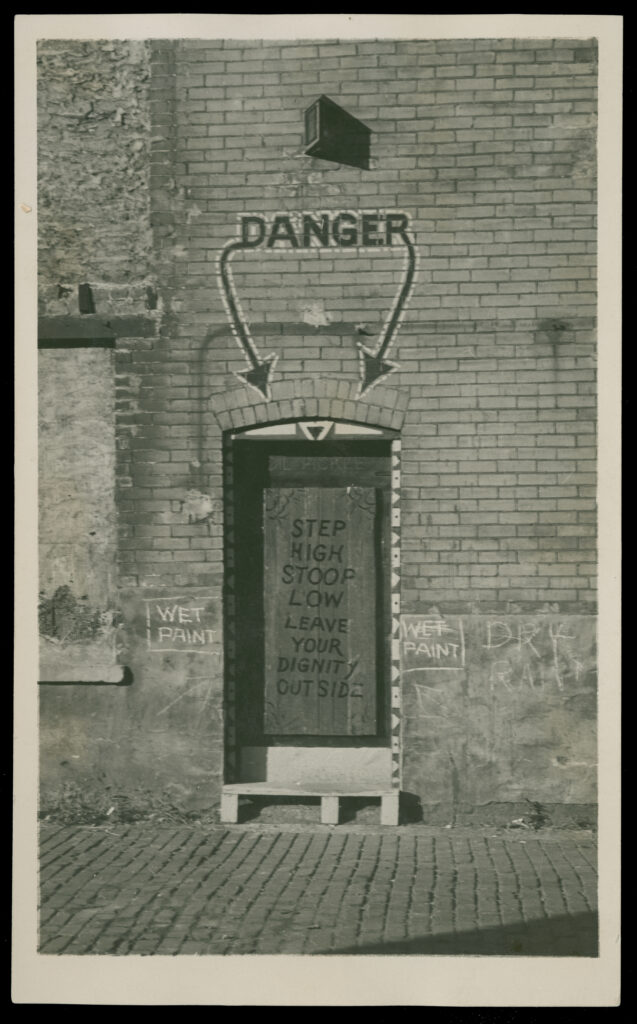
Patrons — or “Picklers” — would enter Tooker Alley on the State Street side through a tunnel-like hole in the wall (see Figs. 4 and 5), and then enter the Pickle itself through the door on which was painted the inspiring admonition: “Step high, stoop low, and leave your dignity outside” (see Fig. 6).
Inside, the whitewashed walls were decorated with the latest canvases of Chicago painters. When patrons weren’t dancing — the main draw on Friday and Saturday nights — Picklers were treated to a smorgasbord of radical culture: “Lowbrowism as well as intellectualism has its place with me,” Jones trumpeted. “I run the world’s greatest university where all isms, theories, phantasies and other stuff can have their hearing…Writers come here for inspiration, poets to dream, engineers to hear the latest wonders of mechanics and surgeons to learn the latest scientific methods in medicine.”15 The program for one week in April, pictured here (Fig. 7), testifies to the range of offerings. One evening a Northwestern University professor might speak on cutting-edge developments in physics. A few days later, a local Pickler might strike an entirely different tone in a lecture on the talents of male escorts. “Every one of these events” is “a real threat,” declares Jones — that is, a threat to received common sense, to conventional ways of understanding the world.
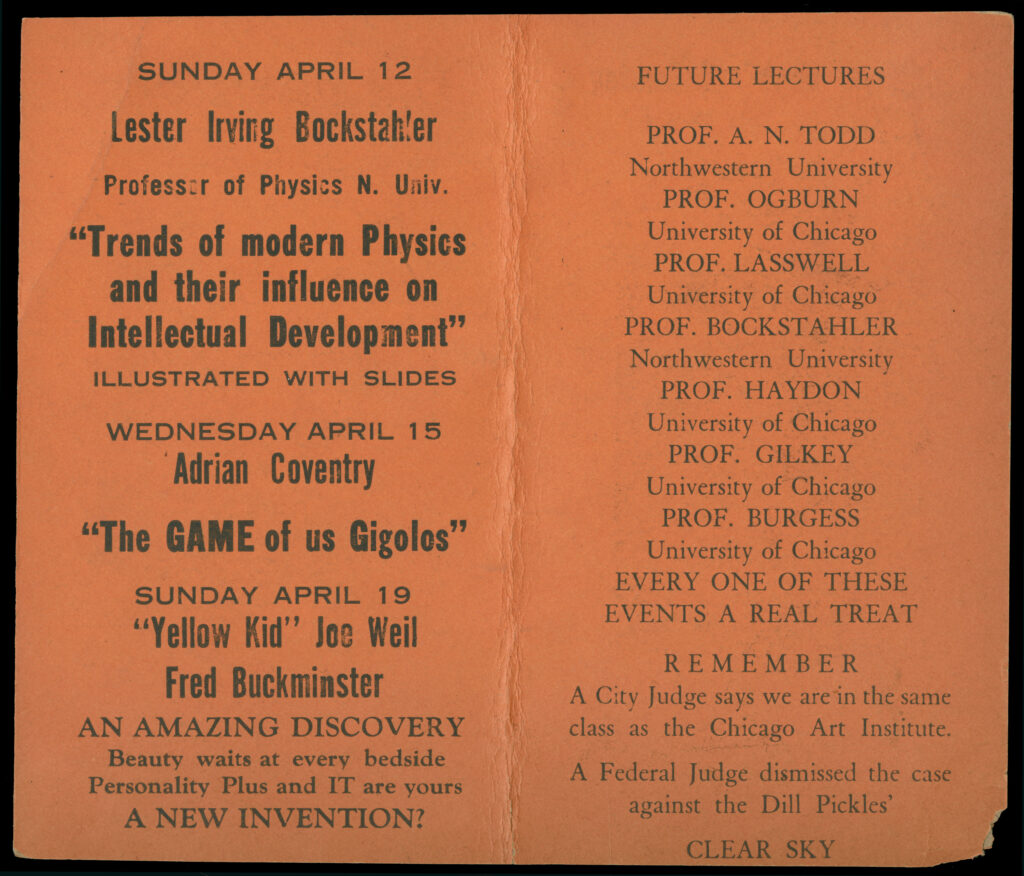
Another typical month might include an original play or a staging of Ibsen, an evening of vaudeville entertainment, a lecture on “Why Bolshevism Succeeded in Russia!,” the Harlem poet William Moore on contemporary African American literature, the head of Colgate University’s psychology department on the “Intimate Relations of a Psych Lab,” or Dr. Don Cabot McCowan, author of Love and Life: The Sex Urge and its Consequences (1928), on the subject of “Frigidity and Impotence.” Jones’s strategy for ensuring a full house involved a novel synthesis of education and titillation, science and sex — for every few edifying events he would bill something downright salacious.
But the scheduled lectures and performances were only half the excitement. “What the Dil Pickle was famous for,” writes Franklin Rosemont, “was talk: unmuzzled self-expression, passionate debate, lively and open discussion, the uninhibited exchange of ideas, poetry, theory, polemic — free speech at its freest. Controversy was its raison d’etre — and the more controversial, the better.”16 Every lecture was followed — sometimes interrupted by — a vigorous Q&A, in which the rowdy audience set on the speaker “like a pack of whelps.”17
Ben Reitman, a doctor who dedicated much of his life to treating sex workers and the unemployed, also found the time to serve the Pickle as, in his words, its “chairman and press-agent.” He once characterized the club as “a synthesis, a coming together, ‘a great, comradely, joyous, free fusing in friendship and understanding of the imaginative and daring souls in every walk of Chicago life.’”18 In accounts of Jazz Age Chicago, the Pickle is sometimes remembered as a den of antics and gimmicks, a sideshow spectacle or tourist trap. But the first thing to know about the Pickle is that it arose out of movements to change the world. It was, above all, a social experiment: a laboratory for new forms of living and thinking and, yes, having fun together.
The Pickler’s experimental attitude toward life included some brazenly frank attitudes toward sexuality, gender, and questions of identity more broadly. An anonymous poem published in The Dill Pickler, the club’s in-house magazine, explains why the Pickle’s door advises all comers to “leave your dignity outside”
Thus the Orange Door
Under the Green Light
Confronts you—
Dark and devious seems its ways
To those who are dignified;
Dignity covers ignorance—
Knowledge needs no mask.Anonymous, The Dill Pickler, n.p.
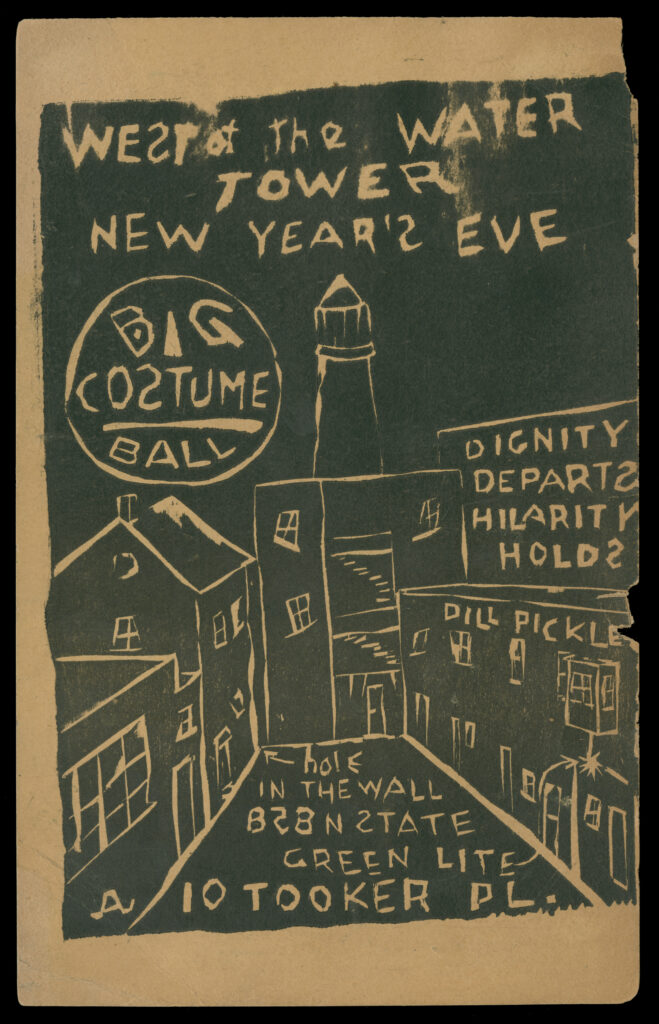
To the “dignified” men and women of Chicago, the well-heeled and respectable citizens who might balk at the prospect of socializing with laborers, prostitutes, and madcap artists in Towertown, the Dil Pickle will seem “[d]ark and devious.” But dignity of that kind is always a false-front, observes the poet, and real knowledge — the knowledge purveyed at the Pickle by professors, plumbers, scientists, social workers, and anyone else with something to say — “needs no mask.” When Picklers did don masks, it was not to hide their true selves but to seize yet another opportunity for expressive freedom and serious play. Indeed, the club’s regulars had a special penchant for costume balls and masquerades (see Fig. 8). In the photograph below (Fig.9), Jack Jones (second from left) poses with several unidentified Picklers, including a cowboy, dock worker, and fortune teller.
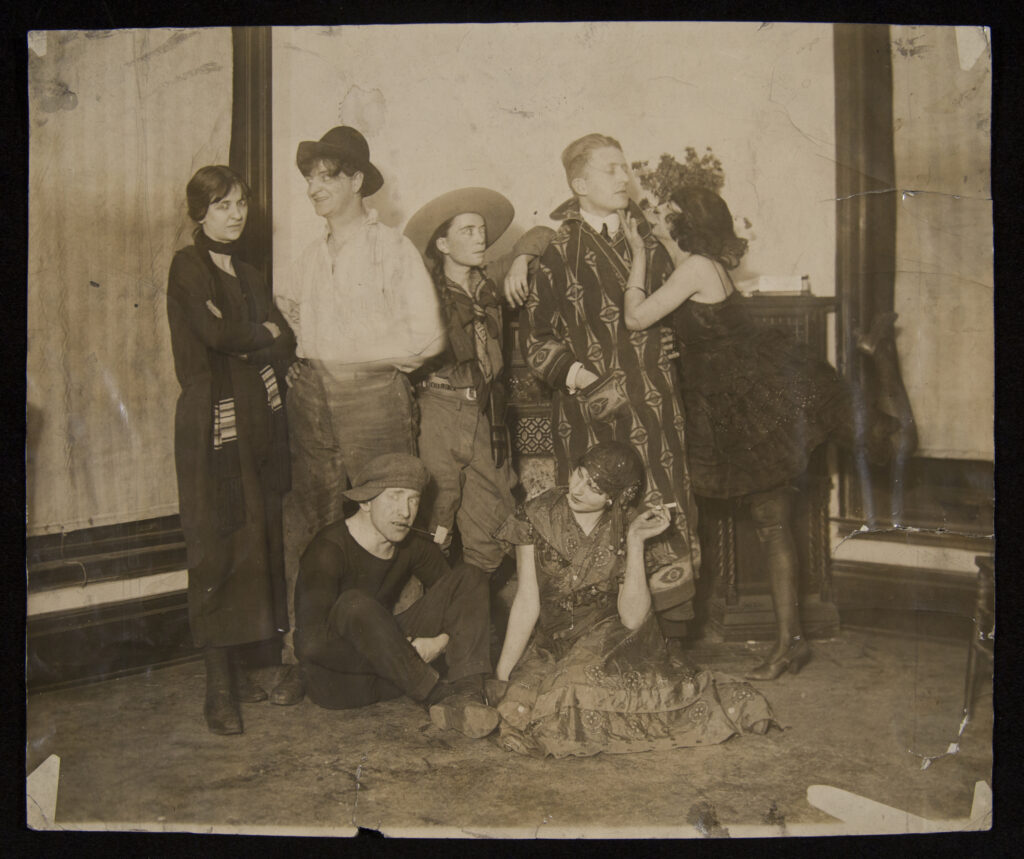
The most striking aspect of this photograph is its vivid play of gazes. Only two of the costumed Picklers are looking forward, and each wears a worried expression, as if skeptical of the camera eye. Everyone else is staring fixedly, even hungrily, at someone else, laying bare ;a tense network of desire. This photograph only seems to document a costume party; passion is its real subject.
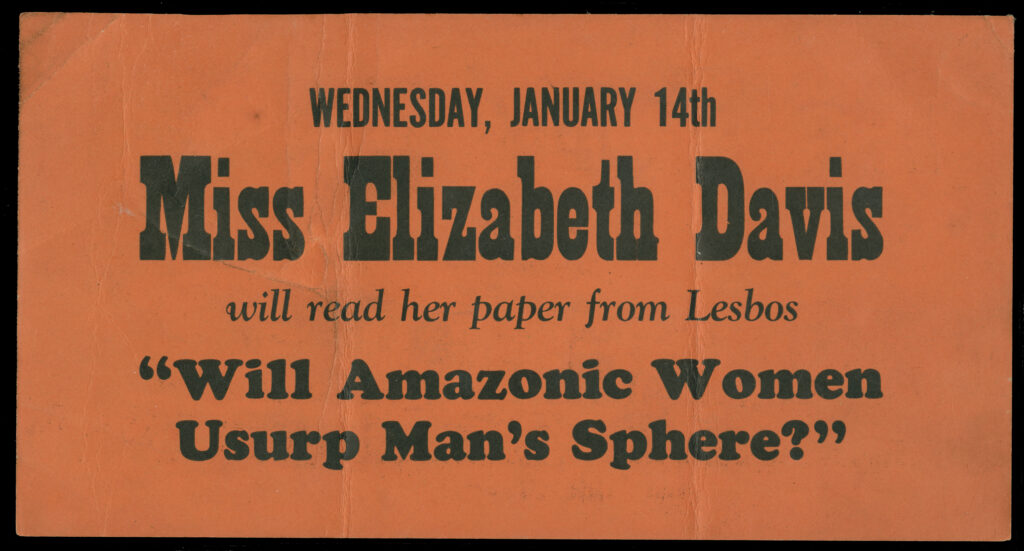
If freedom of expression was the Pickle’s bedrock tenet, nowhere was this commitment more in evidence than in the club’s frank treatment of “free love” and sexual desire. In the radical culture of Towertown, other groups openly touted sexual freedom and birth control, “but none advocated them more often, or more vociferously, than the Picklers in Tooker Alley.”19 This could be serious business, of course; the Comstock Act had put the Pickle’s own Ben Reitman behind bars for six months when he was caught distributing birth control literature. But sex talk was also, by all accounts, a blast.20 The Pickle’s large repertoire of sex-related programming, delivered by authorities of various merit, from doctors and psychologists to the longtime Pickler and “Queen of the Hoboes” Elizabeth Davis freely mixed the sincerely intellectual with the impishly parodic. One week’s lectures might focus on urgent and politically risky subjects like “Homosexuality” and “Is Free Love Possible?” The very next week might feature potentially more farcical fare: “Satisfying Sex Needs Without Trouble,” “Sex Worship,” or “Will Amazonic Women Usurp Man’s Sphere?” (Fig. 10)
Though some may balk at the inconsistency of tone, this blend of sincerity and humor gave politically committed Picklers the critical distance from which to appraise their own programs for social change. A case in point is the work of Mary Marcy. One of the labor movement’s “best fighters and clearest thinkers,” Marcy was a splendid explainer.21 She penned celebrated columns for the International Socialist Review and pamphlets distilling Marxist economics for everyday readers, as well as Rhymes of the Early Jungle Folk (1922), a children’s book about human evolution, then a hot-button subject. A regular at the Pickle, Marcy was just one of the many talented women agitators and artists who fueled the ferment of bohemian Chicago. As Sam Putnam recalled of his days on the near northside, “in Towertown the women are, on the whole, noticeably superior to the men.22 Marcy was an avowed enemy of bourgeois values: “The working class is kept in a condition of wage slavery through its HABITS of MORALITY.” But in the spirit of the Dil Pickle, she was just as suspicious of the way radical thought can be rendered superficial by self-interest or shortsightedness, and of the way hypocrisy worms its way into even the best-intentioned programs of social change.23 Her one-act play, A Free Union: A One Act Comedy of “Free Love,” testifies to the Picklish capacity for relentless self-criticism (see Fig. 11).
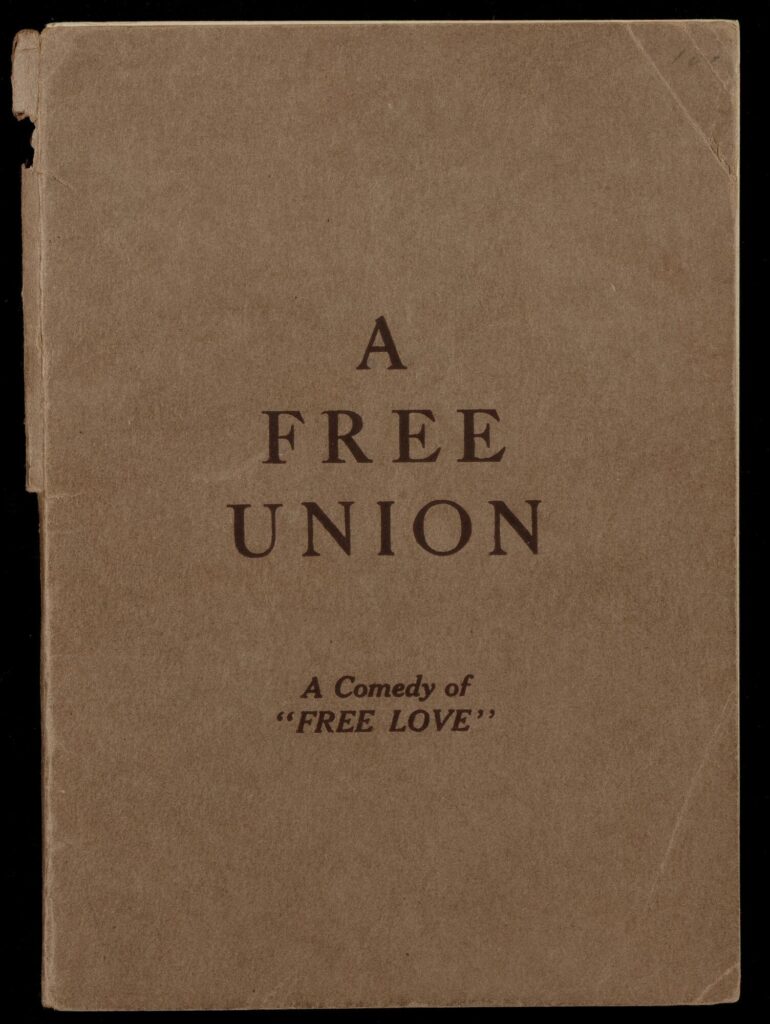
The setting is a Chicago apartment with the unmistakable trappings of bohemia, “scattered half finished drawings and paintings,” empty beer and wine bottles, and a kitschy sign that declares “Personal Liberty / is God / of this Shrine.”24 The plot turns on the precipitous dissolution of the “free union,” or unmarried partnership, of two forward-thinking lovers — Jim Humbolt, “an impecunious painter,” and Sonia Narowski, a self-described “free woman” (7). Jim resents Sonia’s habit of staying out late with friends, neglecting housework, and pursuing affairs with other men, particularly Owen Heddon, a “poet, an artist, a dreamer and a genius” who doesn’t earn a wage, eats their food, and swipes Jim’s things (15). The time and effort spent keeping Owen and Sonia fed and clothed means that Jim has had to forgo his own artistic dream; he has “give[n] up serious, decent attempts at painting to portray ladies in silk underwear at $60 a week” (10). But when Jim complains, Sonia is quick to accuse him of reactionary thinking: “Why don’t you admit,” she cries, “that you’re just an ordinary man who believes that woman’s place is the house and who wants to keep her there” (19-20).
Their caustic bickering, the play’s comedic engine, puts several ironic spins on the idea of “freedom.” Sonia is “free” to the extent that she can behave as she pleases, while Jim feels himself only “[free] to earn the money” (13). When Jim finally decides that he’s fed up and resolves to leave Sonia for a new fiancée, this exercise of freedom leads Sonia first to a wild flight of hypocrisy (she calls the new fiancée a “street-walker” and accuses her of “trying to steal her husband”), and then to abandon her program of free love altogether (40). To prevent him from leaving, she resolves she will marry him after all — though by that time Jim is already out the door, genuinely “free” at last.;
When Owen Heddon (a hedonist, surely) tells Jim that “the real artist lives only for Art’s sake. Art! Poetry! Love Freedom!,” Marcy is making fun of Towertown bohemians (29). Similarly, when Jim lampoons Sonia and her friends, who “stay till two, or three and even four o’clock in the morning, drinking and eating, lovemaking and talking about re-building the world on a nobler, more poetic plan, their plan,” Marcy’s first audience might have had Picklers in mind (47).In this way Free Union allows Marcy to perform some deft satire: she can lend representation to alternative ways of living while at the same time pointing up the limitations of any free love ideology that ignores economic realities and the determinations of class. In other words, the play is a savvy Marxist critique of bohemia. But it’s also a rollicking farce.
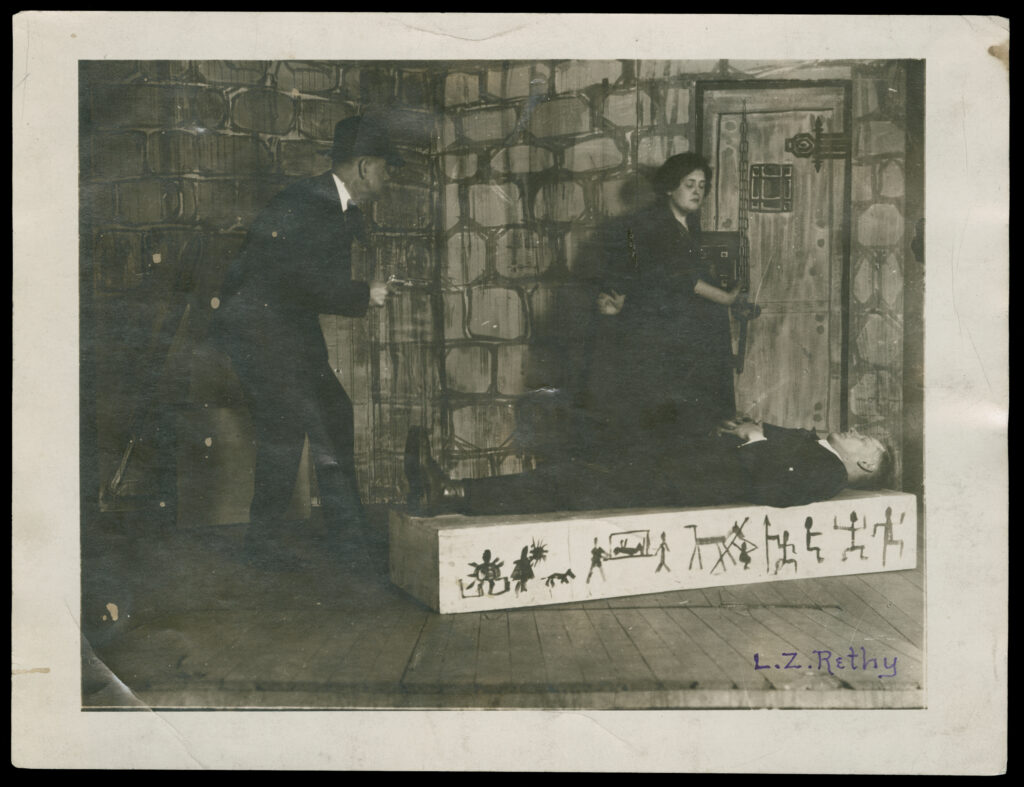
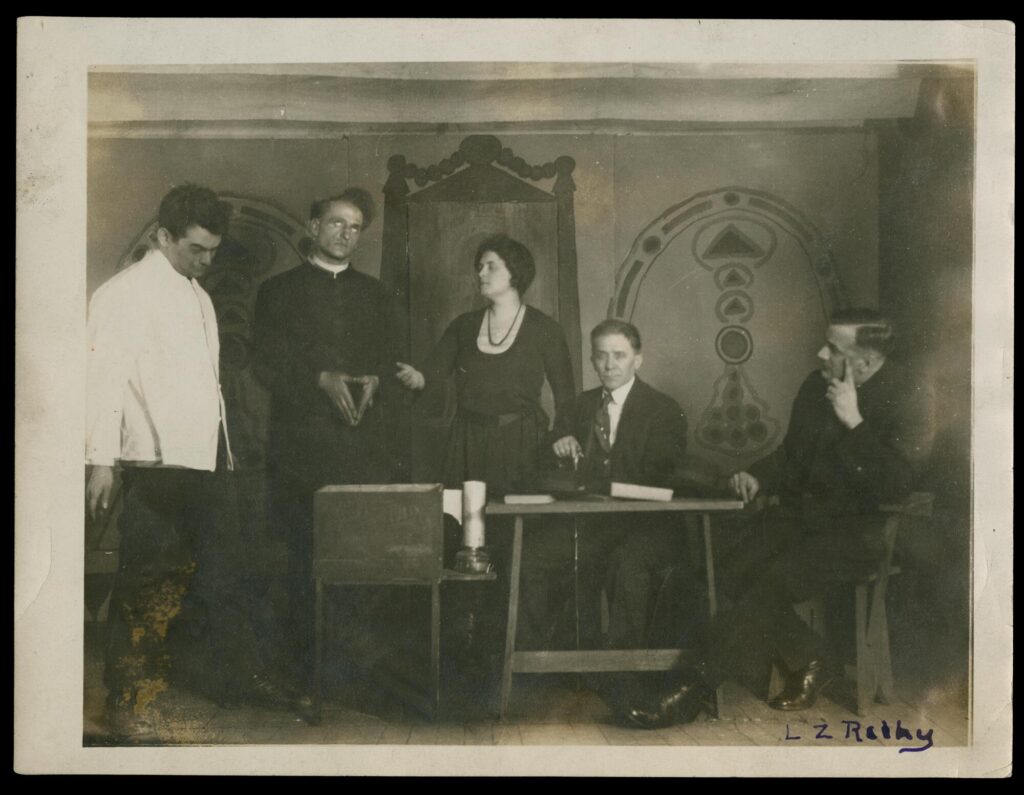
Jack Jones and his Picklers exhibited a passionate interest in all the arts, and the Pickle operated as something of a clearinghouse for all that was avant-garde in Chicago. The Dil Pickle Players put up plays by all the acknowledged giants of the modern European stage — Ibsen, Strindberg, Shaw, etc. — as well as works by hometown heroes like Dreiser and Edgar Lee Masters. They also staged the original productions of avid Picklers like Maxwell Bodenheim and Ben Hecht, whose Master Poisoner (1918) was the “Pickle’s star exhibit of the Chicago Renaissance” (a tough critic, Kenneth Rexroth called it “dreadful”; Bodenheim and Hecht “managed to invent a new shudder of bad taste”).25 Jones himself wrote plays, and he also managed the construction of the scenery, which evinced “a kind of house painter’s amateur Expressionism” (see Fig. 12 and 13).
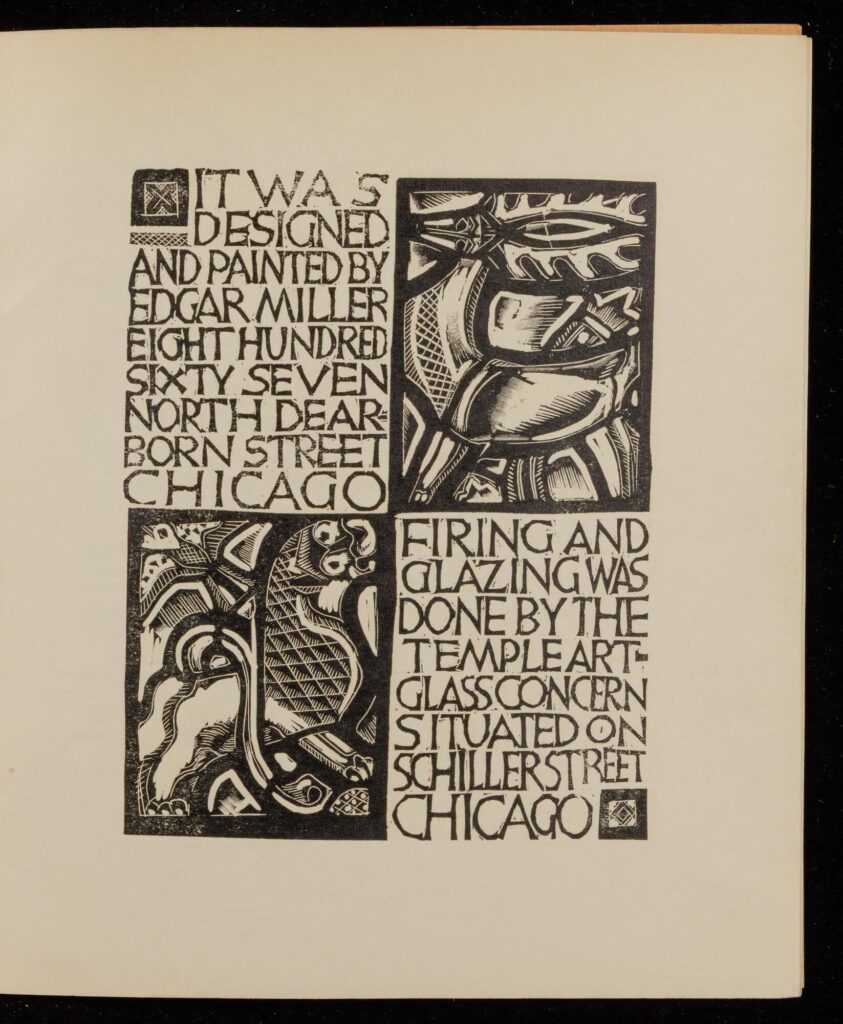
Music — from art song to folk song to jazz — was a fixture of evening programs, and Gail Borden recalls that “The Dil Pickle went out of its way to obtain virtual monopolies on all the screwy music in the Middle West.”26 In the realm of the visual arts, there is ample testimony that the Pickle doubled as an exhibition space for “the leaders of early Chicago modernism,” though since few photographs survive, details are hard to come by.27 We do know that for a time the designer and stained-glass artist Edgar Miller operated a gallery on the club’s top floor, and the short-lived Dil Pickle Press published a handsome series of his woodcuts (Fig. 14).
Notwithstanding this breadth of artistic engagement, it was poetry that occupied pride of place in Picklers’ hearts. Edna Fine Dexter recalls that the “poetry nights were glorious,” in part because these evenings were no exception to the prevailing rule of free speech.28 “Here was a spot so thick with poets and poetry,” writes Franklin Rosemont, foremost expert on the Pickle, that even non-poets among them suddenly became poets — at least for the evening — through a Picklish kind of osmosis.”29 Whatever poet was billed on the program would stride up on stage, read their work before clamoring customers, and then — like any other speaker at the Pickle — find themselves subject to its critical whims. The poet Alfred Kreymborg remembers the good-humored relish with which the audience tried to “undermin[e] and upset” him with criticism that was far from constructive. One Pickler memorably boomed: “I have…no objection to our friend. The man has promise and not a little execution. But I do object that he uses the English language instead of the German. English is so ugly. Take the great Shakespeare himself. He sounds so much better in German. Take for instance how ugly that line sounds—Hark, hark the lark! Now listen to how soft it sounds in German Horch, ;horch die Lerch!“30
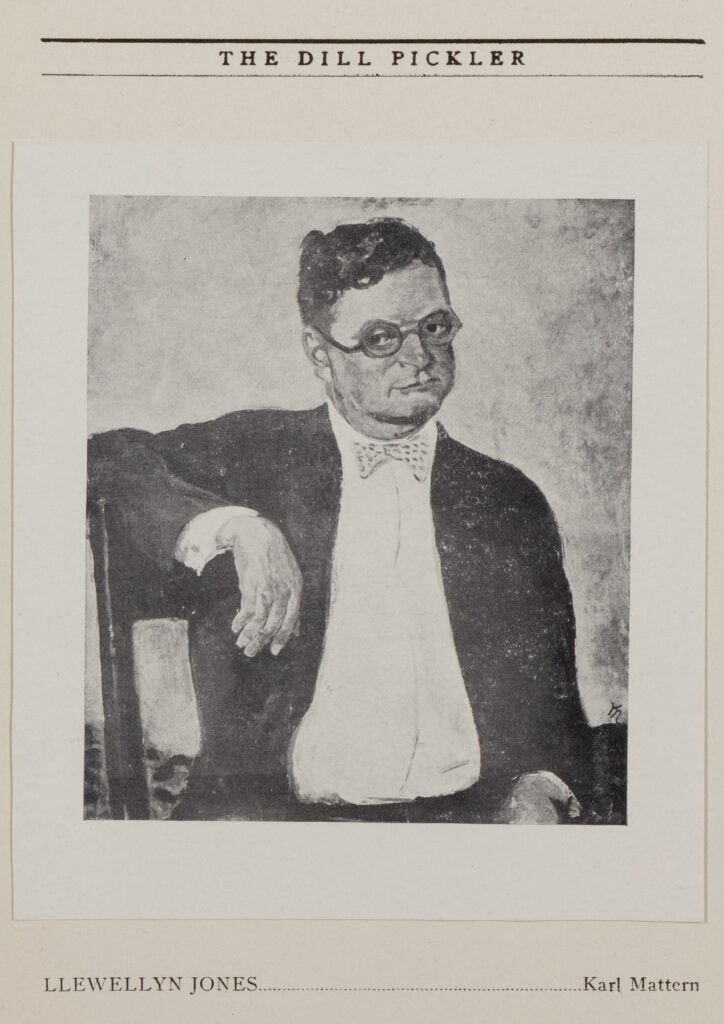
The experience of “ducking and answering questions” taught Kreymborg “that the profession of poetry is a thing of the streets and not of the study.”31 This is something one hears a lot in testimony about Pickle poetry. Here is Llewellyn Jones (Fig. 15), a Dil Pickle regular and literary editor for the Chicago Evening Post:
[T]he whole art of understanding and appreciating poetry depends on recognizing the fact that poetry as such is not high-brow, is not academic, is not essentially aristocratic, but is as likely to come from lowly sources as from high sources, from the unlettered as from the literature, is as likely to be un-moral or even immoral as to be moral; has little to do with ethics, and ought to be able to raise a smile as well as to start a tear.
As a matter of fact poetry has a far closer kinship to profanity than it has to philosophy, and in enjoying poetry we are nearer to drunkenness than we are to what is generally known as wisdom. It is the only art in which the inspired amateur will always beat the uninspired professional.
Llewellyn Jones, “Poetry and Pickles,” The Dill Pickler 1, no. 3 (1925).
Anglophone modernist poetry of the 1920s — the kind of cutting-edge poetry that Picklers were reading, criticizing, and emulating — was enthralled to a mood of cultural pessimism best exemplified by T.S. Eliot’s The Waste Land (1922), which indicts modern life as cruelly loveless and devoid of spiritual meaning. By and large, the poets of the Dil Pickle pledged allegiance to a different strain of modernism, one encapsulated in Ralph Waldo Emerson’s call for& “the sacred affirmative,” or Nietzsche’s “the sacred Yes.” Readers of Jones’s Dil Pickler and Ben Hecht’s Chicago Literary Times discovered poetry of an overwhelmingly affirmative cast. These poems voice a desire to move beyond nihilism and despair, toward the construction of better worlds on earth and some plain good fun in the meantime.
For a sterling example, we can look to Kenneth Rexroth and the “Escalator” movement. In the 1920s, Rexroth was a young club regular, and one of many Picklers paying close attention to artistic developments in Europe. Later he would characterize Dada and Surrealism, the leading avant-gardes of the day, as “organized movements of the broken heart.”32 That moving phrase prompts one to recall that these aesthetic programs emerged as responses, in a tragic, absurdist mode, to the devastations of the First World War, but it fails to characterize the blithe exuberance of the Dil Pickle’s own Dada experiment, which Rexroth himself orchestrated. Here is how he describes it:
About this time [circa 1925] Lawrence Lipton, Sam Putnam, and I organized Chicago’s deliberately abortive Dadaist movement which we called the Escalator. We wrote freely associated poetry, gave lectures in which we read antiphonally from The Critique of Pure Reason and the telephone book, while shills in the audience set off alarm clocks and shot at us with blank cartridges. We made collages out of rubbish and filled the attic with an audience for a dance recital…. Everybody was masked and in leotards, did handsprings and flip-flops, and all killed each other with rolls of folded newspapers and bladders, struggling over a broken bicycle. The music was Bach’s “Air on a G String” and “Cohen on the Telephone” [a comedy recording] both accompanied by two trombones which made them completely inaudible, except, as they say nowadays, at “random” instances… All the participants in the movement were known as Escalator and were numbered… [T]he pictures and poems and demonstrations were numbered, too. The works of art were on an equal footing with human beings.
Rexroth, An Autobiographical Novel (New Directions, 1964), ix.
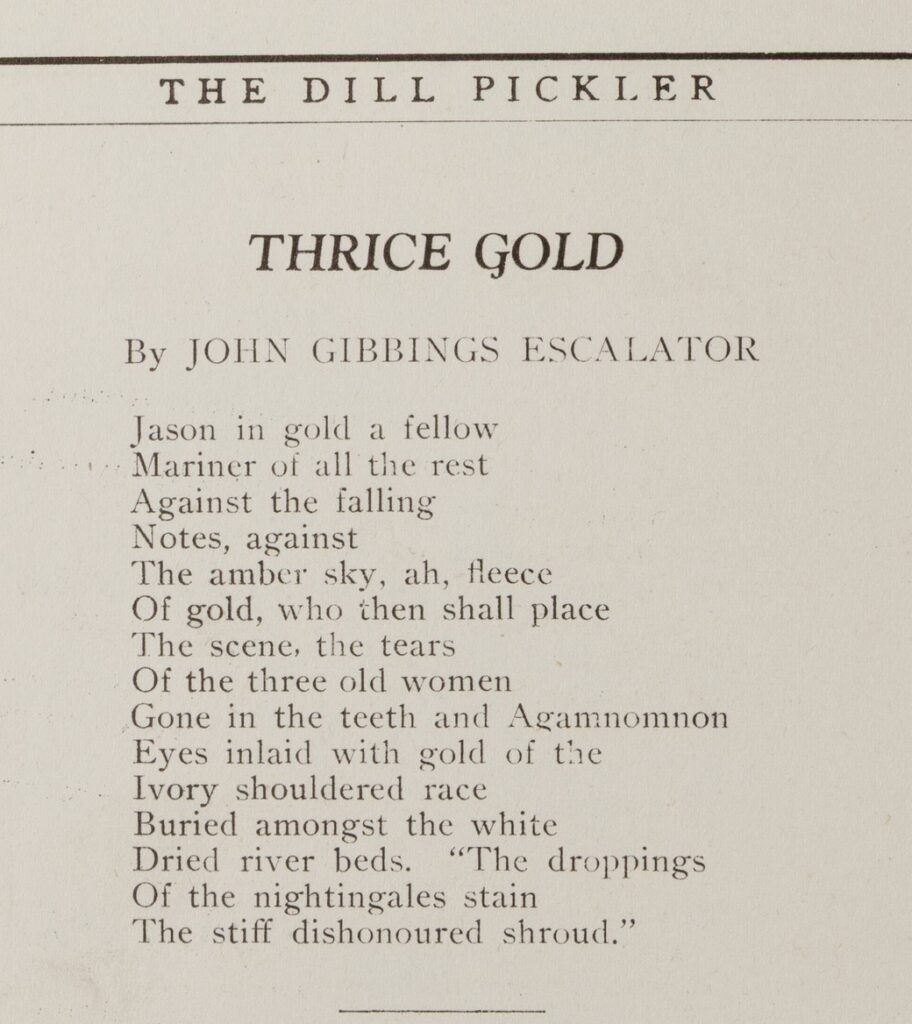
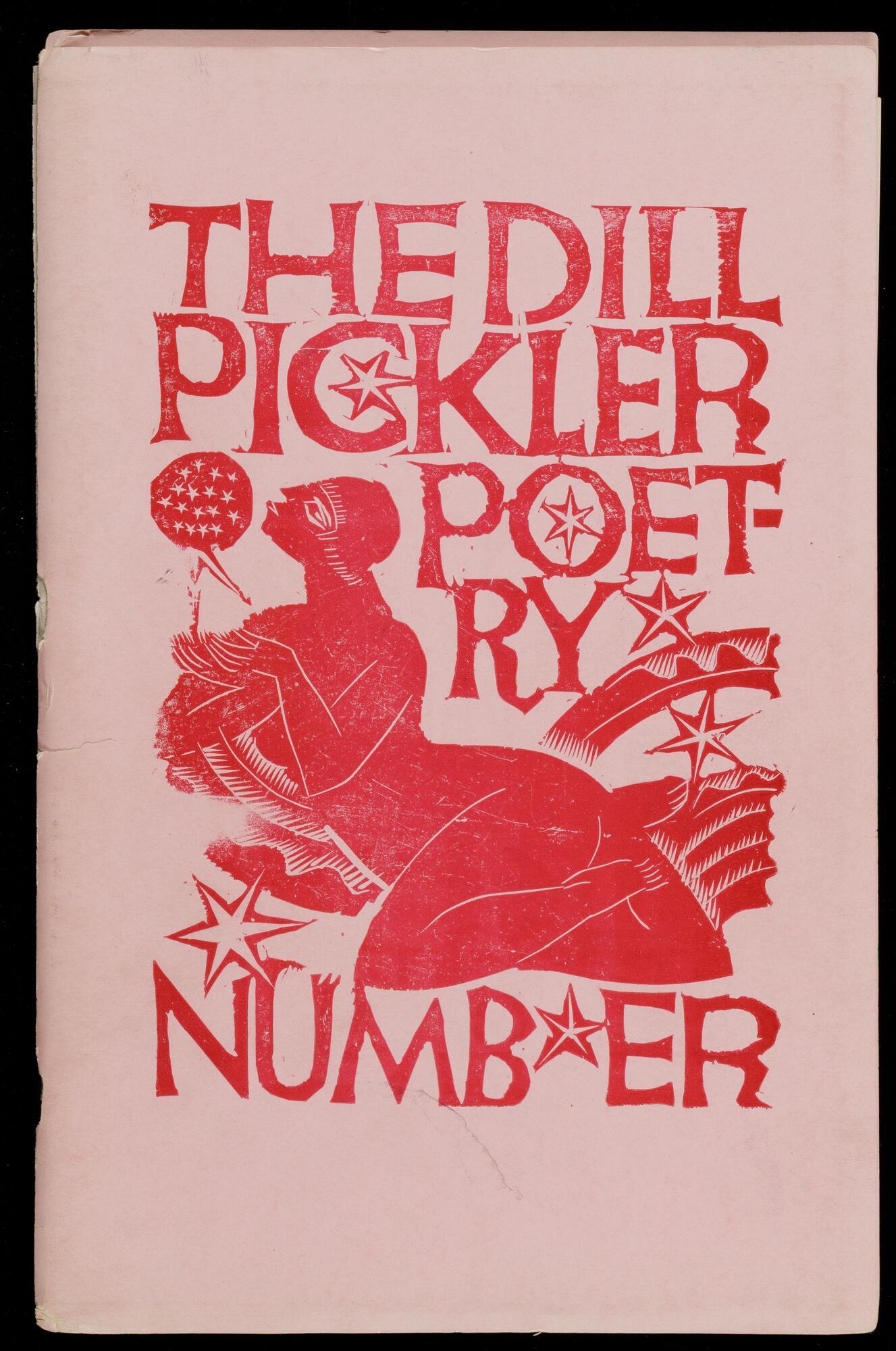
Learning about the “Escalator” movement fueled my search for “Escalator” poems. What would it be like to encounter a “work of art” that was “on an equal footing with human beings,” as Escalator envisioned. Surely, I thought to myself, samples of this radical writing by Lipton, Putnam, or Rexroth must have found its way to publication in The Dil Pickler or Chicago Literary Times. To date, I have located just one surviving “Escalator” poem (Fig. 16). “Thrice Gold,” by the pseudonymous John Gibbings Escalator, appeared in a special 1925 “Poetry Number” of The Dill Pickler (Fig. 17).
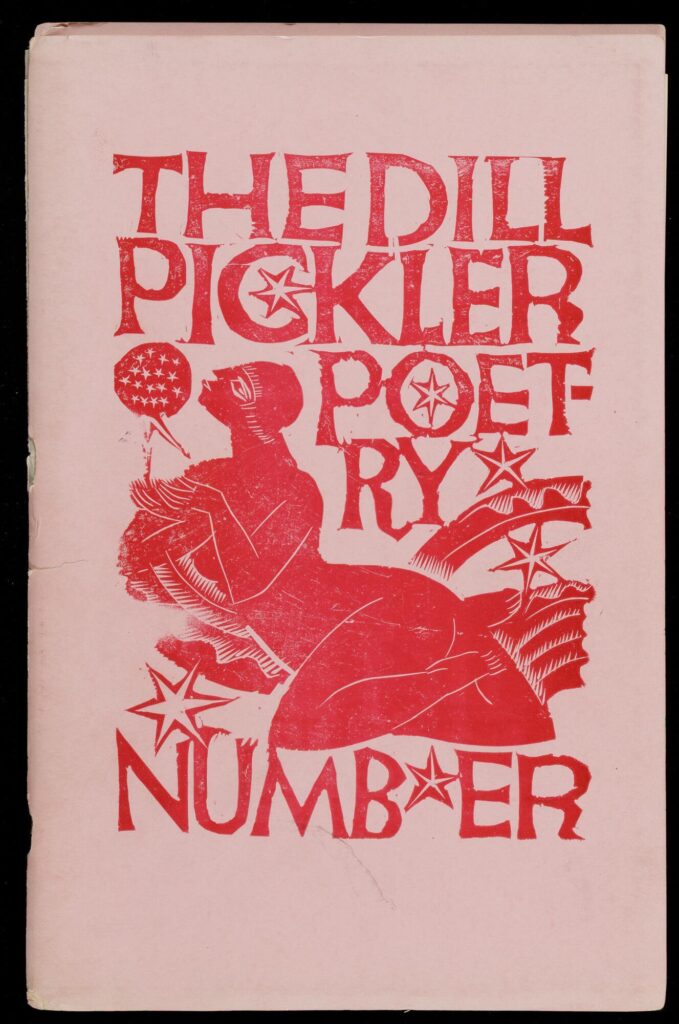
Picklers hip to modern poetry would have heard in these apparently nonsensical verses a winking relation to some then-very-recent literary developments. The final lines of “Thrice Gold” quote T.S. Eliot’s “Sweeney Among the Nightingales” (1918), in which the title figure encounters two prostitutes in a dive bar not so unlike the Dil Pickle. That bitter and sardonic poem by Eliot paints human beings at their ugliest, and it’s also densely allusive. To pick up on just one resonance, the final droppings of the nightingales, in “Sweeney,” seem to invoke the degraded voice of Philomela, whose tongue was cut out by her rapist before she was transformed by the gods into a nightingale. Here, in Escalator’s revision, these droppings are just bird excrement and strangely ennobled in light of the golden imagery shining out in earlier lines. In this way the poem stages an ambivalent but playful contest with Eliot’s brand of cultural pessimism, according to which the modern world — disenchanted, ravaged — is brutal, grotesque, and ultimately doomed. Escalator’s decision to let the droppings be droppings and to associate them with some poetic droppings of Eliot’s suggests that to put artworks “on an equal footing with human beings” is to elevate not so much the artwork as the human being, whose every sign of life is a creative gesture. This faith in the world-making possibilities of art resonates with Franklin Rosemont’s intuition that at the Dil Pickle poets “not only wrote and read poetry but also lived it.”33
In the late 1920s, the Dill Pickle fell prey to two forces: organized crime, which saw an opportunity to capitalize on prohibition, and tourists in search of bohemian thrills. The latter would find their way to the Pickle with guidebooks like Chicago in Seven Days (1928) and Dining in Chicago (1931), which declares that “What Mecca is to a Mohammedan the Dill Pickle Club is to the bohemians of Chicago and to those who merely come to see the bohemians.”34 To its apparent detriment, the Pickle complied. “As the years wore on the club tilted more and more toward the bizarre,” writes Roger Bruns. “One newspaper reporter lamented that the club had deteriorated from an earnest, art-for-art’s sake forum to a ‘sex-sideshow for gin-soaked collegiates and other perennial adolescents out for an intellectual jag.’”35 The Pickle finally shut its doors for good in 1933.

Twenty years later, in a different set of historical circumstances, Slim Brundage (Fig. 19) managed to re-kindle the Pickle spark, on nearly the very same ground. “The College of Complexes is a gathering place for a variety of characters — artists, judges, clergymen, all kinds of politicians, college students, Beat generation cats, bughouse square refugees, and others who like to sip their beer and discuss any and all subjects whether it be politics, poetry, sex, current events, the price of marijuana, or what have you. The College operates in the tradition of the soapbox, the cracker barrel, the corner saloon, and the opium den.” 36 It is indeed “a playground for people who think.”
“We cater to artists, writers, intellectuals and assorted screwballs,” ;Brundage claimed, and that included cultural stars of midcentury Chicago like Thornton Wilder, Jack Conroy, Gwendolyn Brooks, Studs Terkel, Carlos Cortez, Big Bill Broonzy, and Adlai Stevenson, among others.39 Friday evenings at the College were devoted to lectures of intellectual and political significance: the Integration of Deerfield, Illinois; “Why Do All World War II Novels Stink?”; “The Chicago Police Department and its Terrible Record of Civil Liberty Violations”; an ;“Was Karl Marx a Schnook or a Good Guy?” Meanwhile, the racier Saturday nights were given over to performances, hypnotism demos, quiz competitions, and lectures on subjects like “Is Virginity Overrated?”, “Smut, Erotica, and Dirt,” and “Should Marriage Licenses Be Renewed Yearly?”
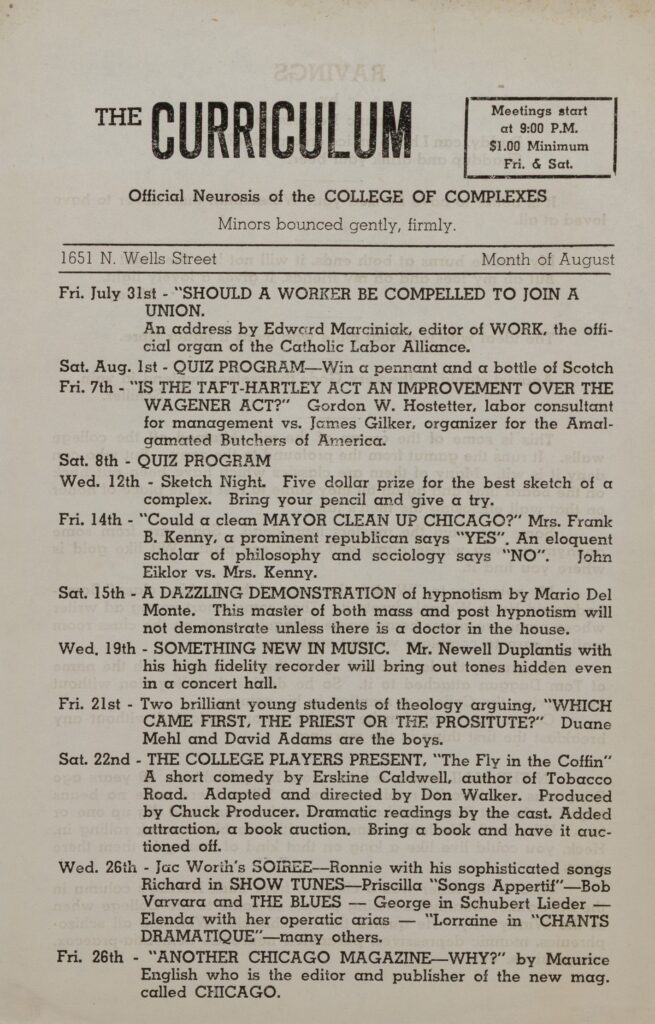
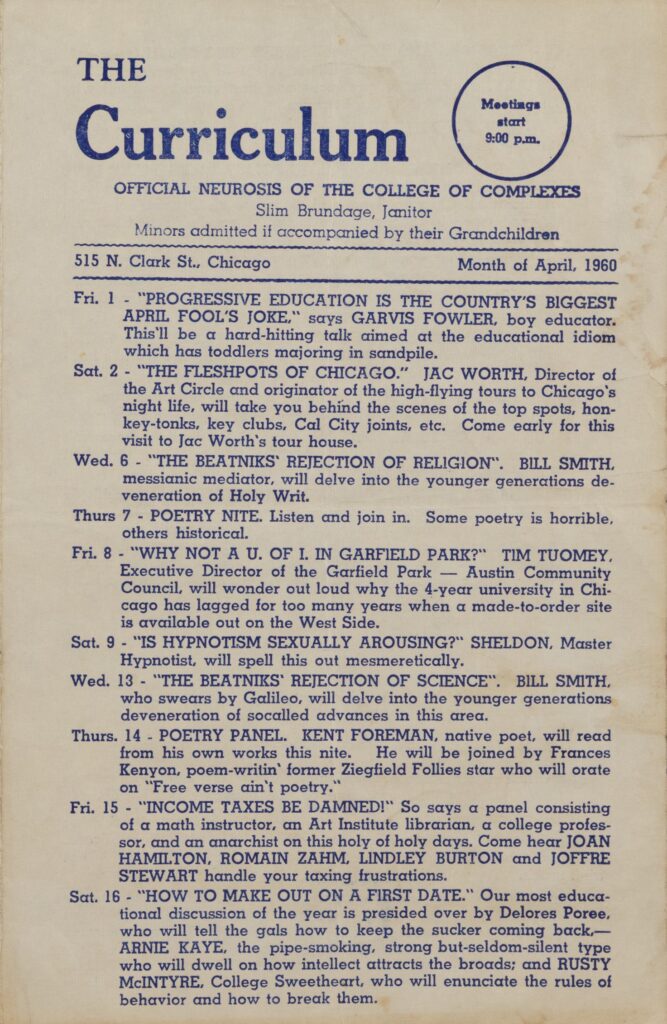
In clear homage to its predecessor, the door of the college sported its own cheeky warning: “Through this portal passes the most odious offal on this orb — OUR CUSTOMERS!” From a hanging basket, a patron could grab a copy of the College’s house organ or “Official Neurosis,” the so-called Curriculum, the cover of which promoted the monthly offerings (Figs. 18 and 19). Inside, the room’s walls and ceiling were covered in chalkboards across which were scrawled quips, gags, and quotations: “Don’t change seats while the room is in motion”; “Lack of sex education causes many misconceptions”; and “Learn to complain without suffering.”
And as at the Pickle, on any given night at the College those in attendance had to be prepared to talk. As one regular reports, “after the main speech, the program is devoted to questions, and next, any member of the audience can rebut the speaker. The rebuttals, a continuance of the soapbox tradition, often put the main speech to shame.”37 “If you are inclined to be timid and sit in some dark corner of the college, you might be in for a surprise, for Slim ‘the janitor’…might come roaring up to your table with a microphone and ask your opinion.” “What Slim…did so well,” recalls another Collegian, “was to exhort” the “old ;Wobs…the college kids, the swells, the tourists, the crackpots and [even] the tight-lipped sectarian bigots of Moody and Marx…to be unmuffled, ungagged, and unsilenced. What he did was to make it fun…to speak up and to hell with the censors!”38
Thursdays were often Poetry Night at the College, but in marked contrast to the Dil Pickle, the format departed significantly from the discursive brawls that were the ostensible goal of the College’s other programming. For the ten years that Brundage ran Poetry Night, “Anybody could read anything, original or not.” Edgar Allan Poe and Robert Service were popular staples, and Brundage was always ready to leap to the stage when the mood demanded a set of comic verses. When it came to the original work of attendees, however, all critical discussion was outlawed. As Brundage explains, “I had found that people got to discussing some poem and everybody wouldn’t have a chance to read theirs.” If anyone wanted to criticize, they had to do it in poetry: those who disapproved “could write an opposition verse.”39
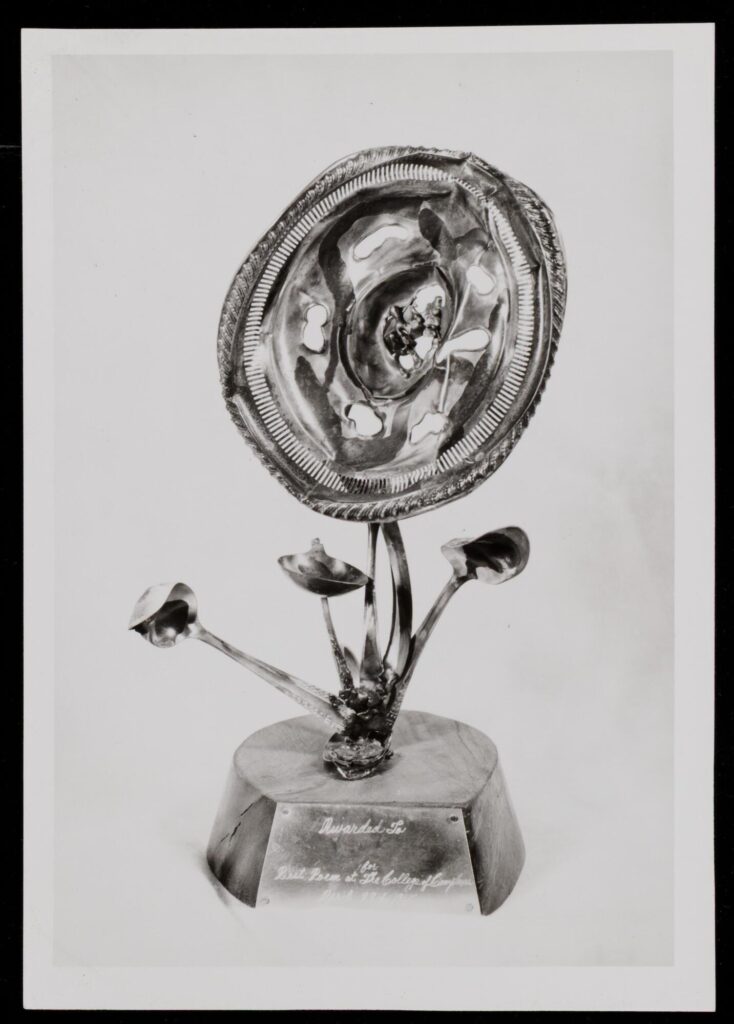
Somewhere between a workshop and a literary reading, Poetry Night at the College managed to reanimate the freewheeling essence of the Pickle. Nothing was taboo or inappropriate. “Although many partakers really read about the city and the people who live there,” remembers one participant, “one was free to recite poems about whatever one felt like.”40 Brundage cultivated a macaronic verse culture equally the possession of Chicago’s working and professional-managerial classes. The regulars at Poetry Night were not only “pseudo-intellectuals” like teachers and chemists and social workers but also “waitresses, window washers…day laborers… firemen…garbage collectors, cab drivers, cooks, [and] housepainters.” “[T]here was no persecution, and people were welcome as they were,” and even when the College did decide to single out someone’s poem for special recognition, the award had a democratic cast that Jack Jones would have appreciated: the trophy for “Best Poem at the College of Complexes” was made of spoons and a hubcap (Fig. 20).41
Matthew Kilbane is the author of The Lyre Book: Modern Poetic Media (Johns Hopkins UP, 2024) and the editor of Expressive Networks: Poetry and Platform Cultures (Amherst College Press, 2025). His essays have appeared or are forthcoming in PMLA, English Literary History, Modern Language Quarterly, American Literature, and elsewhere, and his research has been supported by the Newberry Library, the American Council of Learned Societies, the National Endowment of the Humanities, and the Library of Congress. He is currently the Glynn Family Honors Assistant Professor of English at the University of Notre Dame.
Dil Pickle Club, which occupied the brick barn at 10 Tooker Alley in Chicago’s Towertown neighborhood, was part teahouse, part arts center, part debating society. Founded by Jack Jones in 1917, the club was the gathering place for the city’s many anarchists, Wobblies, hobos, criminals, social workers, free-lovers, poets, playwrights, journalists, and free-thinkers from across the professional classes by the end of World War I.
If freedom of expression was the Pickle’s bedrock tenet, nowhere was this commitment more in evidence than in the club’s frank treatment of “free love.” This could be serious business because of laws like the Comstock Act. It was also a lot of fun. Picklers’ blend of sincerity and humor provided a critical distance from which to debate contemporary programs for social change.
Music, theater, and even some modern visual art appeared at the Pickle, but poetry occupied pride of place. Poetry readings were raucous affairs, reflecting the Picklish idea that poetry was not just for the high-brow. These works included the freely associated poetry of Kenneth Rexroth’s Dadaist “Escalator” movement appeared in The Dill Pickler.
The Dil Pickle closed in 1933, but its spirit continued at the same location with Slim Brundage’s College of Complexes. Cultural stars of midcentury Chicago like Thornton Wilder, Jack Conroy, Gwendolyn Brooks, Studs Terkel, Carlos Cortez, Big Bill Broonzy, and Adlai Stevenson, among others, visited the College to debate topics from politics to literature, sex to hypnotism.
Balavage, Elysia. “Rebellious Space and Radical Movement: The Dil Pickle Club of Tooker Alley.” Genealogies of Modernity (2024).
Higbie, Tobias. Labor’s Mind: A History of Working-Class Intellectual Life (2019).
Myers, Quinn. “Chicago’s Dill Pickle Club: Where Anarchists Mixed With Doctors and Poets.” WBEZ Chicago (2019).
Olsen, Liesl. Chicago Renaissance: Literature and Art in the Midwest Metropolis (2017).
Parry, Albert. Garrets and Pretenders: A History of Bohemianism in America (1960).
Rexroth, Kenneth. An Autobiographical Novel (1964).
Rosemont, Franklin. The Rise & Fall of the Dil Pickle: Jazz-Age Chicago’s Wildest & Most Outrageously Creative Hobohemian Nightspot (2004).