

Themes
American Revolution
Indigenous History
Periods & Events
18th Century
Colonial North America
Revolutionary Period
Skills & Document Types
Close Reading
Letters
Transcripts
Speeches
Overview and Instructional Use
This is a collection of primary sources and discussion questions used or referenced in the Collection Essay Native Nations in an Age of Empire and Revolution, 1750-1783. In these activities, high school students analyze letters, speeches, and meeting minutes to learn about Indigenous history during the American Revolution while practicing close reading.
These activities can be used:
- As part of a unit on Indigenous history.
- To practice close reading.
- As part of a unit on the America Revolution.
Materials
- A copy of B. Franklin, and D. Hall, Excerpt from Minutes of Conferences, Held with the Indians, at Easton, in the Months of July and August 1757, 8-10 (1757).
- A copy of Excerpt from Minutes of Conferences, Held at Lancaster, in August, 1762 with the Sachems and Warriors of Several Tribes of Northern and Western Indians, 31 (1763).
- A copy of Letter from William Browning to Sir William Johnson (April 30, 1764).
- A copy of A Talk from the Honorable {William} H. Drayton One of the Beloved Men of South Carolina To the Beloved Men, & Warriors of The Cherokee Nation (September 25, 1775).
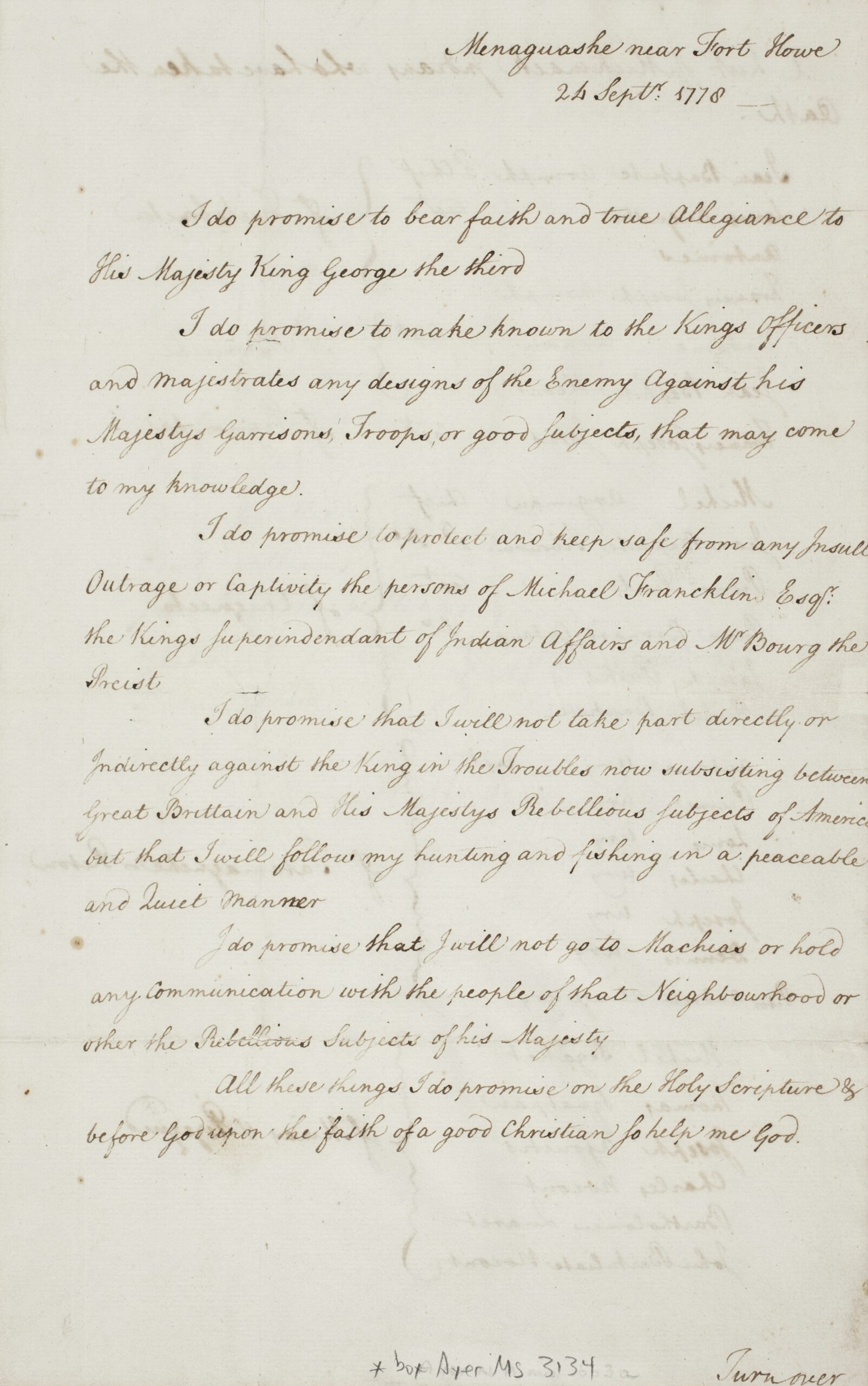
- A copy of the Micmac Oath (September 24, 1778).
These classroom materials were produced through a generous annual fellowship for digital education on American Women’s History or Early American History funded by the Chicago Chapter, National Society Daughters of the American Revolution, 2022.
Below are transcripts and discussion questions from sources included in the Collection Essay Native Nations in an Age of Empire and Revolution, 1750-1783. Click on the title of each source to view the original.
B. Franklin, and D. Hall, Excerpt from Minutes of Conferences, Held with the Indians, at Easton, in the Months of July and August 1757, 8-10 (1757)
Excerpt from Minutes of Conferences, Held at Lancaster, in August, 1762 with the Sachems and Warriors of Several Tribes of Northern and Western Indians, 31 (1763)
Letter from William Browning to Sir William Johnson (April 30, 1764)
A Talk from the Honorable {William} H. Drayton One of the Beloved Men of South Carolina To the Beloved Men, & Warriors of The Cherokee Nation (September 25, 1775)
Micmac Oath (September 24, 1778)
About the Author
Rachel Banke, PhD, currently works as a Teaching Associate at the University of Illinois Laboratory High School (Uni High) in Urbana, Illinois, an innovative public school for talented and motivated students in the 8th-12th grades. Her experience includes teaching American, British, Atlantic, and world history classes at the secondary and university levels. She has previously taught at the University of Notre Dame, University of Missouri-Columbia, Illinois Mathematics and Science Academy, and Aurora University. Dr. Banke received her PhD in early American history from the University of Notre Dame with a dissertation entitled “Bute’s Empire: Reform, Reaction, and the Roots of Imperial Crisis.” She also recently published a chapter entitled “The Ideology of Imperial Reform: Enlightened Absolutism and the American Colonies” in Ireland and America: Empire, Revolution, and Sovereignty (University of Virginia, 2021).
Illinois Social Science Standards
This lesson supports the following standards from the Illinois Learning Standards for Social Science:
History
- SS.9-12.H.1. Evaluate the context of time and place as well as structural factors that influence historical developments.
- SS.9-12.H.5. Analyze the factors and historical context, including overarching movements, that influenced the perspectives of people during different historical eras.
- SS.9-12.H.7. Identify and analyze the role of individuals, groups, and institutions in people’s struggle for safety, freedom, equality, and justice.
- SS.9-12.H.8. Analyze key historical events and contributions of individuals through a variety of perspectives, including those of historically underrepresented groups.
Common Core
This lesson supports the following Common Core Literacy in History/Social Science standards:
English Language Arts: History/Social Studies
- CCSS.ELA-LITERACY.RI.9-10.1: Cite strong and thorough textual evidence to support analysis of what the text says explicitly as well as inferences drawn from the text.
- CCSS.ELA-LITERACY.RI.9-10.2: Determine the central ideas or information of a primary or secondary source; provide an accurate summary of how key events or ideas develop over the course of the text.
- CCSS.ELA-LITERACY.RI.11-12.1: Cite strong and thorough textual evidence to support analysis of what the text says explicitly as well as inferences drawn from the text, including determining where the text leaves matters uncertain.
- CCSS.ELA-LITERACY.RI.11-12.2: Determine the central ideas or information of a primary or secondary source; provide an accurate summary that makes clear the relationships among the key details and ideas.
The College, Career, and Civic Life (C3) Framework
This lesson supports the following C3 Framework standards:

Dimension 2, History
- D2.His.1.9-12. Evaluate how historical events and developments were shaped by unique circumstances of time and place as well as broader historical contexts.
- D2.His.4.9-12. Analyze complex and interacting factors that influenced the perspectives of people during different historical eras.
- D2.His.5.9-12. Analyze how historical contexts shaped and continue to shape people’s perspectives
Related Newberry Resources

A custom curriculum hosted by the Newberry and centered on Chicago as a Native Place.
Created in alignment with Illinois State Standards and to support the HB1633 mandate to teach Native history.