


It is difficult to fathom what it might have been like to live through the American Civil War. Between 1861 and 1865, 620,000 soldiers were killed, approximately 200,000 women were widowed, and at the close, four million enslaved persons were freed. The numbers are staggering but hard to picture. Thankfully, books, poems, newspapers, illustrations, and essays written by those who endured the war give us a window through which we might see how people lived, what their anxieties were, and how they imagined their communities might move forward.
“Literature of the American Civil War” explores a variety of texts published around or during the American Civil War, from approximately 1861-1865. This digital collection focuses on five main topics relating to the people who wrote and published during the war, their relationship to the war, and how they reflected on it: Abolitionist literature, types of publications, literature on the warfront, Southern voices, and reflections on the war. Questions that arose for these writers not only reflect fears about the war and the dissolution and reconstruction of the Union. They are also questions we still face today about what it means to be a free subject; what it means to be a citizen; what it means to do good; and what we can learn from conflict. At the center of these questions was the institution of slavery.
Slavery had a profound impact on the lives of enslaved people and those forcing them into bondage. It also impacted those not living within the eleven states that seceded from the Union in 1861. Northern economics were tied up in slavery through cotton factories located in New England; New York City residents owned plantations in the south; Wall Street investments in shipping, manufacturing, and insurance industries were entwined with enslaved labor; Americans owned plantations abroad, like in Cuba and Mexico; and popular commodities like coffee, sugar, fabric, and tobacco were harvested by enslaved people. As slavery was economically everywhere, so too was it constantly on the minds of writers, who used the status of the enslaved to comprehend and define the concepts of liberty and oppression in their writing. To put it in simpler terms, any time an author of this period discussed freedom, they were thinking about the enslaved.
Because slavery had a profound impact on literature written during the Civil War, this essay begins with abolitionist literature written just before the war. What do these primary sources tell us about the world in which they were penned? What kinds of information can we learn from the printed word that we cannot learn elsewhere? How do different kinds of publications inform our interpretation of our own histories?
Essential Questions
Historians agree that the eleven states that formed the Confederacy seceded because they determined that the 1860 election of President Abraham Lincoln threatened the institution of slavery. Long before the war broke out, writers published hundreds of works over many decades aiming to abolish slavery.
To understand the literature published during the war, it is vital to examine the radical abolitionist literature that circulated in the years leading up to it. Newspapers, journals, tracts (small pamphlets), and books were the primary means by which nineteenth-century Americans learned about the political and moral structures of their society and expressed opinions and arguments about their world. Abolitionist literature was a genre of texts that had one thing in common: every text called for the abolition of slavery. However, these texts take a wide range of forms, including novels, short stories, personal essays, speeches, poems, opinion articles, book reviews, and the most impactful form, narratives of enslavement. Most abolitionist activism was rooted in Massachusetts, especially Boston, and New York, especially New York City and Rochester. The literature printed in these cities circulated throughout the United States, including in the South, where it was met with a firestorm of disapproval and threats of violence to abolitionist authors.
Ask Students
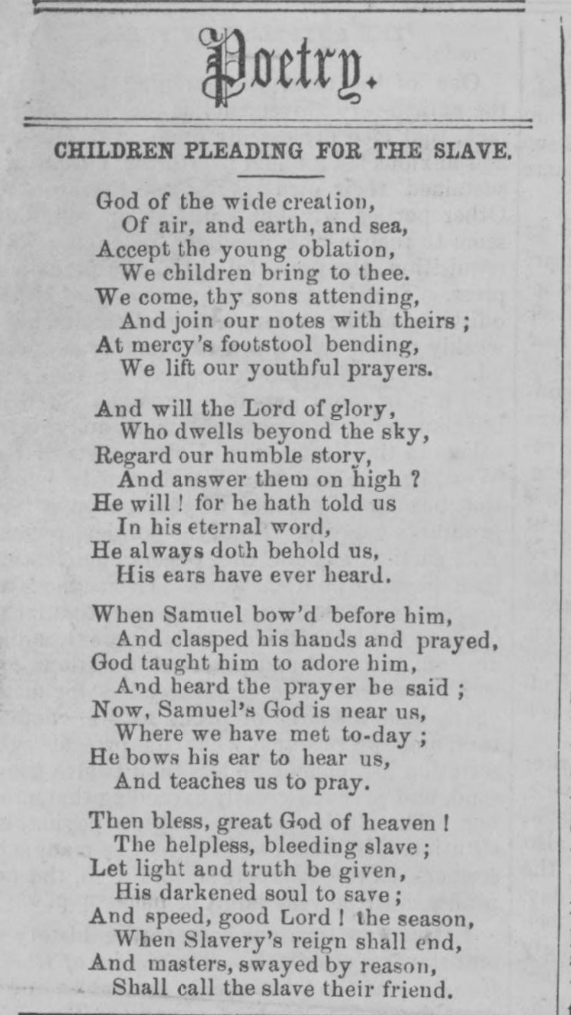
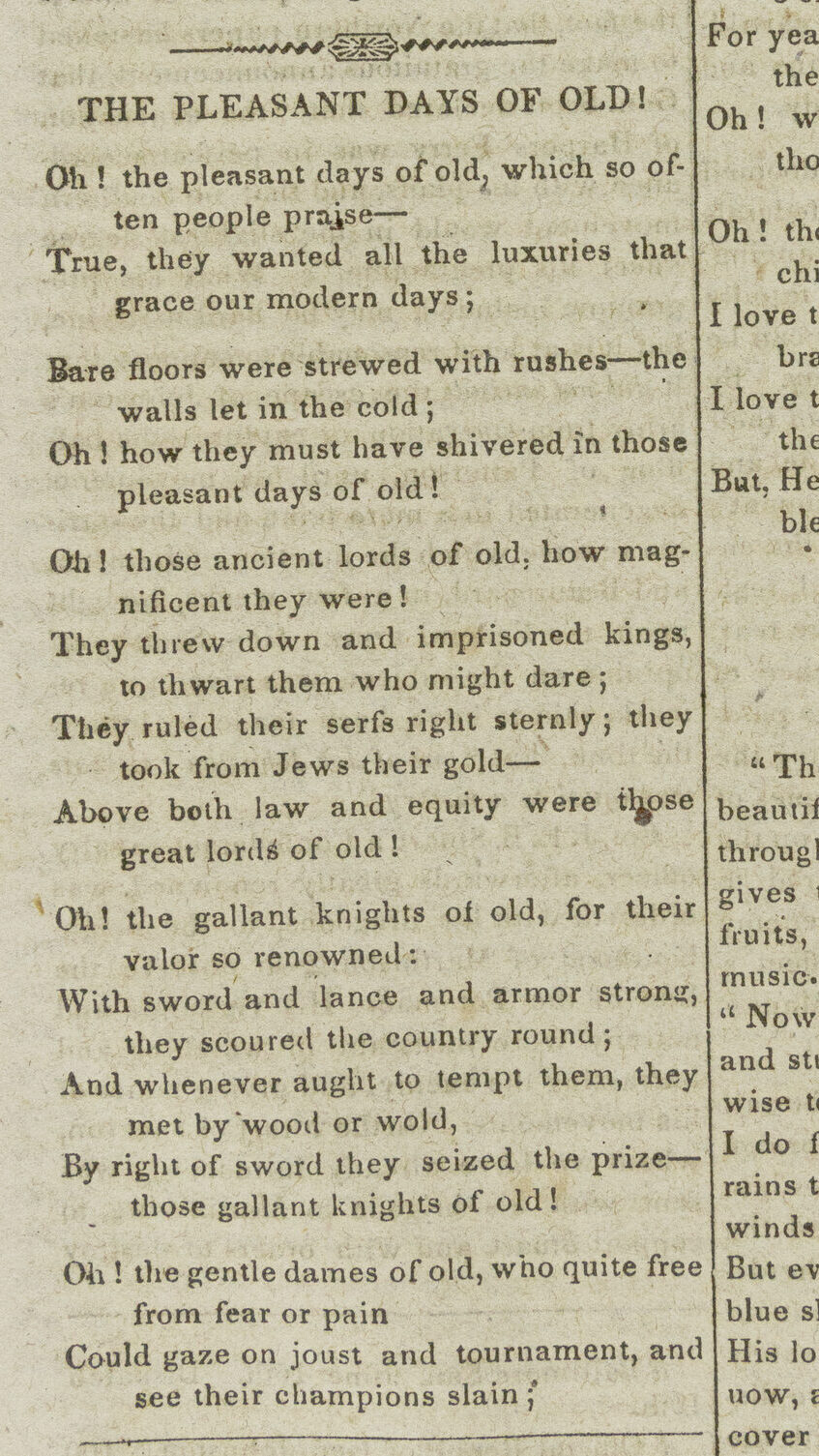
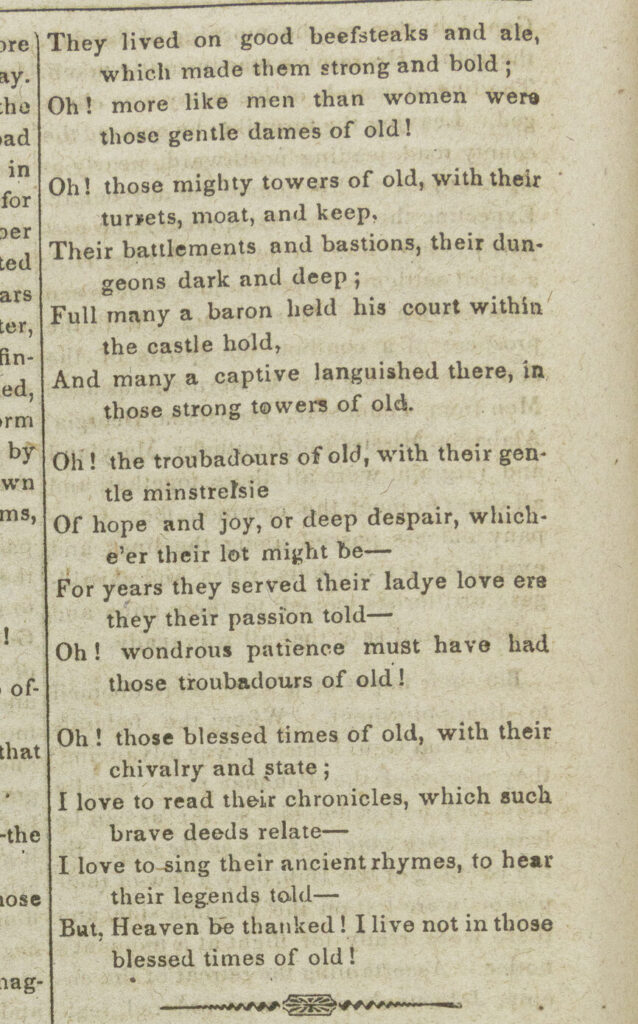
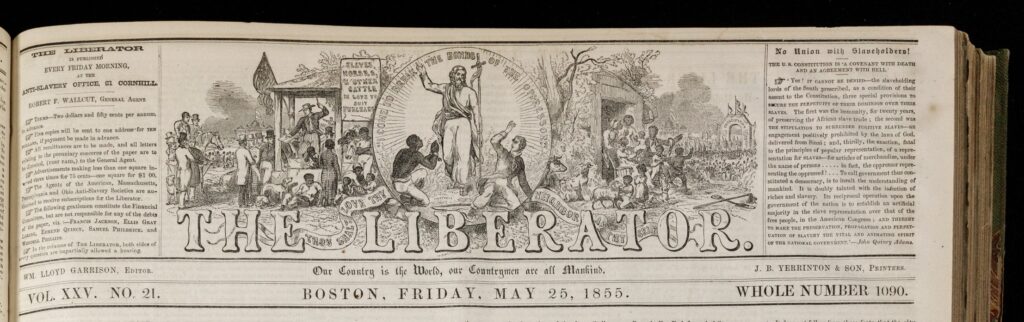
One influential abolitionist text is William Lloyd Garrison’s weekly newspaper, The Liberator, which ran from 1831 until 1865 in Boston. The Liberator was the premier abolitionist newspaper and had a wide audience, including those who had escaped slavery. Frederick Douglass, perhaps the most famous formerly enslaved author, was an avid reader and would eventually eclipse Garrison with his own newspaper. Approximately three-quarters of Garrison’s readers were African American, almost all living in the North. The newspaper contained articles about current events, like lectures; essays on the antislavery cause; and poems, letters, and advertisements for books. It emphasized religious and moral rejection of slavery through nonviolence.
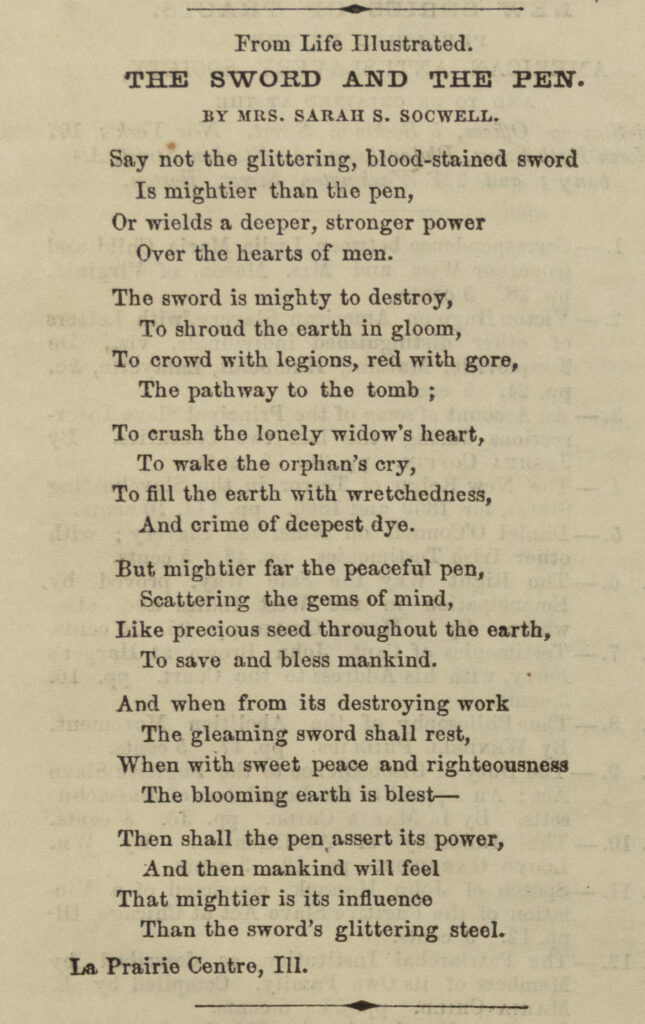
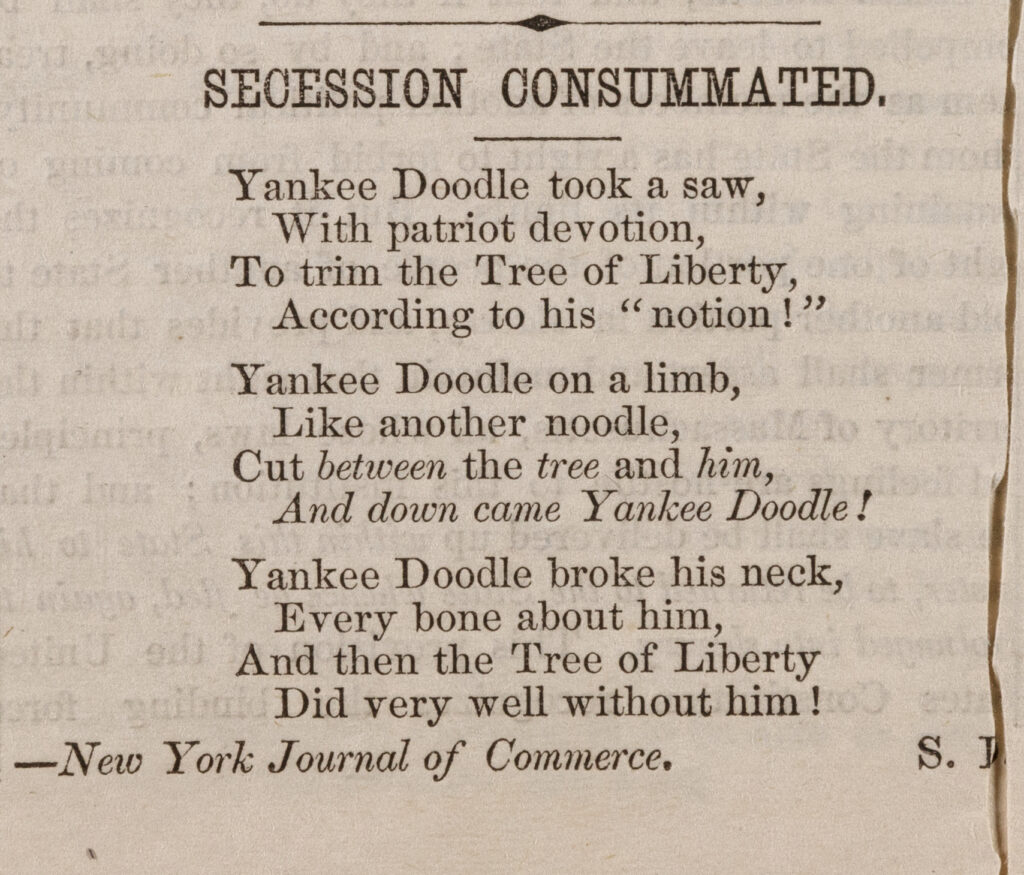
Depicted above are two poems published in The Liberator in 1861, with vastly different tones but similar political commentary.
Ask Students
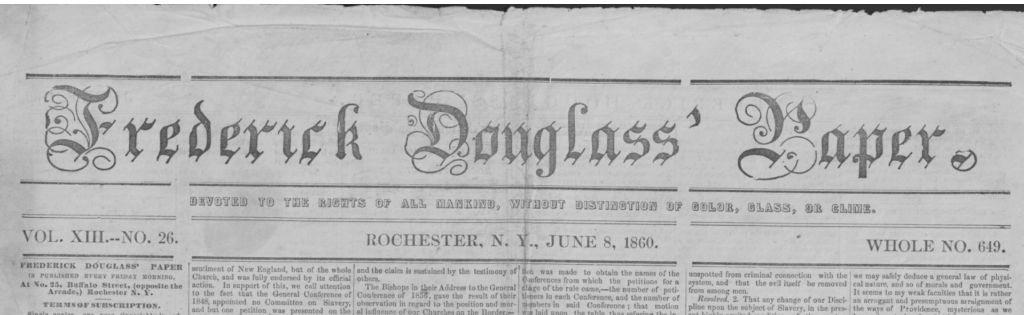
Frederick Douglass, author of Narrative of the Life of Frederick Douglass, A Slave (1845), was a bestselling author and one of the most influential abolitionists. After a rift with Garrison that involved a philosophical disagreement, he started his own newspaper, The North Star, first published in Rochester in 1847. He changed the name of the paper several times, including Frederick Douglass’ Paper, and during the war, Douglass’ Monthly. It ultimately had about one thousand more subscribers than Garrison’s (Petruzzello, “The North Star”).
Ask Students
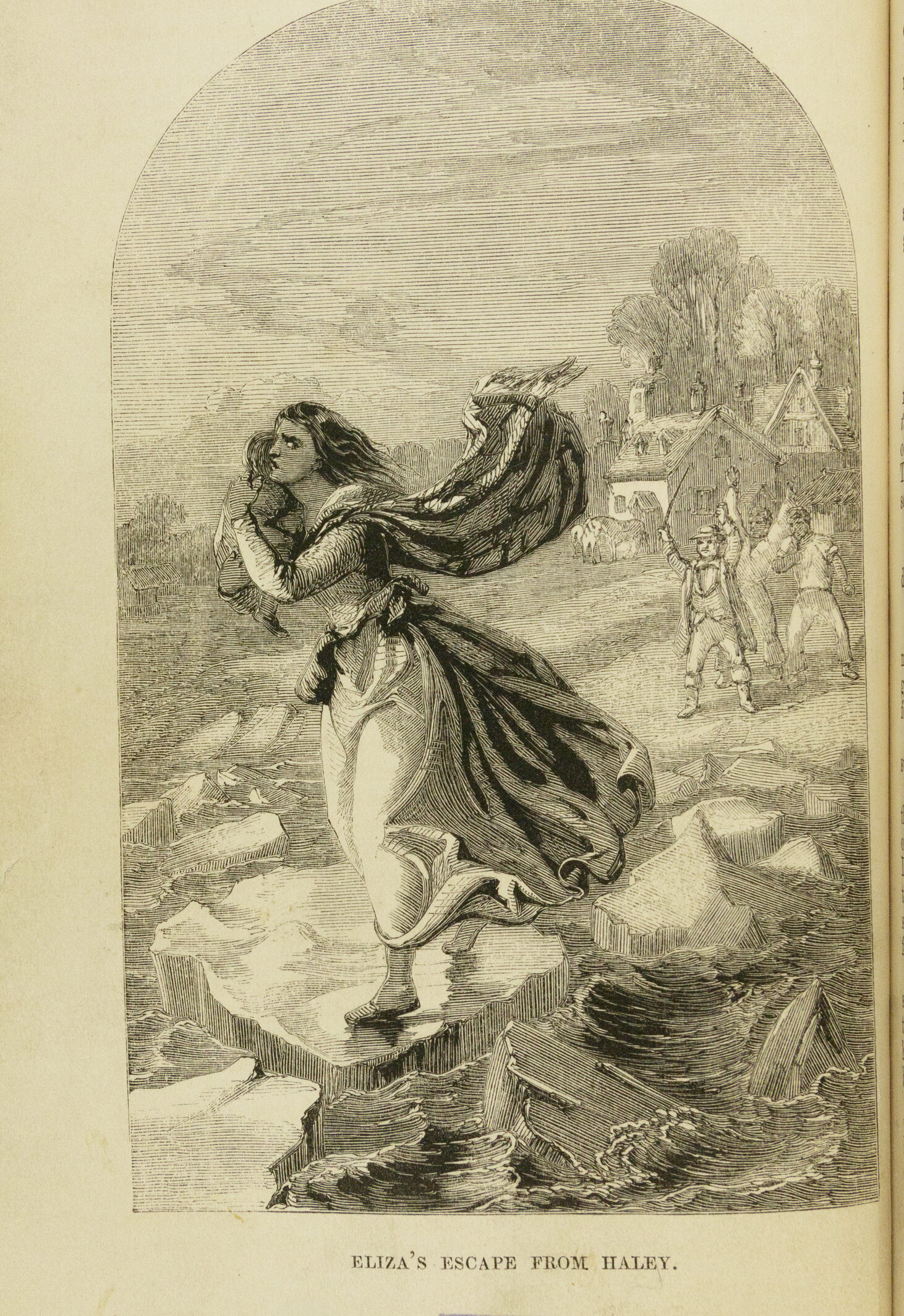
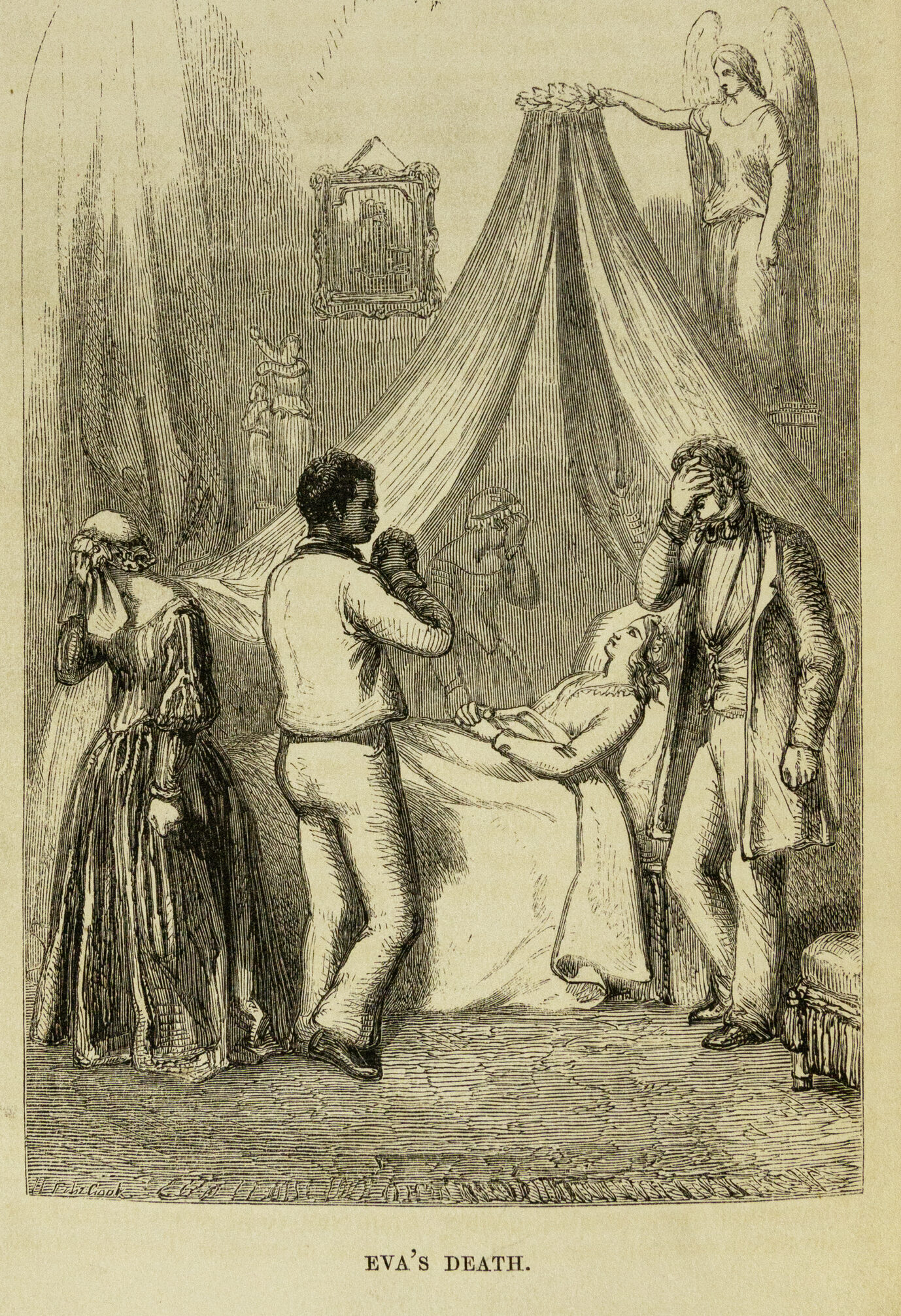
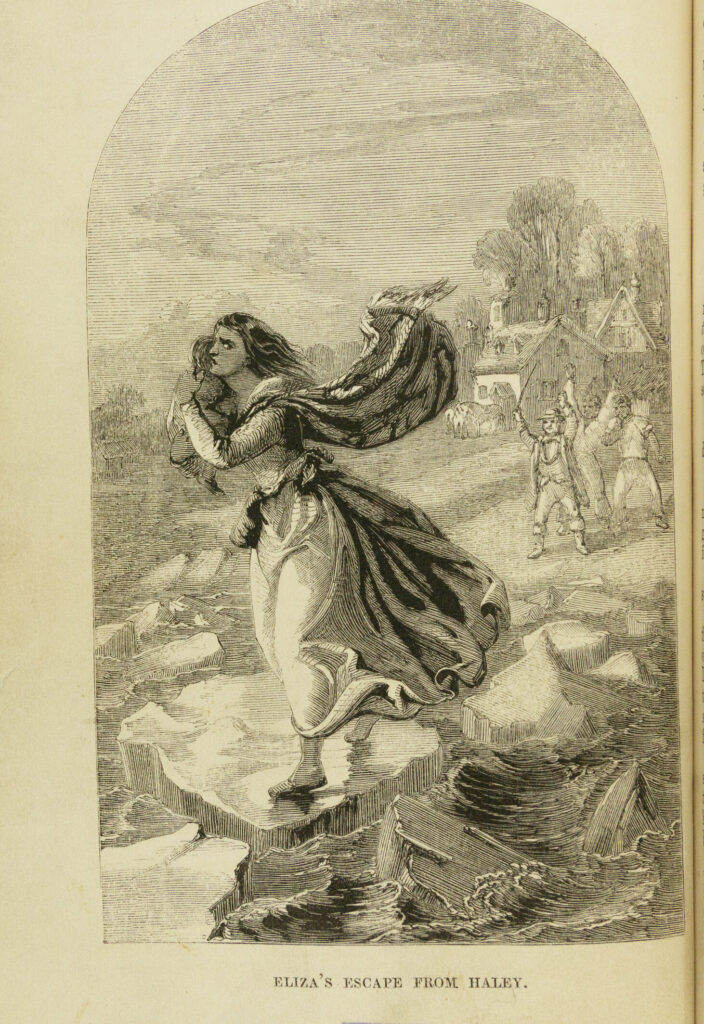
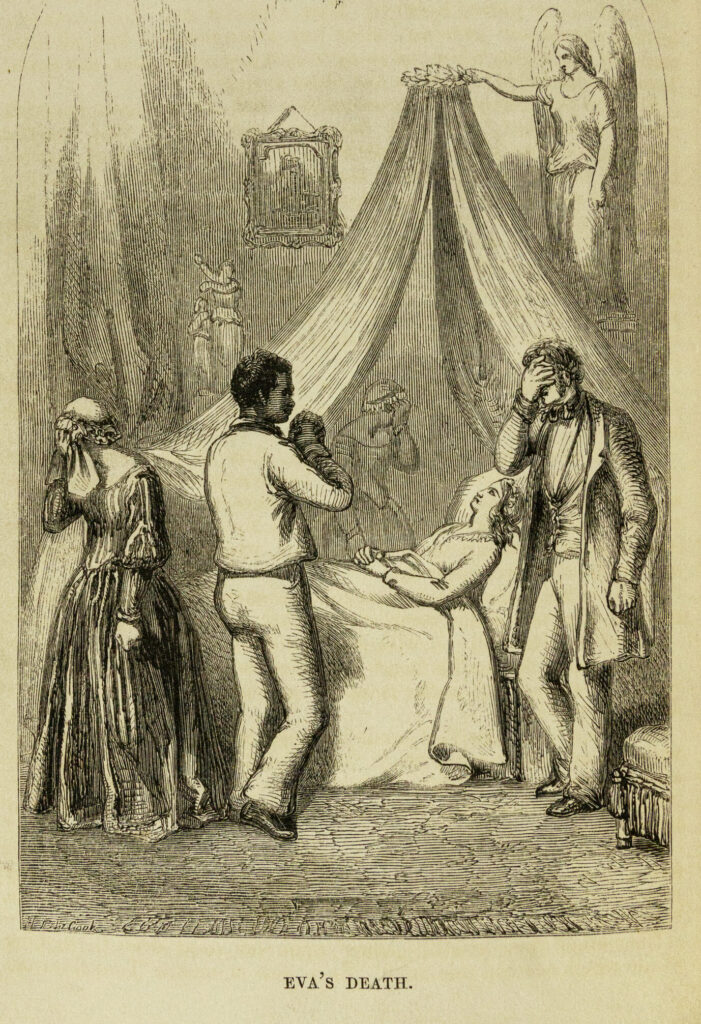
Abraham Lincoln supposedly lauded Harriet Beecher Stowe as “the little lady who started this great war” upon meeting her, because she was the author of Uncle Tom’s Cabin (1852). Uncle Tom’s Cabin is often acknowledged as a central book that fueled abolitionist sentiment over the decade leading to the Civil War. The novel follows the stories of several enslaved people as they grapple with the violence and oppression of slavery, including Eliza, a woman who is threatened with separation from her son, and Tom, the titular character. The illness and death of Little Eva, a young white girl, is also often interpreted as caused by slavery, a symbolic plague that can infect anyone. Nevertheless, contemporary scholars critique the novel’s depiction of enslaved persons as riddled with problematic stereotypes, such as the subservient Black man.
The book is also an example of sentimental literature, a genre that dominated the literary marketplace in the early nineteenth century. Scholars have pointed out that sentimental literature’s primary goal is to evoke a strong feeling in the reader–actual crying, for example–which could take place instead of political action. Below are illustrations of scenes from the novel included with the full printed version of Uncle Tom’s Cabin.
Ask Students
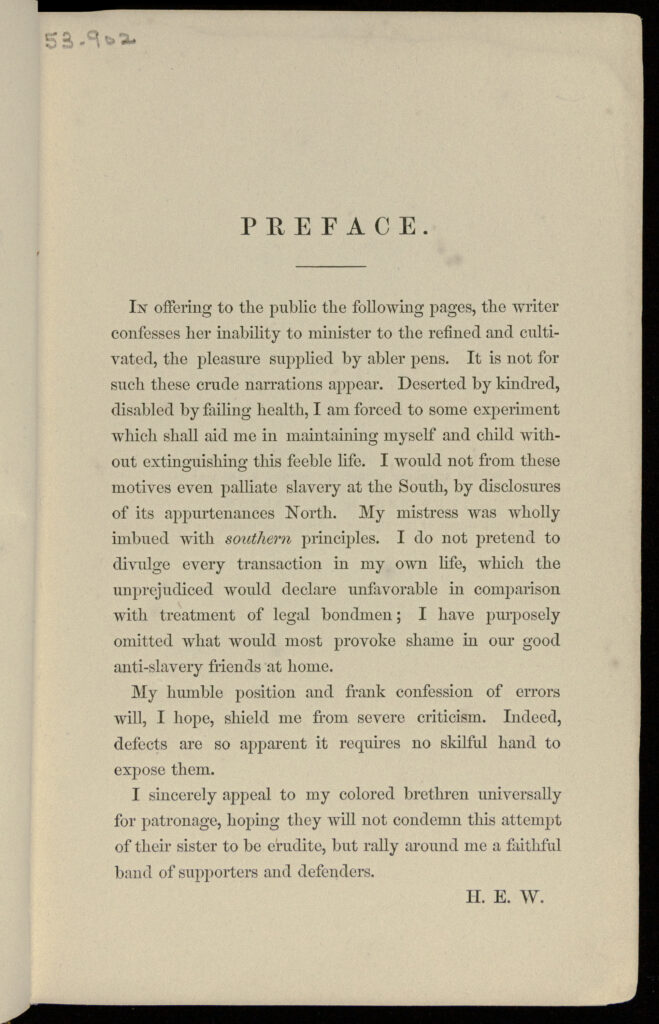
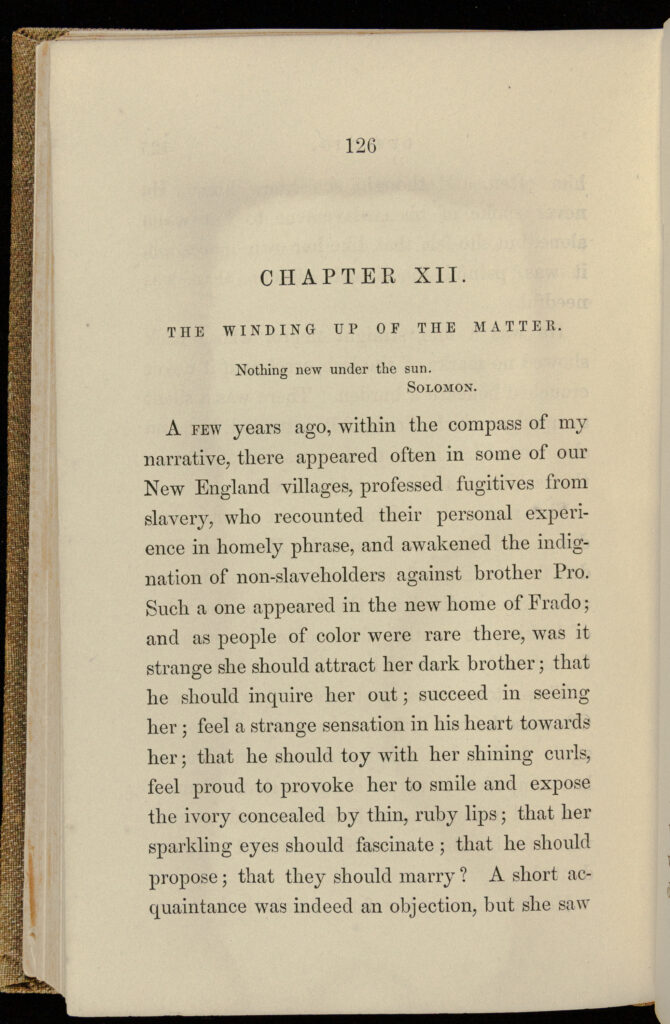
Forced labor was also a fundamental aspect of life in the North. For example, Harriet Wilson published a novel based on her life as an indentured servant in New Hampshire. This book highlights the abuses that Black Northerners had to endure at the hands of white tormentors. It represents how race had profound impacts outside the legal bounds of slavery—the borders of the Southern states. For example, a portion of Wilson’s title reads, “Showing That Slavery’s Shadows Fall Even There,” meaning, in the Northern states. Because of her vulnerable status, the protagonist Frado has no option but to endure violence and torment in servitude of the Bellmont family until she legally can leave at age eighteen.
Northern readers may have been uncomfortable with the novel because the most significant antagonist is Frado’s white adoptive “mother,” who sees no issue with mistreating the child in her charge. However, many white women would have simply seen Mrs. Bellmont as a typical “bad mother” character, similar to those found in books like Uncle Tom’s Cabin. The book did not receive as much critical acclaim as books like Narrative of the Life of Frederick Douglass. Abolitionists at the time may have dismissed it as an important text for African Americans in the United States because it portrays the difficulty of living with racism in the North.
Ask Students
Printing presses of all kinds continued production during the Civil War, but especially in large cities like Boston, Philadelphia, New York, and Baltimore. They printed a wide range of publications. The “penny press” published newspapers cheaply and frequently, like The New York Herald and New Orleans’ The Picayune, the first American paper to report on “society.” By contrast, prestige literary journals like The Atlantic Monthly, founded in 1857, published political and cultural pieces by the leading authors of the era, such as Ralph Waldo Emerson and Henry W. Longfellow.
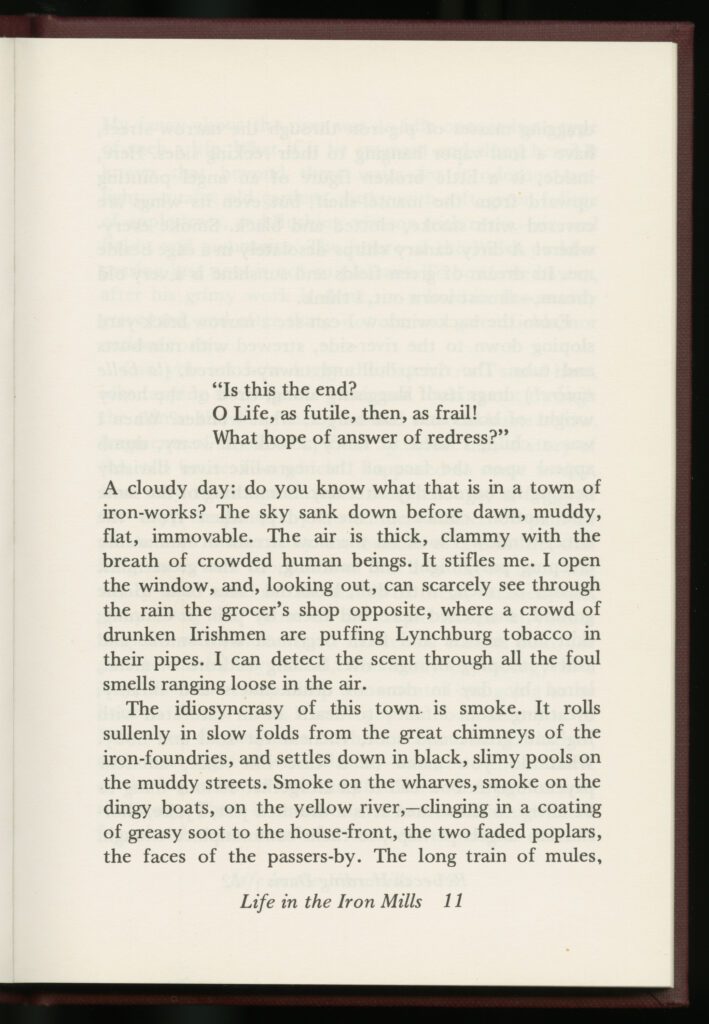
In 1861, Rebecca Harding Davis published “Life in the Iron Mills,” a fiction story, in The Atlantic. Davis published anonymously and was paid $50, a fine price at the time. The story depicts the lives of Welsh immigrant workers in an iron mill in the 1830s. Hugh is the main character, and readers follow him through the drudgery of his day. Hugh isn’t only an ironworker, though; he is also a sculptor. A group of wealthy society people walk through the mill and spot Hugh’s latest creation, remarking on its unparalleled artistic value. The story takes a turn for the worse when Hugh is wrongly accused of stealing from one of the wealthy men and is sentenced to die.
This story is one of the first instances of literary realism–an influential genre in the postwar era, employed most often to immerse readers in a lifelike environment. “Life in the Iron Mills” signals a shift in the interests of American readers. At this pivotal moment, the more lyrical and fantastical genre of Romanticism, which often dealt with the spiritual or the supernatural, begins to be displaced by stories that readers imagine are rooted in their world and lived experiences. In addition, that The Atlantic chose to publish Davis’ story in April 1861, the very same month that the American Civil War began, indicates that highbrow readers were interested in this kind of fiction even during a moment of national turmoil.
Ask Students
By contrast to the publicly available works printed in The Atlantic, Emily Dickinson’s work was little-known in her lifetime. During her life, Dickinson wrote 1,789 poems, many of which were a complete secret to even her closest friends and family. Dickinson “published” by sewing little books of poems together. She circulated some poems to family members and friends, like the abolitionist Thomas Wentworth Higginson, occasionally toying with the idea of formal publication. But she ultimately decided that her secret books–“fascicles”–were sufficient.
From 1858 until 1861, Dickinson produced on average about sixty-seven poems per year. But in 1862, Dickinson’s average number skyrocketed to 227. 1863 was her biggest year, with 295 poems. Her final period of extreme production was 1865, when she wrote 229 poems. In 1866, she dropped down to ten poems per year, and the average stayed low for the rest of her life.
We can attribute Dickinson’s great productivity to many factors, like more free time to spend writing, greater confidence, or even life events that inspired her to write more, like death and heartbreak. But 1861 to 1865 were fraught years not just for Dickinson, but for the United States. That she wrote hundreds of poems during the war suggests that it impacted her deeply. In addition, Dickinson was a great reader of a variety of publications, which kept her well-informed about the war and others’ opinions on it.
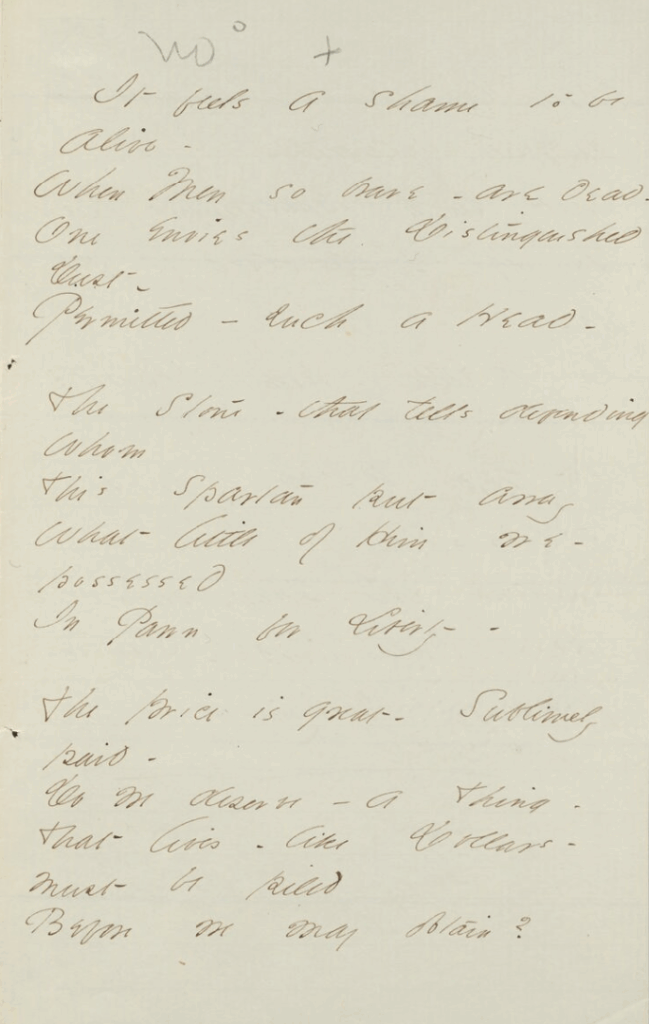
Dickinson’s private, but significant, contribution to the American literary scene during the war demonstrates that there are more ways than one to engage with large political events. Even though Dickinson was not directly involved in the war, as the majority of Americans were not, she still was touched deeply by it. For example, in her poem “It feels a shame to be alive,” Dickinson reflects on the deaths of those killed in battle from the perspective of those remaining at home. This poem is a useful example of the constructed martyrdom of Union soldiers and the feeling of relative disempowerment of those who could not take up arms.
It feels a shame to be Alive—
When Men so brave—are dead—
One envies the Distinguished Dust—
Permitted—such a Head—
The Stone—that tells defending Whom
This Spartan put away
What little of Him we—possessed
In Pawn for Liberty—
The price is great—Sublimely paid—
Do we deserve—a Thing—
That lives—like Dollars—must be piled
Before we may obtain?
Are we that wait—sufficient worth—
That such Enormous Pearl
As life—dissolved be—for Us—
In Battle’s—horrid Bowl?
It may be—a Renown to live—
I think the Man who die—
Those unsustained—Saviors—
Present Divinity—
Compared to a well-circulated author like Harriet Beecher Stowe, Dickinson’s ability to influence anyone’s opinions about the war was small. However, during the Civil War, there was a major increase in women’s participation in public life, due to new employment opportunities and the expectation that all Americans, regardless of gender, contribute to the war effort. Through Dickenson’s private compositions, we see the significance of the war for a woman whose public exposure was the opposite of Stowe’s. One example of their differences is how these documents look. While Stowe’s novel is widely distributed enough to warrant it being printed and includes illustrations, Dickinson’s work is handwritten.
Ask Students
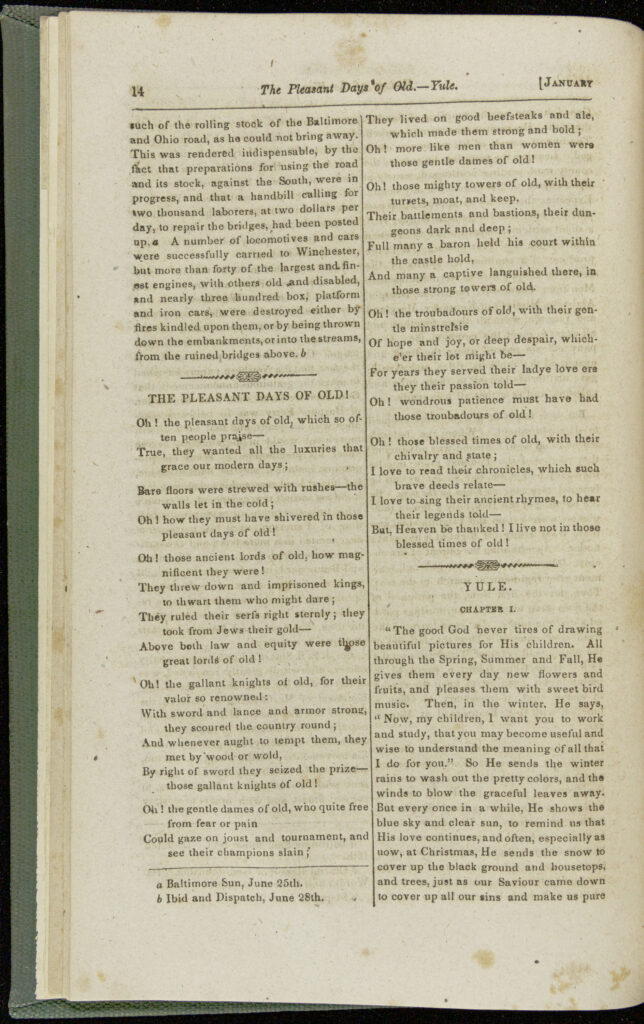
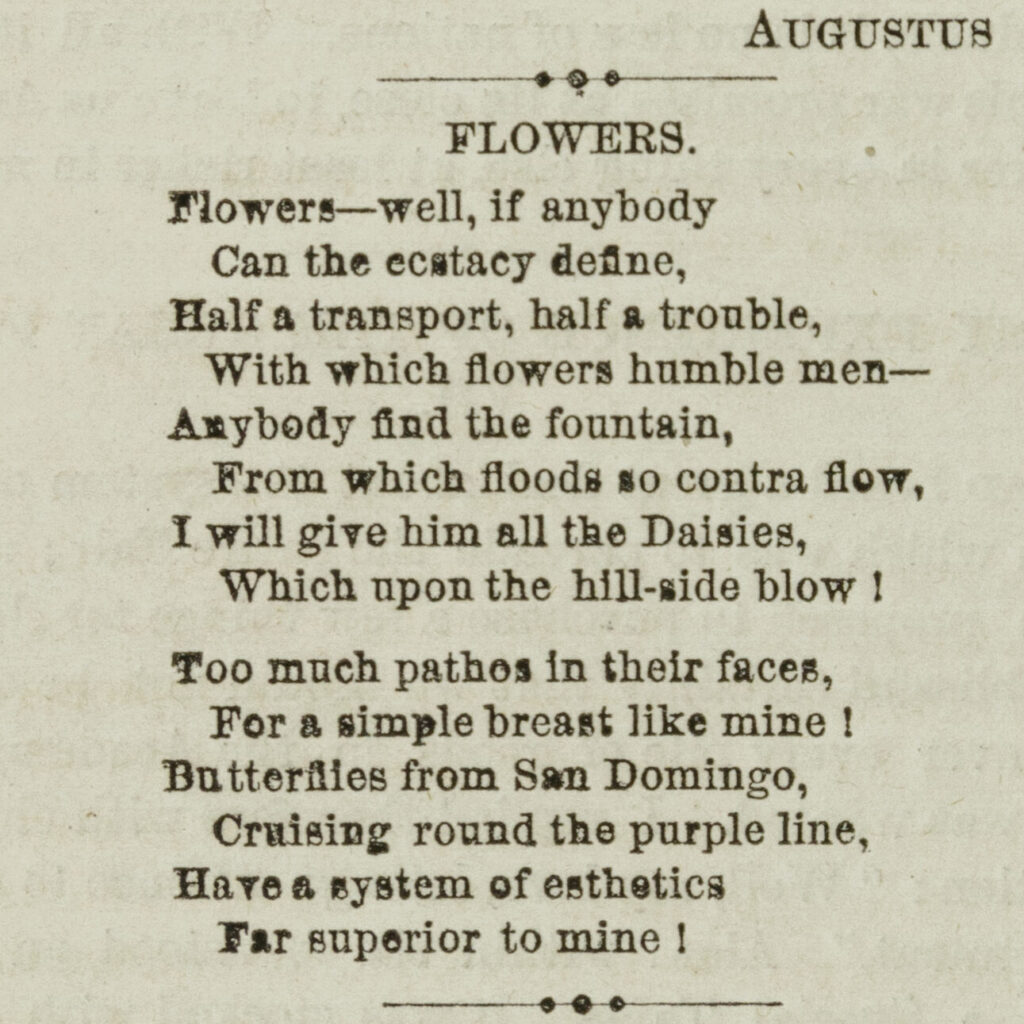
The Southern Literary Messenger was the primary prestige literary publication of the South before and during the Civil War. One might compare its goals to those of The Atlantic, the magazine that published Rebecca Harding Davis’ story. During the war, the magazine published a broad range of pieces, like serialized novels, poems, short stories, essays, excerpts from other magazines and newspapers, and advertisements for new books. Copies published from 1862 to 1864 opened with a “History of the War” series that gave an account of the war from its beginning until publication ceased in 1864. Magazines like this one pushed Southern authors to write about the war in a favorable way.
The Southern literary scene prior to the war was smaller than that of the North, though writers like Edgar Allan Poe influenced the marketplace broadly. Poe was a popular writer of fiction and poetry until his death in 1849 and briefly served as an editor for the Southern Literary Messenger. Even before the start of the war, certain books and tracts (political or religious pamphlets) were banned in Southern states, such as David Walker’s revolutionary 1829 Appeal. Mail was intercepted in fear that if any of these texts got into the hands of the enslaved, it would incite a rebellion.
The publication industry in the South suffered during the war. The Union’s naval blockade stopped the flow of supplies like paper and ink, and printers could be called to leave their posts and take up arms. In addition, General William T. Sherman targeted printing presses during his invasion of Georgia. As a result, the Southern publishing industry did not recover until the 1930s, when the South experienced a literary renaissance.
Ask Students
During the war, literature did not cease circulation. Women, elders, community leaders, and children read avidly on the home front. Soldiers also spent time reading newspapers, novels, letters from home, and the Bible. Newspapers contained important information about the war and the names of those who had died. They also featured creative works meant to entertain, educate, and sometimes fundraise.
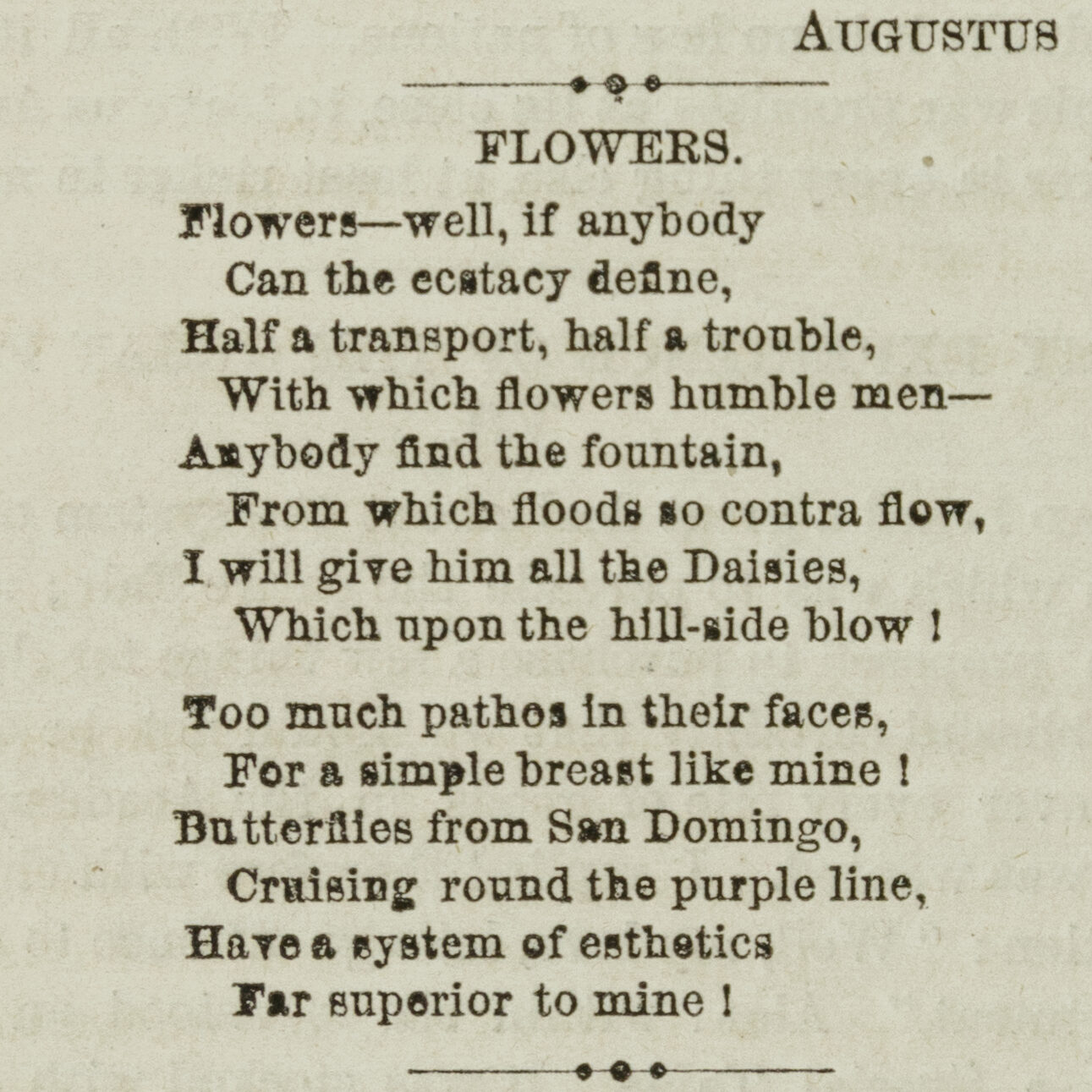
The United States Sanitary Commission published a newspaper entitled The Drum Beat to fundraise in the spring of 1864. Wartime field hospital conditions were unsanitary and doctors were ill-equipped, so the Sanitary Commission was founded to save the lives of wounded soldiers who might otherwise have died of illness. They were wildly successful at raising money, about twenty-five million dollars by 1865 (a little under $495.5 million in 2025 dollars). They spent the funds on improving army hospital facilities. Copies of The Drum Beat were sold cheaply at a “Sanitary Fair” in Brooklyn from February to March of 1864. Three anonymous poems in The Drum Beat have been identified as written by Emily Dickinson. Dickinson not only cared about the war, but she took an active part in fundraising for the Union.
Ask Students
The Black regiments of the Union army, the United States Colored Troops, were legendary at the time and still are. Many Black soldiers were formerly enslaved persons who, hearing about emancipation, walked off their plantations and directly onto Union military bases.
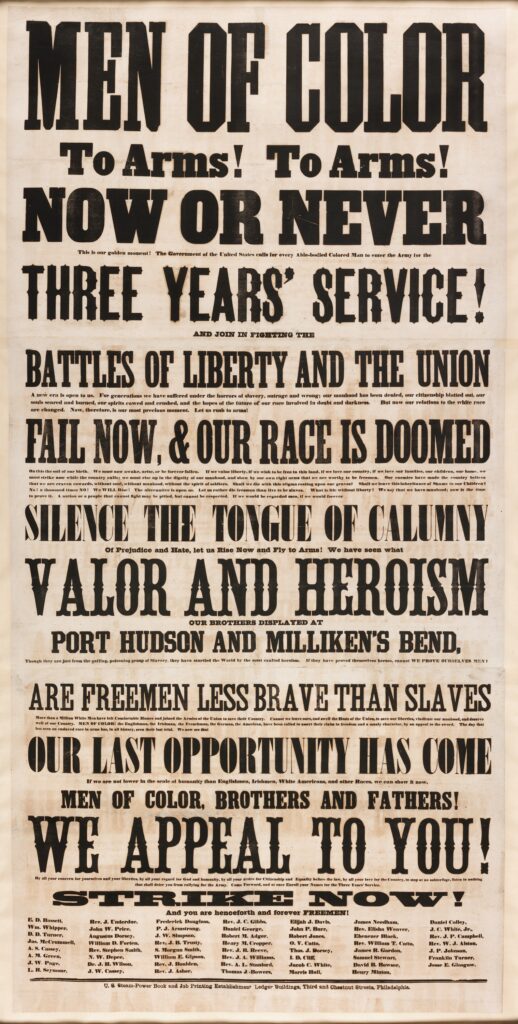
In the North, Black abolitionists capitalized on the fervor for emancipation and the ever-present desire for liberty to recruit Black soldiers for the Union. In 1863, after the Union belatedly authorized Black troops’ enlistment, a large party of prominent abolitionists, including Frederick Douglass, held a convention in Philadelphia that promoted the enlistment of Black troops.

Ask Students
After the convention, a broadside was circulated as a call-to-arms. A broadside is printed on one side of a sheet of paper, unlike a newspaper, which is printed on both sides. The broadsides would have been passed around and hung as posters.
In 1859, abolitionist John Brown, his three sons, and a group of nineteen other abolitionists conducted a raid on a federal armory at Harper’s Ferry, Virginia. Brown’s goal was to arm local enslaved people with the weapons he captured and incite an insurrection. Brown was captured and tried for treason instead, eventually being executed on December 2 of that year. The trial was the first in United States history to be covered in national newspapers, and so Brown’s legacy touched both the North and the South. Southern whites feared further rebellion; northerners were inspired by Brown and lauded him as a martyr. William Lloyd Garrison and Frederick Douglass both commented that Brown’s zeal and tenacity were admirable, and yet many political officials and Republican elites distanced themselves from Brown’s violence. In addition to heightening political tension, Brown’s raid also inspired literary adaptation and interpretation.
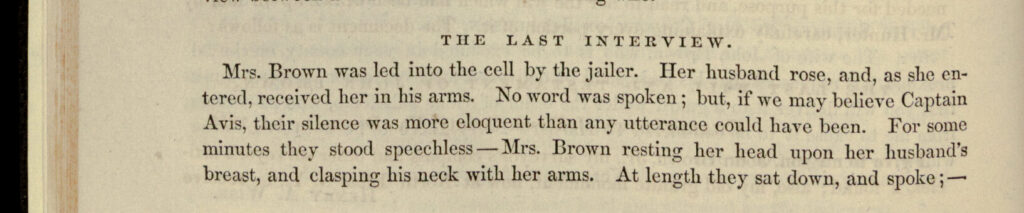
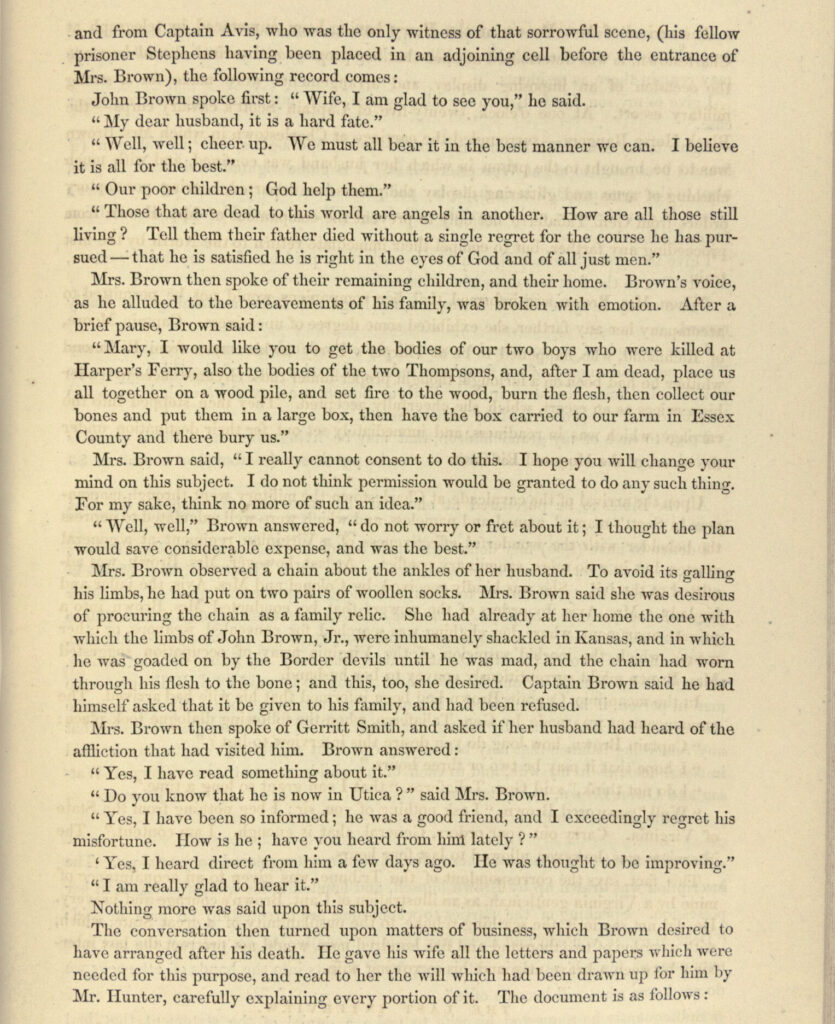
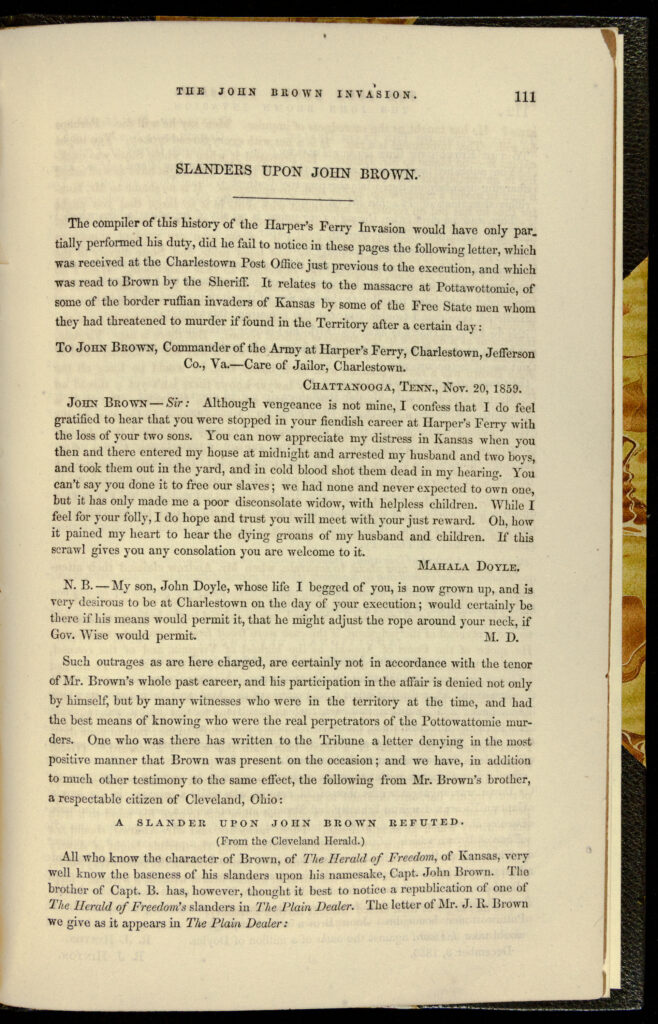
In 1860, Thomas Drew published a book entitled The John Brown Invasion; An Authentic History of the Harper’s Ferry Tragedy. The book attempts to give an objective account of the raid on Harper’s Ferry, the trial, Brown’s execution, and the repercussions of these events. Below are excerpts from the book, including the section in which Drew recounts Brown’s final meeting with his wife before his execution and the last pages of the book, in which Drew includes slander against Brown and refutes it.
Ask Students
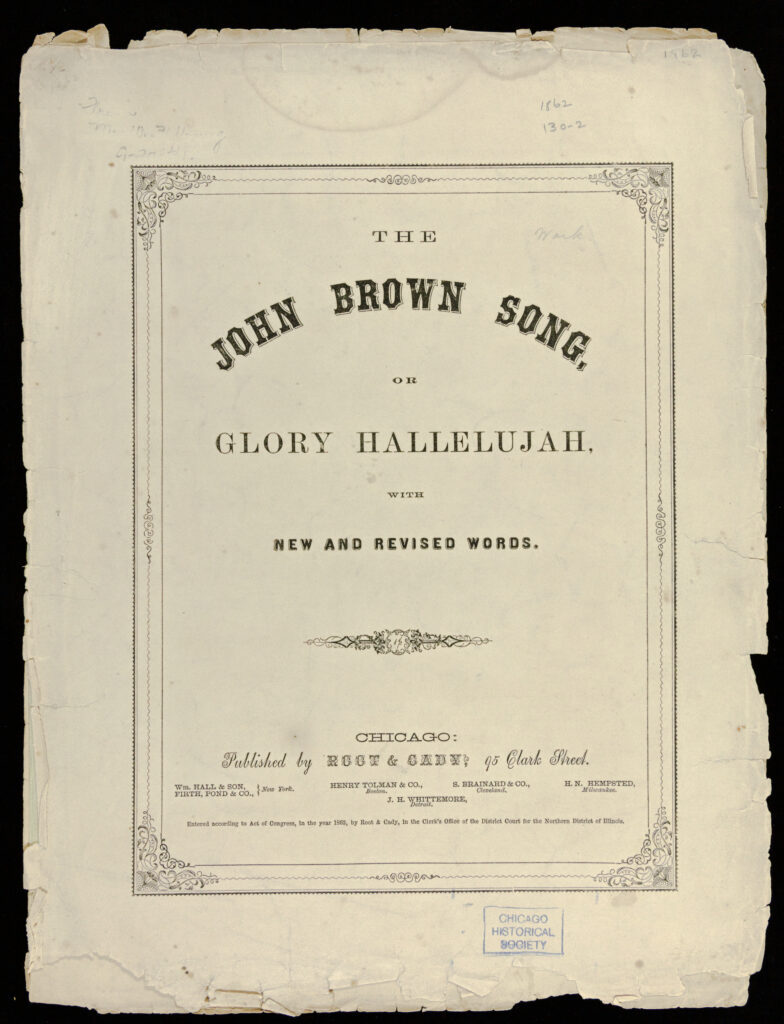
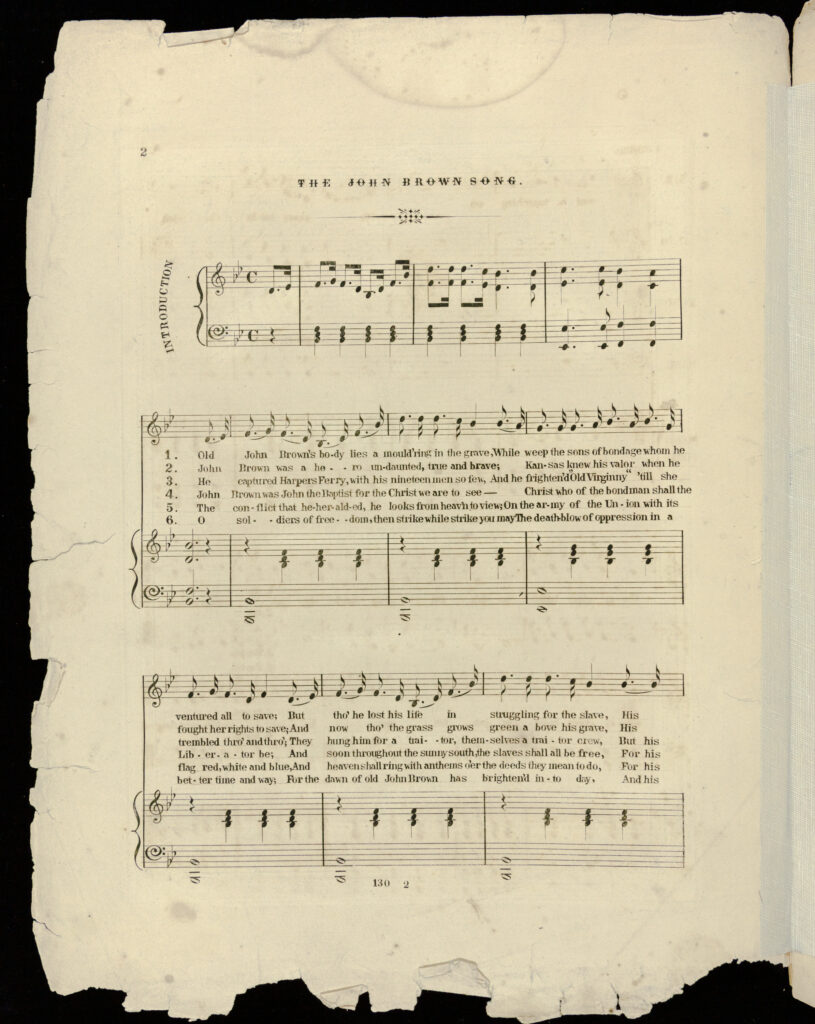
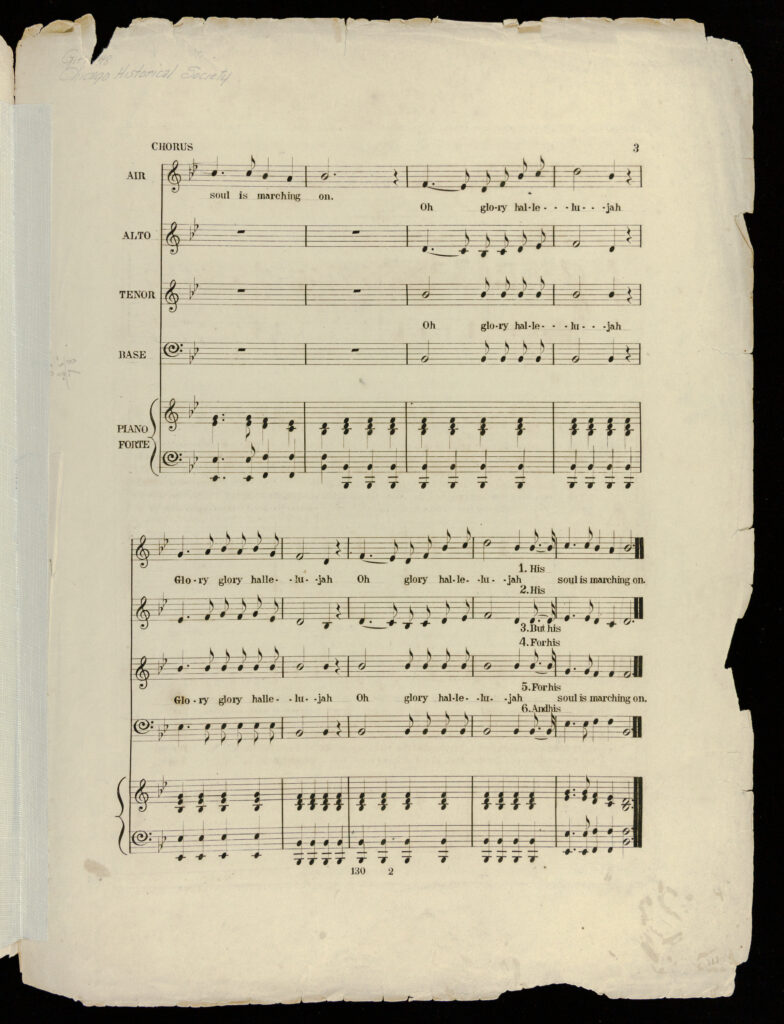
During the Civil War, the most popular marching song of the Union army was “John Brown’s Body,” which soldiers sang to the tune that would later be used for the “Battle Hymn of the Republic.” The song was reportedly heard nationwide, including in Boston, Virginia, prison camps in Georgia, and after the war in South Carolina, when it was sung in a parade by three thousand formerly enslaved children. The New York Tribune even circulated the lyrics to the song in July of 1861.
Ask Students
Narratives of enslavement, often called “slave narratives,” were the most popular genre of literature by Black authors just before the war. Other writers broke from the expectation that Black authors could only write personal narratives of enslavement and freedom, however, and wrote poetry, educational materials, and essays. Because enslaved people were banned from reading and writing, those who spent their lives in captivity were unlikely to encounter written poetry. Enslaved persons primarily engaged with poetry through oral culture, such as in song and storytelling. Many enslaved people were also literate and were avid writers.
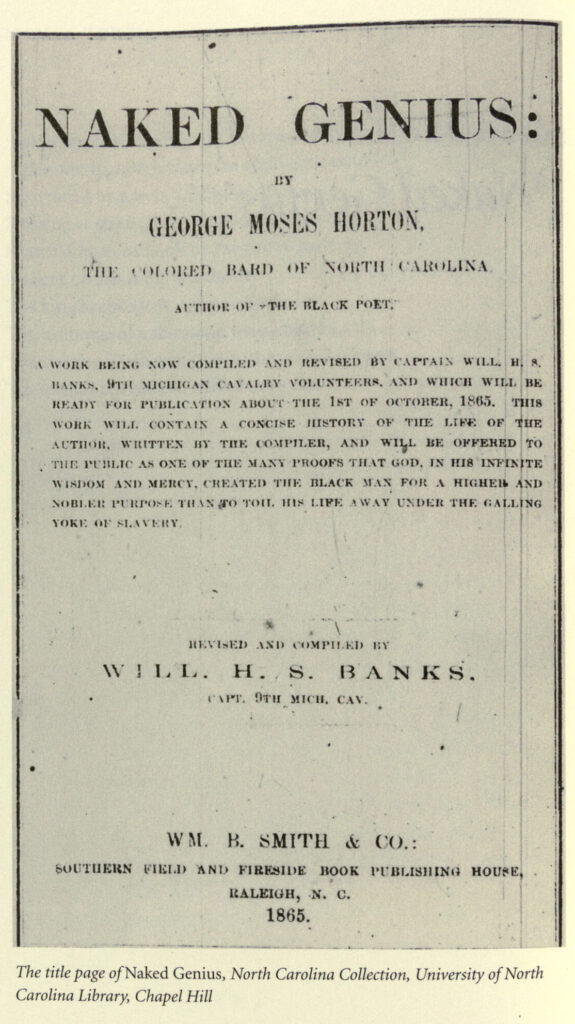
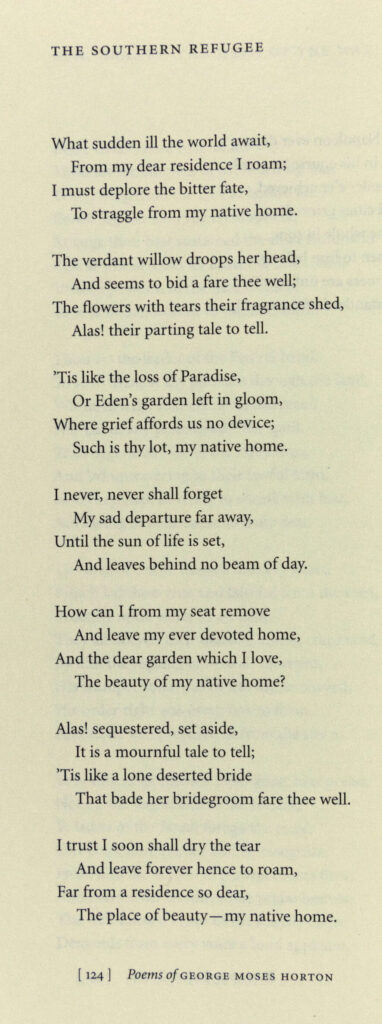
George Moses Horton wrote and published multiple volumes of poetry while enslaved. At first, Horton would recite his poems to a transcriber, who wrote them down. By 1829, Horton had gathered enough poems to publish in his first volume, which was the first book published by an African American writer in the South. Horton made enough money each week from writing poetry to buy his time from his enslaver and essentially worked full-time as a poet. He also ceaselessly appealed for his freedom, though he was not freed until the Civil War. Near the close of the war, Horton traveled to Raleigh, North Carolina with a Northern calvary and there published Naked Genius, his final volume. After the war, he relocated to Philadelphia and spent the rest of his life writing.
Ask Students
Also referred to as the “slave narrative,” this genre was extremely popular leading up to the Civil War. It generally consists of a story written or orated by a formerly enslaved person about what it was like to endure slavery, including sketches of enslaved people and their enslavers, the tale of the narrator’s escape and emancipation, and sometimes gaining literacy.
Narratives of enslavement were the most widespread genre of literature written by the formerly enslaved in the mid-nineteenth century. Even today when we talk about Black authors of the 1840s, 1850s, and 1860s, we tend to focus on Frederick Douglass’ Narrative (1845) and Harriet Jacobs’ Incidents in the Life of a Slave Girl (1861), rather than poets like George Horton or novelists like Harriet Wilson. Two reasons for this are that these books were well-circulated and key to the abolitionist movement. They had a massive impact and therefore remain iconic and fruitful subjects in literary studies.
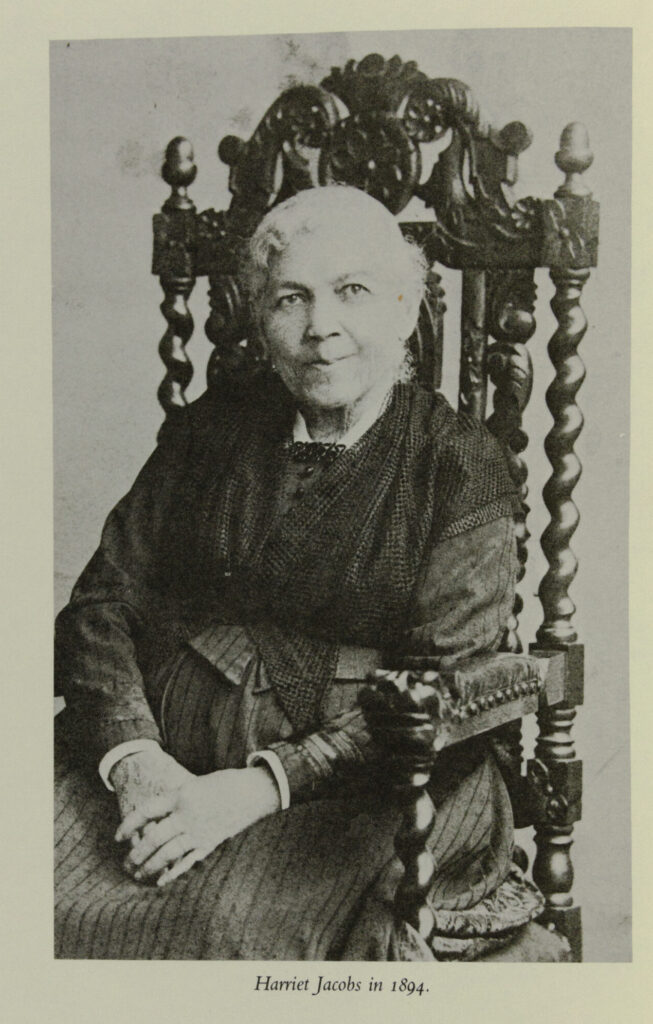
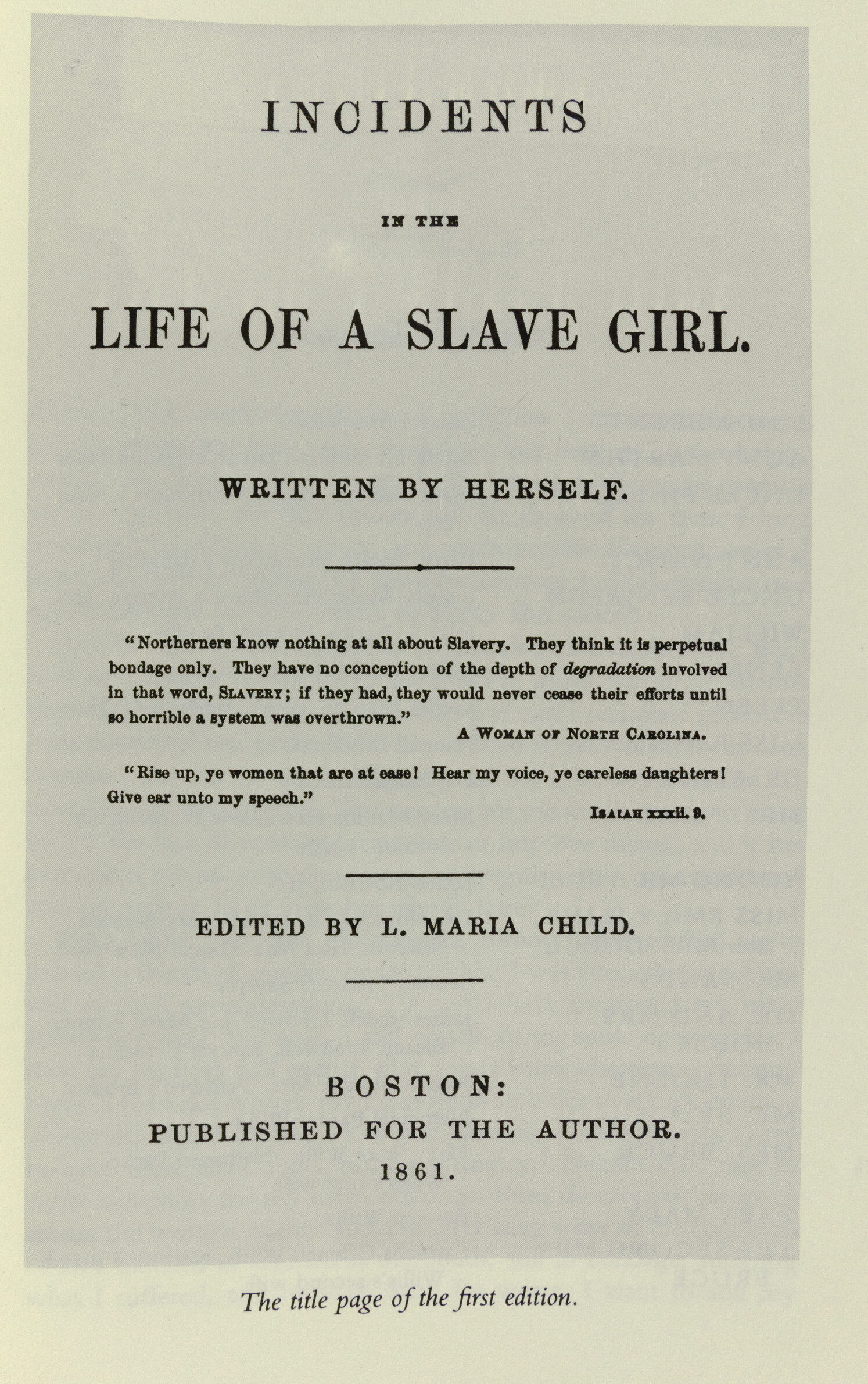
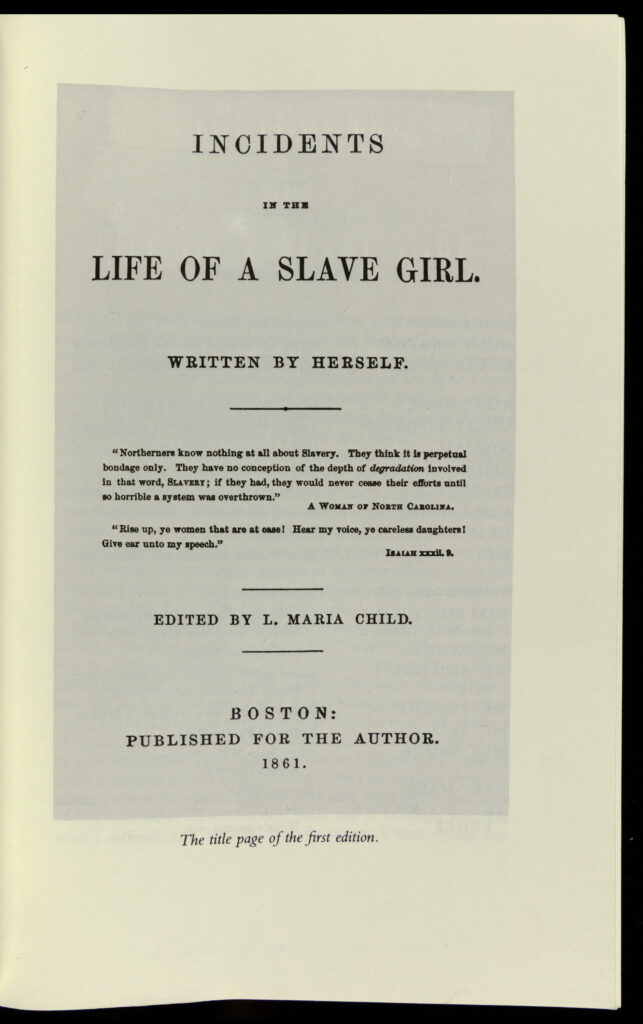
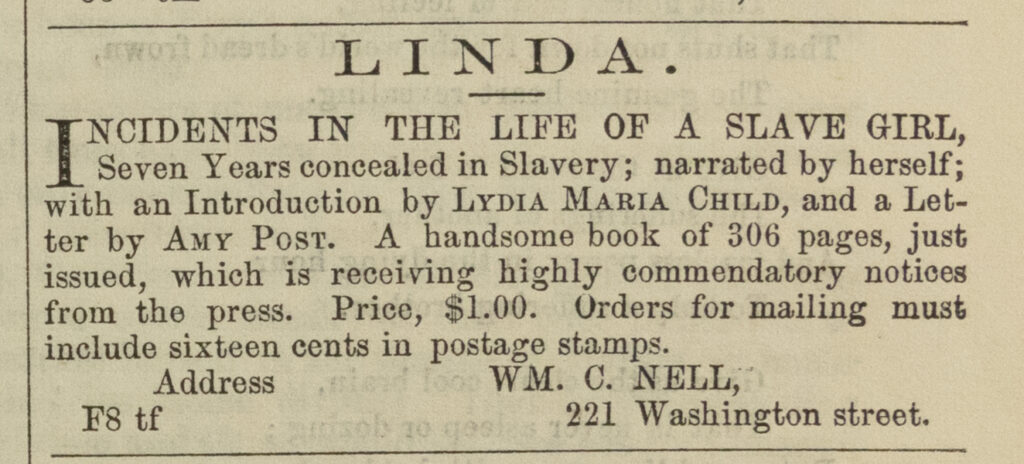
Harriet Jacobs is unequivocally recognized as the foremost female author of a narrative of enslavement. Her book Incidents is often discussed as the sister narrative of Douglass’, meaning that it is contains similar formal elements of the narrative of enslavement, yet more expressly covers the experience of female enslavement. In particular, Jacobs discusses sexual assault as an inherent aspect of slavery for enslaved women. Her story centers around the character Linda, a fictionalized version of herself, who hides in her grandmother’s attic for seven years to avoid sexual predation by her married master, Dr. Flint, who was thirty-five years older than her and unrelenting in his threats.
Jacobs first tried to publish her story in 1858. She had difficulty locating a printer but eventually self-published in 1861. Her book was well-received, selling a fair number of copies in the United States and earning an imprint in England. By the twentieth century, though, her book was forgotten, in part because she published it anonymously. It was only rediscovered in the 1980s, when scholar Jean Fagan Yellin proved that Harriet Jacobs was the author through census records and archived correspondence.
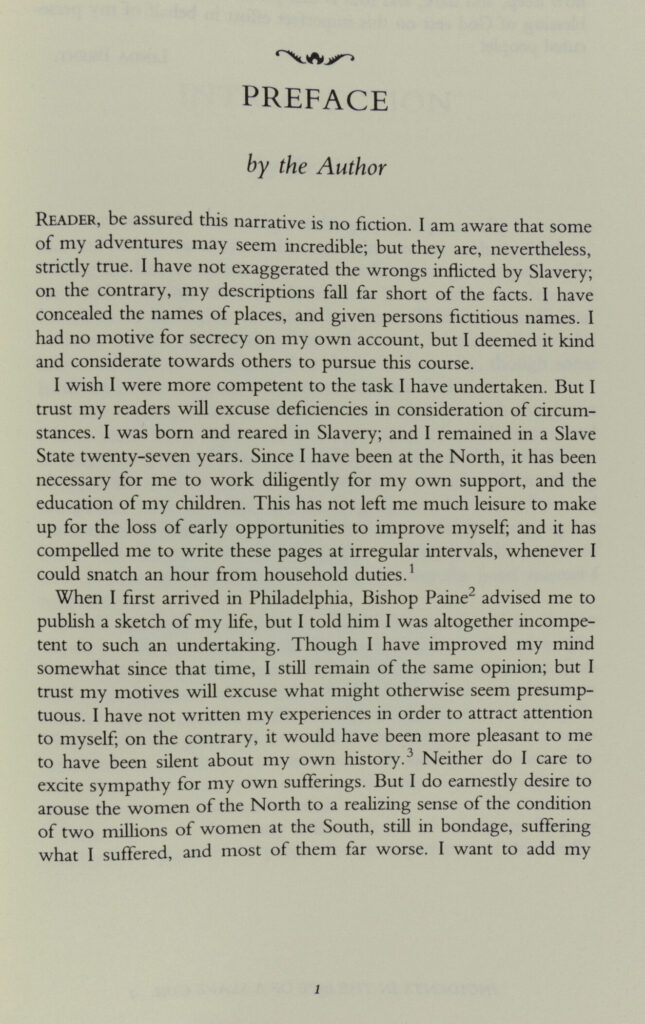
For many narratives of enslavement, authors include an authenticating document, which conveys to readers that the author is trustworthy and the events are verified. A formerly enslaved author might include letters written by people who knew her while she was enslaved, or letters from editors who worked closely with her and attest to her character. The authenticating document is a troubling feature of narratives of enslavement because it indicates a fundamental distrust of stories about slavery. In general, authenticating documents indicated that the story being told was truth, rather than fictional, and that the author was a reliable storyteller. However, in some cases, the document fueled further confusion about the author. For example, before Jacobs was identified as the author of her story, many believed that the true author was Lydia Maria Child, who wrote one of the book’s authenticating documents. In this instance, the document provided doubt regarding the truth of the story because Harriet Jacobs’ identity had not been identified.
In an additional example, see Harriet Wilson’s “Preface” above, where she justifies her relationship to her narrative and to writing more generally. In addition, Wilson’s book includes an extensive appendix in which friends and editors include a “few words in her [sic] behalf,” in other words, vouch for her character. In Harriet Jacobs’ case, she includes a preface written by herself as part of her authenticating documents. Pay special attention to the language Jacobs uses when discussing her own merit as an author and her methods of writing, as well as her assessment of the final product.
Ask Students
Ask Students
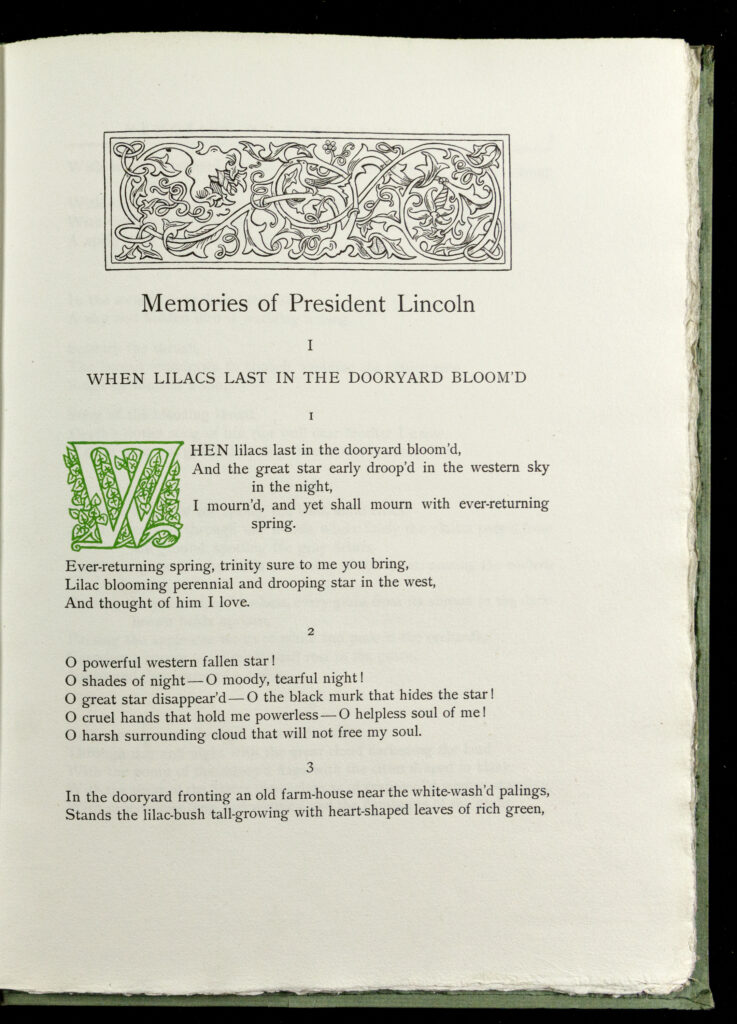
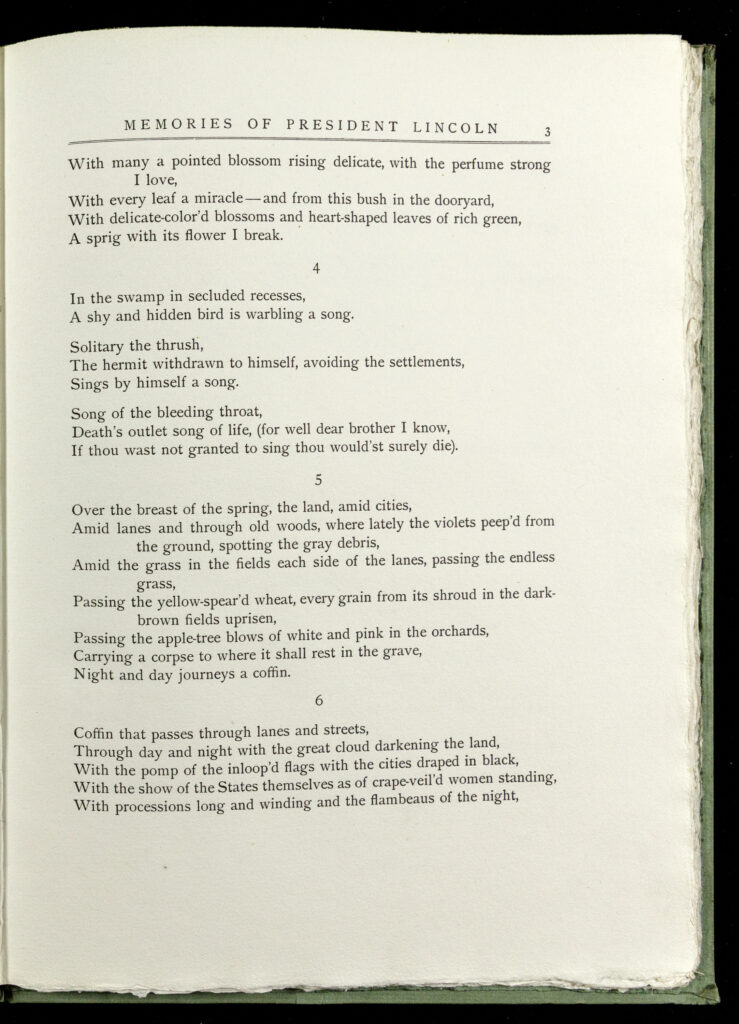
Walt Whitman, one of the most famous poets of the nineteenth century, was filled with grief at President Abraham Lincoln’s passing. He wrote the famous poem, “O Captain! My Captain” to commemorate Lincoln’s death. Another of his masterpieces is “When Lilacs Last in the Dooryard Bloom’d,” which explores the nation’s loss and, self-consciously, Whitman’s own attempts to memorialize that loss. Whitman uses the symbols of the star, lilacs, and the hermit thrush to triangulate his relationship with Lincoln’s death, the passages of time, and his role as a poet attempting to capture the impact of this historical moment.
Ask Students
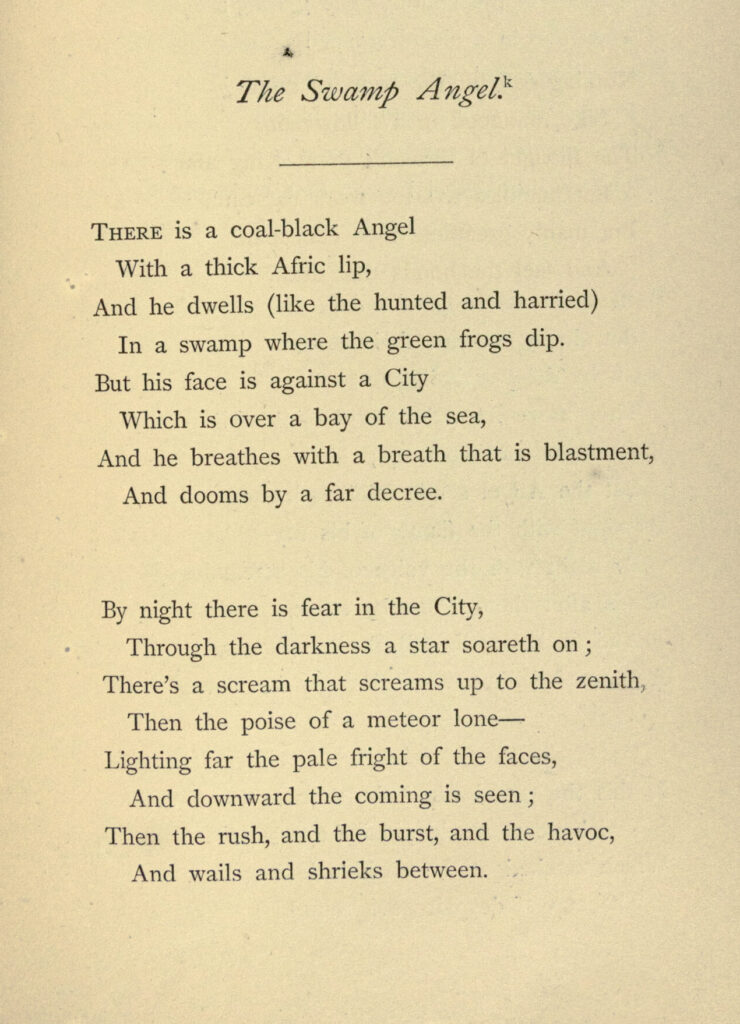
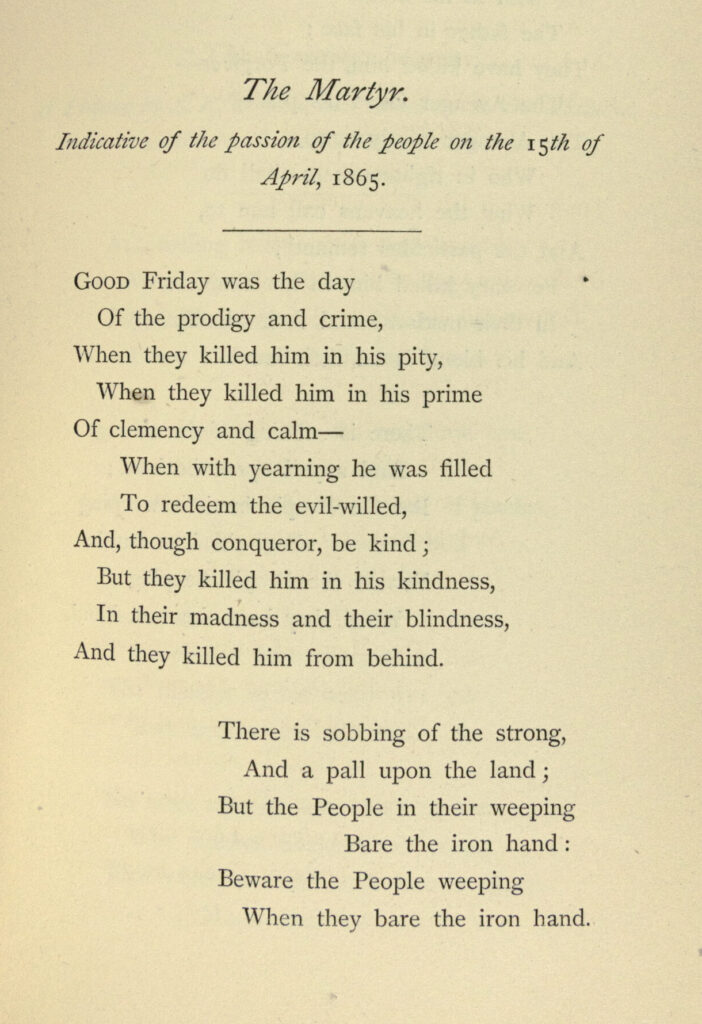
Herman Melville, now known for writing Moby-Dick; or, The White Whale (1851), had early literary success, but his popularity diminished as his books became more complex. During the Civil War, Melville searched for different ways to become involved in the war effort, including offering his services to the Union’s navy. He never took up a naval post. Melville did spend the majority of the war crafting poems about it, however, and Battle-Pieces was one of his final major published works in his lifetime. In the collection, written between 1859 and 1866, Melville used primary sources like newspapers and war reports to illustrate and frame battles and other aspects of the war. For example, in “The Swamp Angel,” Melville employs the metaphor of the angel to stand in for a particular kind of gun used by the Union in 1863 at Charleston, South Carolina. In addition, Melville was struck by the level of nation-wide grief he witnessed after Lincoln’s assassination. “The Martyr” is an exploration of Lincoln’s death, but even more so a demonstration of the significance of Americans’ reactions to it.
Ask Students
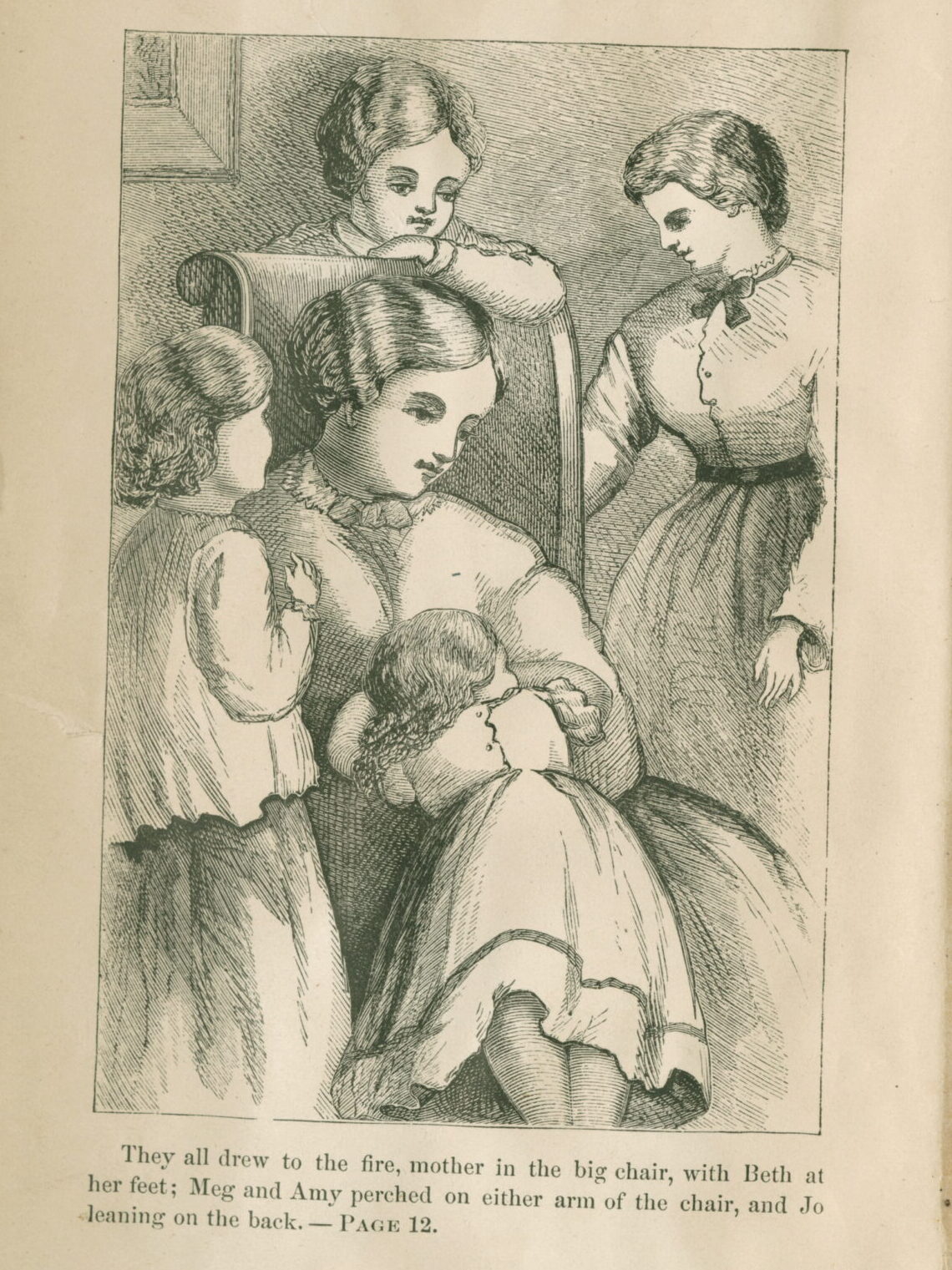
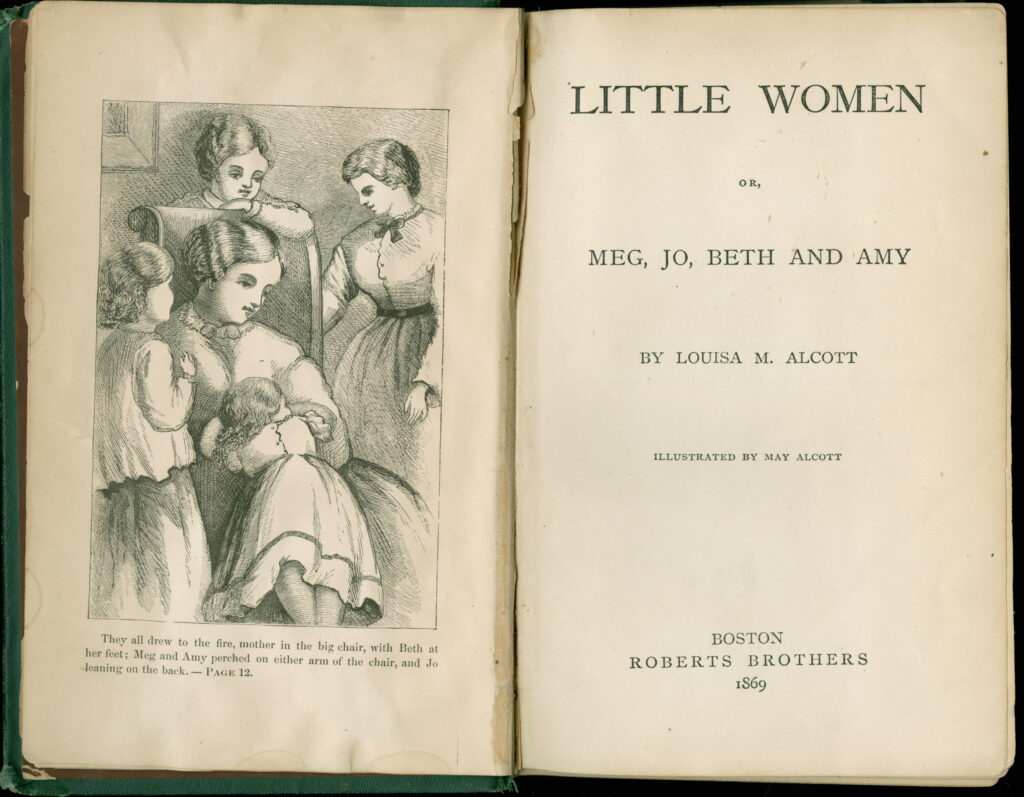
In the years following the Civil War, Louisa May Alcott wrote and published her book, Little Women, which was a bestseller of the nineteenth century. Published across two volumes in 1868 and 1869, Alcott weaves together the stories of four sisters before, during, and after the Civil War. Little Women depicts how women and girls grappled with the Civil War–simultaneously showing what life was like in the North, how they dealt psychologically with the fear and anxieties of the war, and how they carved out independence without male influence getting in the way.
Ask Students
Michaela Corning-Myers is a PhD Candidate in the Department of English at Northwestern University. Her work centers on the interconnection of mid-nineteenth century texts and naturalist novels published in the 1890s and beyond. Her dissertation, “The Age of Affliction: Illness, Disability, Gender, and Race in American Literary Naturalism” argues that the key traits of the genre of naturalism are rooted in mid-nineteenth-century texts, like narratives of enslavement. In particular, attunement to ill and disabled bodies in texts of the 1850s and 1860s prefigures later explorations of the afflicted body in texts written by Edith Wharton, Willa Cather, and Ann Petry, especially through the embodied experiences of race and gender.
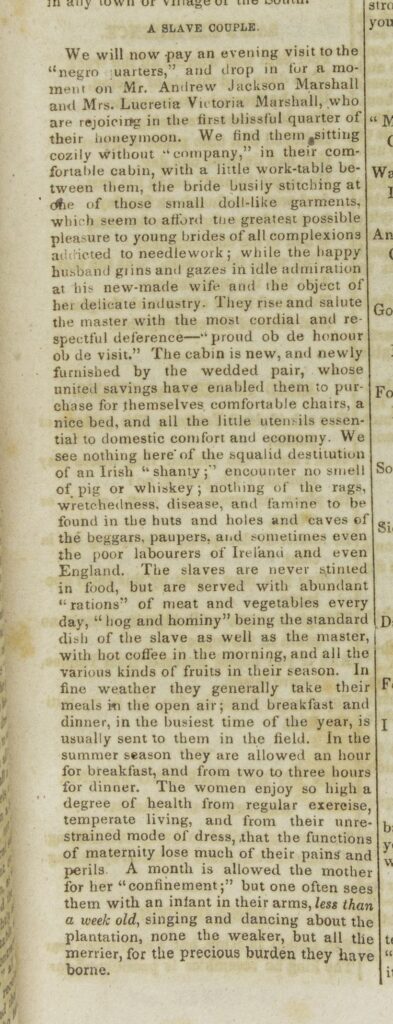
To understand the literature published during the war, it is vital to examine the radical abolitionist literature that circulated in the years leading up to it. These include newspapers, journals, tracts (small pamphlets), and books. Below are excerpts from William Llyod Garrison’s The Liberator, Frederick Douglass’ Frederick Douglass’ Paper, Harriet Beecher Stowe’s Uncle Tom’s Cabin, and Harriet Wilson’s Our Nig: or, Sketches from the Life of a Free Black.
Printing presses in the North and South kept publishing during the war. In addition to war-related material, they published everything from cheap newspapers to literary journals. Below is a cross-section of that kind of material: “Life in the Iron Mills” published in the prestige journal The Atlantic, Emily Dickinson’s private publications about the war, and examples from a Sothern literary journal.
Soldiers, civilians, and politicians all wrote about the war as it unfolded. Below are a poem published in a newspaper fundraising for the Sanitary Commission, two documents encouraging Black men to enlist in the Union Army, selections from a book posthumously defending John Brown, and the music and lyrics of “The John Brown Song, Or, Glory Hallelujah.”
While the so-called “slave narrative” or narrative of enslavement was the most well-known type of text by Black authors before and during the Civil War, they also wrote poetry and composed texts and songs orally. This section includes an example of George Moses Horton’s poetry and excerpts from Harriet Jacob’s Incidents in the Life of a Slave Girl.
The texts in this section by Walt Whitman, Herman Melville, and Louisa May Alcott demonstrate different responses to the Civil War in its immediate aftermath. These authors discuss the war’s violence, Lincoln’s assassination, and the war changed the lives of women and girls in the North.
Dickinson, Emily. Emily Dickinson’s Poems : As She Preserved Them / Edited by Cristanne Miller. Ed. by Cristanne Miller. 2016.
Horton, George Moses, and Joan R Sherman. The Black Bard of North Carolina : George Moses Horton and His Poetry / Edited by Joan R. Sherman. 1997.
Jacobs, Harriet A. (Harriet Ann), Lydia Maria Child, and Jean Fagan Yellin. Incidents in the Life of a Slave Girl : Written by Herself / by Harriet A. Jacobs ; Edited by L. Maria Child ; Edited and with an Introduction by Jean Fagan Yellin. 1987
Melville, Herman, and Hennig Cohen. The Battle-Pieces of Herman Melville / Edited with Introduction and Notes by Hennig Cohen. 1963.
Ripley, C. Peter. The Black Abolitionist Papers: Vol. III: The United States, 1830–1846. 1991.
Whitman, Walt. Drum Taps . 1865.
Whitman, Walt and Richard Maurice Bucke. The Wound Dresser : A Series of Letters Written from the Hospitals in Washington during the War of the Rebellion / by Walt Whitman ; Edited by Richard Maurice Bucke. 1898.
Allukian, Kristin. Slavery, Capitalism, and Women’s Literature : Economic Insights of American Women Writers, 1852-1869 . Print.
Cutrer, Thomas. “Popular Literature during the Civil War.” Encyclopedia Virginia, 5 Feb. 2021.
Belasco, Susan. Stowe in Her Own Time : A Biographical Chronicle of Her Life, Drawn from Recollections, Interviews, and Memoirs by Family, Friends, and Associates. 2009.
Clark, Beverly Lyon. The Afterlife of Little Women. 2014.
“From the Stacks… Three Early Dickinson Publications.” Modern Books and Manuscripts, Harvard University Houghton Library, 3 June 2009.
Gardner, Eric. “‘This Attempt of Their Sister’: Harriet Wilson’s Our Nig from Printer to Readers,” The New England Quarterly 66, Volume 2 (1993): 226–246.
Garfield, Deborah M, and Rafia Zafar. Harriet Jacobs and Incidents in the Life of a Slave Girl : New Critical Essays / Edited by Deborah M. Garfield, Rafia Zafar. 1996.
Habegger, Alfred. My Wars Are Laid Away in Books : The Life of Emily Dickinson. 2001.
Jackson, Virginia. Dickinson’s Misery: A Theory of Lyric Reading. 2005.
Petruzzello, Melissa. “The North Star,” Encyclopedia Britannica, 11 November 2016.
Quinn, Katrina J. and David B. Sachsman, editors. The Civil War Soldier and the Press. 2023.
Reynolds, David S. John Brown, Abolitionist : The Man Who Killed Slavery, Sparked the Civil War, and Seeded Civil Rights. 2005.
Stauffer, John, and Benjamin Soskis. The Battle Hymn of the Republic : A Biography of the Song That Marches On . 2013.
Weiss, Shira Wolosky. Emily Dickinson : A Voice of War. 1984.
Downs, Gregory P. After Appomattox: Military Occupation and the Ends of War. 2019.
Leonard, Elizabeth D. Men of Color to Arms! : Black Soldiers, Indian Wars, and the Quest for Equality . Print.
Willis, Deborah. The Black Civil War Soldier : A Visual History of Conflict and Citizenship . 2021.