

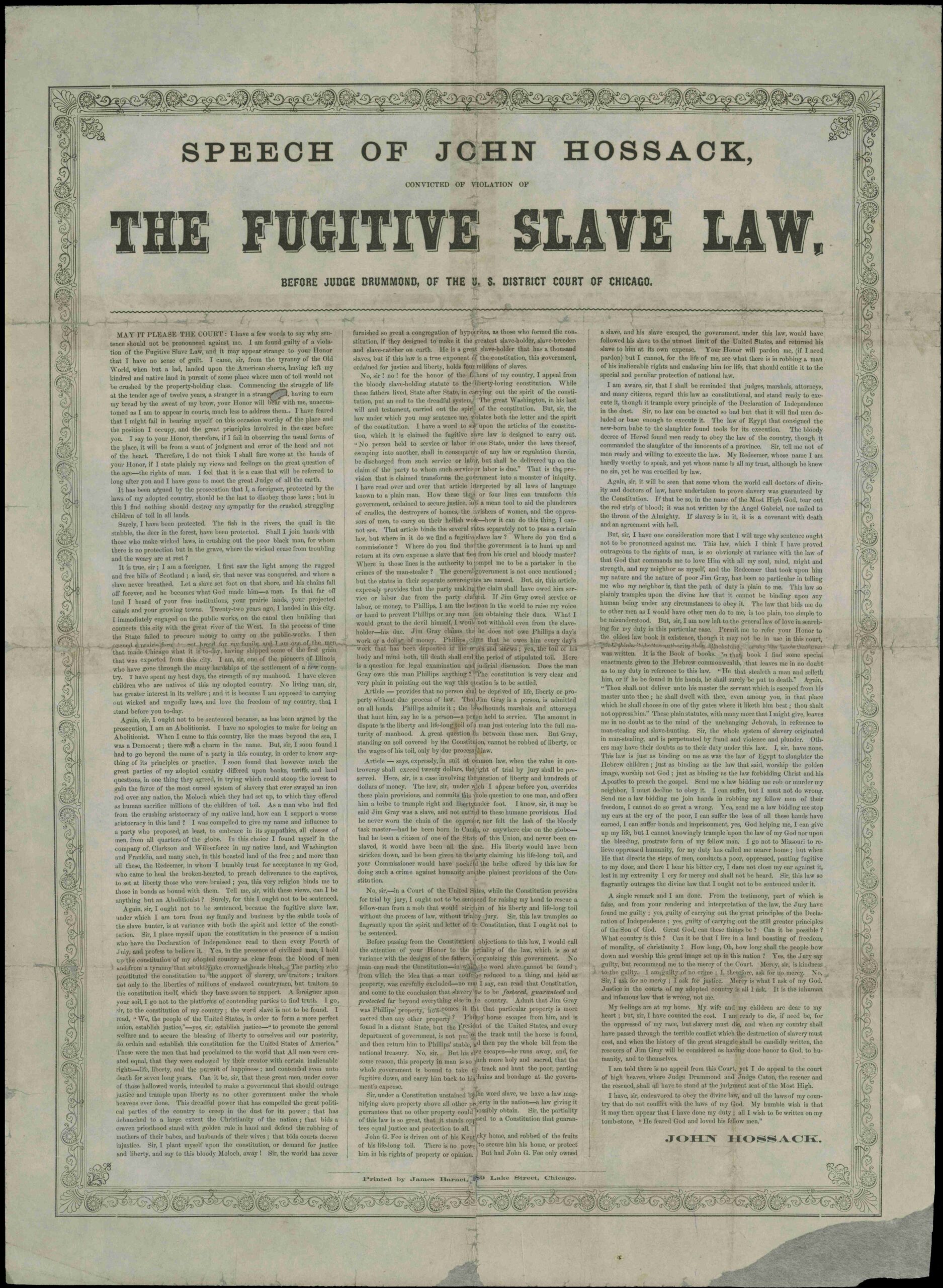
Speech given by John Hossack at his sentencing for violating the Fugitive Slave Law.

John Hossack’s Speech on the Fugitive Slave Law

Themes
Black History
Illinois History
Resistance to Slavery

Periods & Events
19th Century
Antebellum Period
Fugitive Slave Law (1850)

Skills & Document Types
Textual Analysis
Broadsides
Speeches

Overview & Instructional Use

In this activity for middle school, students will read an excerpt from a speech given by John Hossack, a Scottish immigrant and abolitionist, after he was convicted of violating the Fugitive Slave Law by aiding Jim Gray, a man escaping slavery.

It can be used:

  • To practice textual analysis in a history curriculum.
  • As an introduction to the effects of the Fugitive Slave Law in the North.
  • As part of a discussion on abolitionism, principled resistance to laws, and loyalty to the Constitution.
Materials

Procedure

Speech given by John Hossack at his sentencing for violating the Fugitive Slave Law.
Speech of John Hossack (1860)
  1. Read: Display or distribute the excerpt of John Hossack’s speech. Have students read the excerpt, discussing unfamiliar words and phrases. Introduce the words to know below as needed.
  2. Analyze: Use the questions below to help students pull out information about Hossack’s beliefs about Christianity, loyalty to the Constitution, and the nature of just government.
  3. Bring in the background information below when it is most relevant to students.
Process
Step 1: Read
  1. Display or distribute the excerpt.
  2. Explain to students that Hossack had been found guilty of violating the Fugitive Slave Law by helping Jim Gray, a formerly enslaved man, escape from slavecatchers. Reference the background information below as needed.
  3. Have students read the excerpt and discuss unfamiliar words and phrases, using the words to know as desired.
Words to Know
  • Abolitionist | one who wants to abolish or end slavery
  • Aristocracy | nobility; the rich and privileged class in a society
  • Deliverance | the act of being rescued or set free
  • Endowed | to be given a quality, ability, or asset
  • Hallowed | honored as holy or sacred
  • Inalienable | nonnegotiable; unable to be taken away
  • Redeemer | another name for Jesus 
  • Variance | the quality of being different or inconsistent
Step 2: Analyze
  1. Distribute the student worksheet or other place for students to record observations.
  2. Come together as a class or in small groups to discuss questions like those below.
Potential Questions
  • What kind of document is this? (a speech given in court) 
  • Is it a primary or secondary source? How do you know? (primary; it is a first-hand account) 
  • Where is John Hossack from, and where does he live now? (from Scotland and now lives in the United States, Chicago area) 
  • In the first paragraph, how does Hossack describe the Fugitive Slave Law? (“wicked and ungodly”) 
  • How does Hossack use his personal experience as an immigrant in support of his cause? (He refers to the “the crushing aristocracy of my native land” as something that taught him to love freedom and forces him to oppose the “worse aristocracy” of slavery in the US.)
  • How does Hossack appeal to Christianity in support of his cause? (He refers to being in the company of the Redeemer who would free the enslaved and states his religion binds him to those in bonds, meaning he and the enslaved are entwined through Christian beliefs, and that freeing them is a religious duty.) 
  • How does Hossack appeal to the Founding Fathers and documents in support of his cause? (He refers to the Declaration of Independence saying all men are created equal and the Constitution’s lack of the word “slave” to support his argument.) 
  • What does Hossack think about the supporters of slavery? (They are traitors to the Constitution.) 
  • What impact does the writer believe the institution of slavery has on the government? (It creates a government that is unjust and limits the freedom promised by the Founding Fathers.) 

Background

The Fugitive Slave Act was passed on September 18, 1850, requiring non-slave states and their citizens to return freedom seekers to their enslavers, thus expanding slavery to the entire nation. Many citizens of non-slave states were angry the law would force them to participate in the institution of slavery against their will. Free people of color feared for their own safety, as well as the safety of their friends and families because they could be forced into slavery by slave-catchers from the South regardless of their papers proving their free status. 

Resistance to the institution of slavery was common in Illinois, starting with the formation of multiple abolitionist societies in the 1830s. Despite Illinois being a free state, counter-resistance to abolition was common as well, as in the case of printer Elijah Lovejoy, whose abolitionist views prompted the destruction of his printing press three times and ultimately ended in his death at the hands of a mob in Alton, Illinois in 1838.  

The Fugitive Slave Law provoked profound organized resistance in Chicago. Chicago was a city with a large abolitionist presence, and many of her citizens vehemently opposed the law, seeing it as an infringement on personal freedom and a moral abomination.  Resistance via the Underground Railroad increased in the Chicago area as residents were compelled to observe and participate in the capture of freedom seekers as required by the new law. The city’s proximity to both Canada and other free states, made it an essential nexus for both resistance and the safe passage of fugitives seeking freedom.  

Many Scottish immigrants, particularly those with religious beliefs like John Hossack, viewed slavery as morally wrong and actively protested against it. In particular, the Reformed Presbyterian Church, made mostly of Scots-Irish immigrants, opposed slavery and supported the Underground Railroad in the Chicago area. In 1860, Hossack, an abolitionist leader and grain merchant from nearby Ottawa, Illinois, was jailed and fined for his major role in helping freedom seeker Jim Gray escape from United States Marshalls by the Chicago courthouse. Hossack’s home, an essential station on the Underground Railroad, still stands in Ottawa today. 

More background can be found in the following essay: The Anti-Slavery Movement in Chicago and Illinois. 

About the Author

Illinois Social Science Standards

This lesson supports the following standards from the Illinois Learning Standards for Social Science:

Evaluating Sources and Using Evidence
  • SS.6-8.IS.2.LC: Determine the value of sources by evaluating their relevance and intended use.
Civics
  • SS.6-8.CV.2.LC: Describe the origins and purposes and impact of governing documents and policies (e.g. the US Constitution, Illinois Constitution, laws, treaties, and international agreements) and synthesize their application and impacts on multiple groups of people with how they have changed over time.
  • SS.6-8.CV.1.MC: Evaluate the powers and responsibilities of individuals, political parties, interest groups, and the media; how these have changed over time; and the impacts on multiple communities
History
  • SS.6-8.H.2.MdC: Analyze and compare multiple factors that influenced the perspectives of multiple groups of people during different historical eras relevant to the cultural groups.  
  • SS.6-8.H.3.MdC: Detect possible biases and limitations in the historical record based on evidence collected from different kinds of historical sources by identifying the author, purpose, funding/source, type of publication, outlet, intended audience, etc.  

Common Core

This lesson supports the following Common Core Literacy in History/Social Science standards:

English Language Arts: History/Social Studies
  • CCSS.ELA-Literacy.RH.6-8.1: Cite specific textual evidence to support analysis of primary and secondary sources. 
  • CCSS.ELA-Literacy.RH-6-8.2: Determine the central ideas of information of a primary or secondary source; provide an accurate summary of the source distinct from prior knowledge or opinions.  

The College, Career, and Civic Life (C3) Framework

This lesson supports the following C3 Framework standards:

Dimension 2, Civics
  • D2.Civ.13.6-8: Analyze the purposes, implementation, and consequences of public policies in multiple settings.  
Dimension 2, History
  • D2.His.4.6-8: Analyze multiple factors that influenced the perspectives of people during different historical eras.  
  • D2.His.13.6-8: Evaluate the relevancy and utility of a historical source based on information such as maker, date, place of origin, intended audience, and purpose.  
Dimension 3
  • D3.2.6-8: Evaluate the credibility of a source by determining its relevance and intended use.