

Using the life stories of three exemplary Jewish immigrants—Abraham Bisno, Philip Bregstone, and Hilda Satt Polacheck—this essay explores major events and institutions that shaped Jewish immigrant life in Chicago during the turn of the twentieth century, including the Haymarket Affair, the garment industry, Maxwell Street and the Jewish “ghetto,” Hull House, and the labor movement. In tracing these intertwined threads, it shows how Jewish immigrants from Eastern Europe crafted identities as Jews, workers, Americans, and Chicagoans while contributing to the city’s history, culture, and politics.
Ask Students
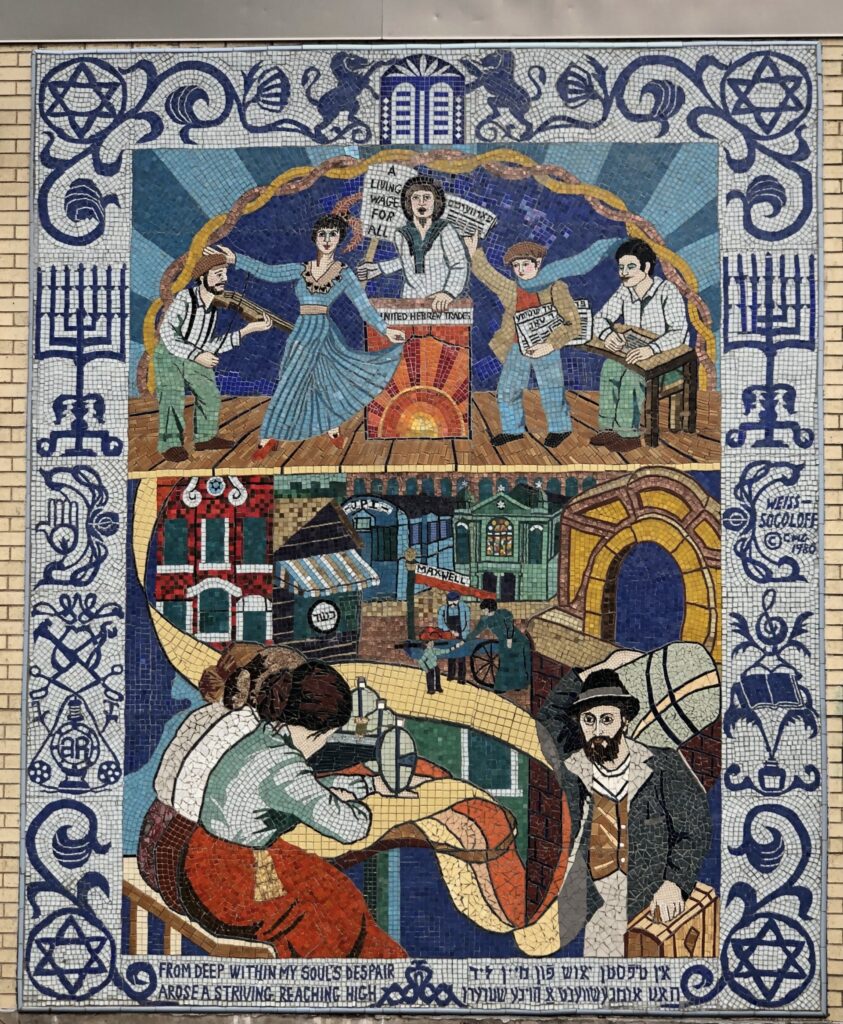
In September 2020, as the Covid-19 Pandemic raged, artists Cynthia Weiss and Miriam Socoloff met in West Rogers Park on Chicago’s far North Side to restore a mural that they had created together forty years earlier. Entitled “Fabric of Our Lives,” the mural—a colorful mosaic that depicts scenes from Chicago’s Jewish history—adorns an outer wall of the Bernard Horwich Community Center, one of many Jewish institutions in this part of the city.
In the center of the mural’s top half, a woman stands onstage behind a lectern that says, “United Hebrew Trades,” a federation of Jewish trade unions formed at the end of the nineteenth century. She holds a picket sign that reads “A Living Wage for All.” To her left, a paper boy in a scarf and cap holds up a Yiddish newspaper, a second tucked under his arm. Their mastheads read Forverts (The Forward) and Fraye Arbeter Shtime (The Free Voice of Labor), two influential leftwing Jewish newspapers founded during the same period. Further stage left, a writer sits at his desk, pen and paper in hand. Stage right, a woman in a blue dress and red shoes with a feather in her hair dances, while to her right a man dressed in shirtsleeves, suspenders, and a cap plays the fiddle. Together they symbolize the cultural and institutional life of Chicago’s Jewish immigrants.
Beneath the stage, on the left side of the mural’s bottom half, three women bend over sewing machines. Their hunched forms contrast with the exuberant scenes above. The image reflects the prominent role of the garment industry in the experience of many Jewish immigrants to the United States in the late nineteenth and early twentieth centuries. During these years, over two million Jews came from the Russian Empire and other parts of Eastern and Central Europe, fleeing violence, persecution, and economic hardship to make a new life for themselves in Di Goldene Medine (a Yiddish term for the United States that means “the Golden Country”). Not all these Jewish immigrants worked in the clothing industry, but a large share of them did. According to economic historian Arcadius Kahan, between 1899 and 1914 garment workers comprised “the single largest occupational group in the Jewish immigration” (Kahan, 106).
Many of these workers settled in New York City, the undisputed center of the garment industry. But beginning in the 1880s, thousands of Jewish immigrants made their way to Chicago, where demand for garment workers in the city’s factories and sweatshops was high. Others, meanwhile, plied different trades, working as cigar makers, slaughterhouse attendants, or builders, among other jobs. Some gained access to white-collar professions and became lawyers, doctors, dentists, pharmacists, or journalists. The flow of Jewish immigrants continued until the early 1920s, when Congress imposed restrictions on immigration from Eastern and Southern Europe that slowed their influx dramatically. Toward the mural’s bottom right, a man in a coat and hat carrying baggage symbolizes the Jewish immigrant’s journey.
In the background of the mural’s bottom section, three smaller figures surround a pushcart beneath a street sign that reads, “Maxwell Street.” Located on Chicago’s near west side, Maxwell Street came to designate the larger enclave—or “ghetto,” as it was known—where many Jewish immigrants settled upon arriving in Chicago. Street commerce of the type practiced in the shtetlekh (predominantly Jewish towns) of Eastern Europe flourished in Maxwell Street’s environs, where many Jews worked as peddlers or street merchants, and the sounds of Yiddish, the vernacular language of most Jews in the shtetl, filled the air. Amidst the mural’s street scene, synagogues and a sign that reads “kosher” in Hebrew letters represent the neighborhood’s strongly Jewish cultural milieu.
At the foot of the mural’s blue-and-white border, where Stars of David, menorahs, and other Jewish symbols mesh with emblems of labor and culture, such as books and bobbins, an epigraph in Yiddish and English from the poet Morris Rosenfeld proclaims: “From deep within my soul’s despair / Arose a striving reaching high.” Rosenfeld was among the best known of the “Sweatshop Poets,” a group of Yiddish lyricists who wrote during the turn of the twentieth century. Though their poetry was sometimes considered crude, simple, or didactic by the standards of later Yiddish writers, the Sweatshop Poets embodied the lament of the Jewish workers as well as their desire for a more just and beautiful world.
With its title, which functions both literally and metaphorically, “Fabric of Our Lives” suggests that Jewish labor and culture were deeply intertwined, woven together into the larger tapestry of the city’s life. The mural’s choice of images, Socoloff explains, was partly inspired by her participation in Chutzpah, “a radical Jewish organization that dealt with issues of Jewish identity, radical Jewish history, the history of Jewish labor in America, the history of Jewish political left thought in Europe, and rediscovered Jewish culture and the world that our grandparents had built coming here.” The group formed during the 1970s, when numerous ethnic identity and rights movements flourished in the US. It was also a time when Chicago’s Jewish population increasingly lived outside the city, reaching the terminus of its trajectory “from shtetl to suburb,” in the words of historian Irving Cutler. Seen in this context, “Fabric of Our Lives” calls on descendants of Chicago’s Eastern European Jewish immigrants to remember their working-class roots.
Learn More
Chicago’s Jewish garment workers were not directly involved in the events of Haymarket, but as contemporaries they were profoundly influenced by them.
The first Jews arrived in Chicago in the 1830s and 1840s and came primarily from Germany and Central Europe (Cutler, 2). They formed a small but cohesive community with a distinct cultural profile, founding synagogues in what is now the Loop and laying the foundations for Reform Judaism in the city. In the 1860s and 1870s, a small number of Eastern European Jews began to settle in Chicago, erecting their own religious institutions and often working as peddlers and small traders.
Their numbers were modest, however, when compared with the massive wave of Jewish immigration that began in the 1880s. Whereas earlier Jewish immigrants were mainly motivated by economic opportunity, these newcomers were often fleeing violence and persecution. In the Russian Empire, for example, most Jews were legally confined to the Pale of Settlement, an area on the empire’s western fringe, and anti-Jewish violence increased markedly following the assassination of Tsar Alexander II in 1881. The tsar’s death reversed the halting process of Jewish integration, accelerating Jewish migration. When these Jewish immigrants arrived in Chicago, they encountered a city in the throes of rapid industrial development, seething with class conflict.
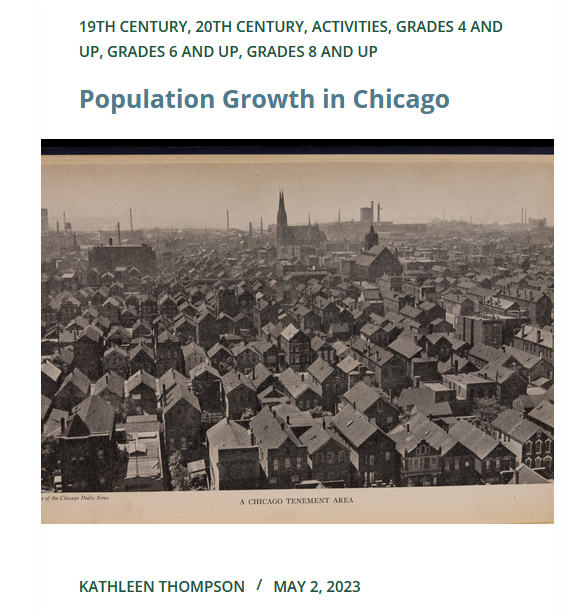
The 1880s were a period of stunning growth for the young city. As historian Carl Smith observes, Chicago’s population boomed during this decade, increasing from half a million to over a million residents. Jewish and other immigrants contributed to this rapid growth. The very forces that drew immigrants to the city—opportunities to earn wages in its factories, stockyards, and workshops—also produced tensions and unrest among workers who resented the long hours and low pay that characterized the industrial era (Smith, “Dramas of Haymarket”).
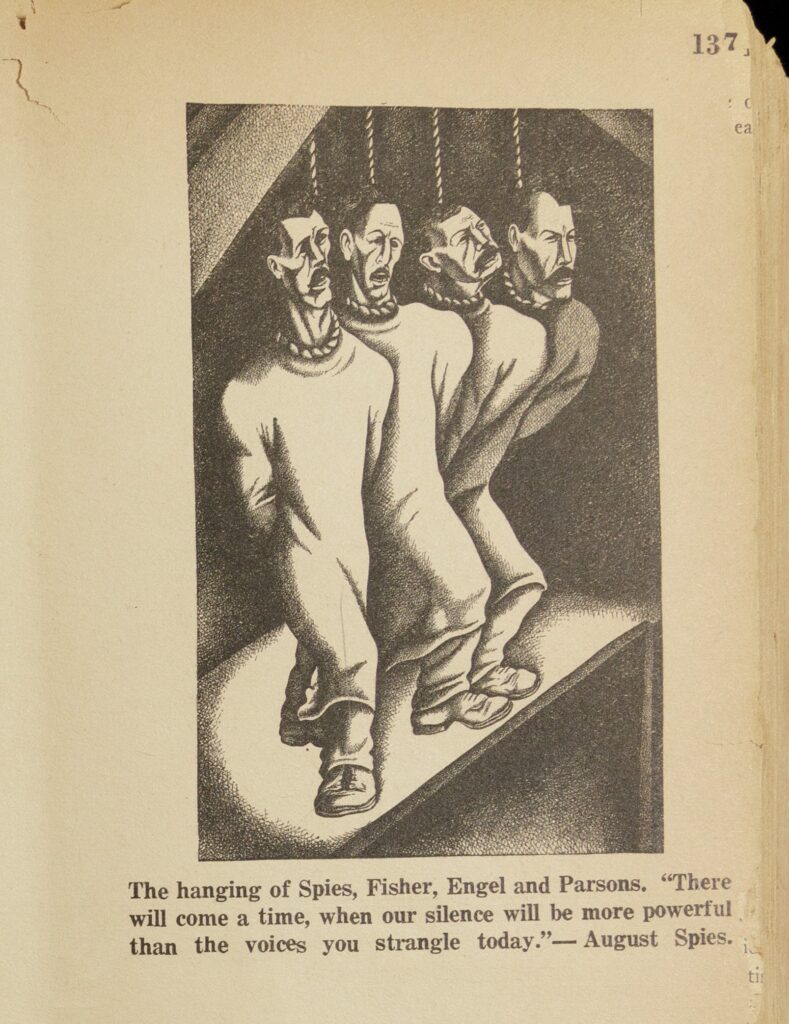
Simmering tensions boiled over in the infamous Haymarket Affair of 1886. In that year Chicago became the epicenter of a nationwide movement for an eight-hour workday. Tens of thousands of workers participated in marches and work stoppages throughout the city on May 1. Activity continued over the following days, and on May 3 a confrontation in front of the McCormick Reaper Works ended in bloodshed when police killed two workers. A meeting was called for the next day to protest the killings.
On the evening of May 4, workers gathered near Haymarket Square at Desplaines and Randolph Streets. They listened to a series of speakers, including anarchists Albert Parsons, August Spies, and Samuel Fielden. Also listening was the city’s mayor, Carter H. Harrison. Satisfied that the assembly was peaceable, Harrison went home after admonishing the police to allow the meeting to conclude of its own accord. As the crowd dwindled, however, the police moved in to disperse the remaining listeners. Suddenly, a bomb arced through the air, detonating amidst the police officers. One officer was killed by the blast and dozens more were injured in the ensuing melee, some fatally. Several workers were also killed or injured (Smith, “Dramas of Haymarket”).
Although the identity of the bomb thrower remains a mystery, eight anarchists were tried and convicted for murder on the theory that their words and ideas, if not their actions, had encouraged the violence. Among their defense counsel were two young Jewish attorneys—Moses Salomon and Sigmund Zeisler, a recent German-speaking immigrant from Austria. One of the defendants was sentenced to fifteen years’ hard labor and seven were sentenced to death. Of these, one killed himself in prison by detonating a small piece of dynamite in his mouth. Four, including August Speis, were hanged in November 1887. The other two death sentences were commuted to life in prison, and all three surviving defendants were subsequently pardoned by Illinois Governor John Peter Altgeld in 1893.
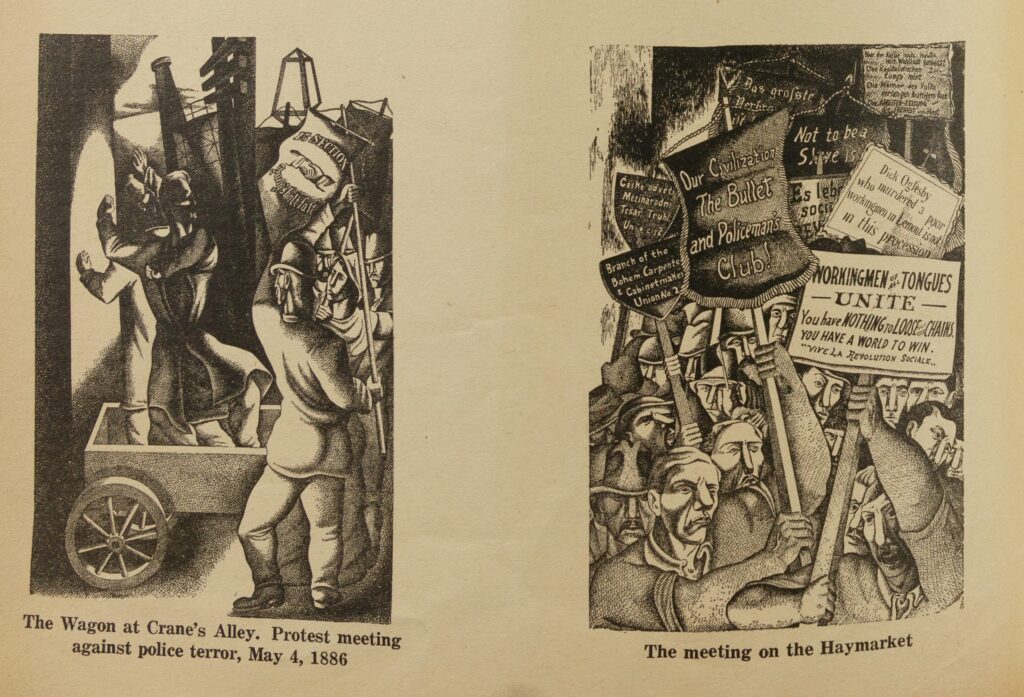
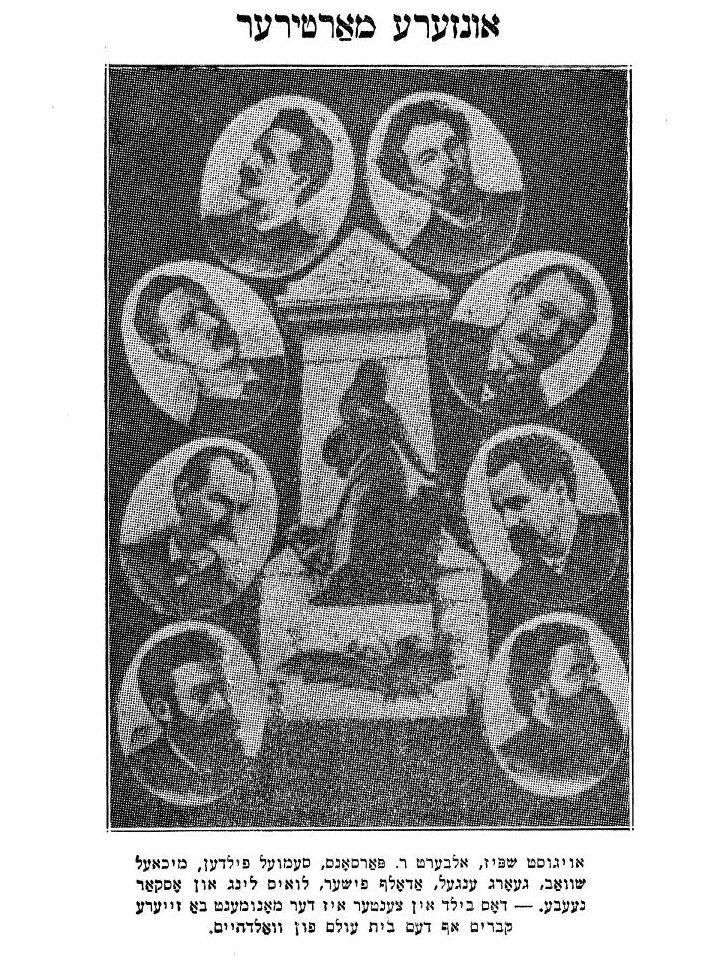
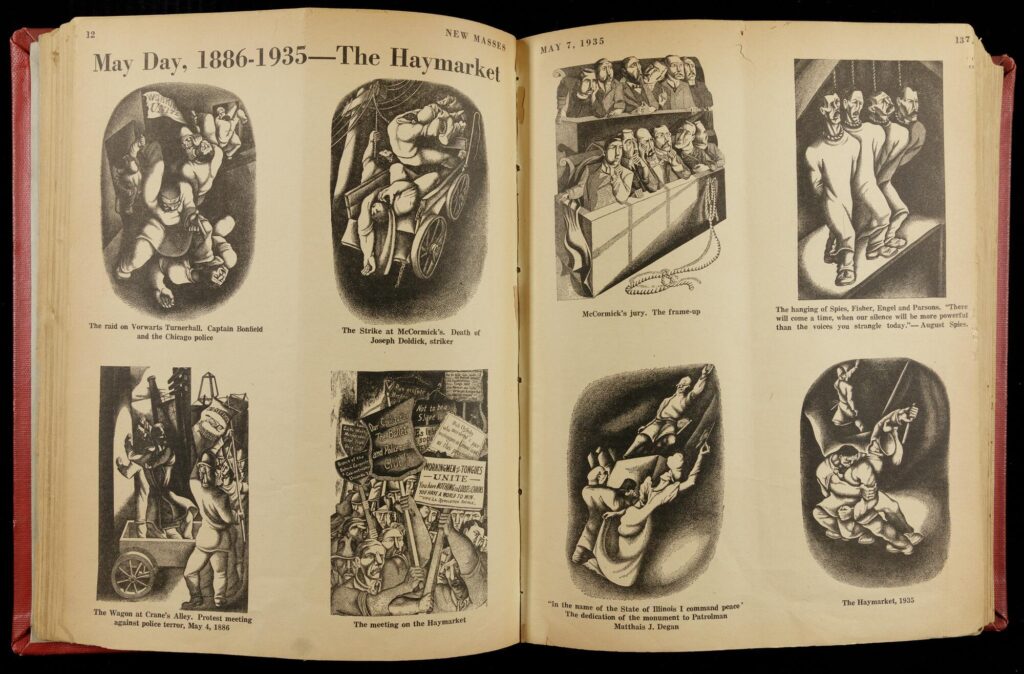
As news of the events and trial swept the nation, Yiddish-speaking immigrants were among the most outspoken champions of the “anarchist martyrs.” For example, the sweatshop poet David Edelshtat paid tribute to them in a series of Yiddish poems (Roth Breitzer, 66-67). Even as Haymarket’s flame dimmed in the following decades, leftwing Jewish artists and writers strove to keep it alive. In 1933, Jewish anarchists A. Frumkin and Alexander Berkman published a Yiddish translation of speeches by the Haymarket martyrs that featured their names and images; their faces surround a photograph of the monument erected in their honor in Waldheim Cemetery. Two years later, Chicago Jewish artist and activist Mitchell Siporin published a series of Haymarket-themed illustrations in the Marxist journal New Masses (pictured above). Together, these images show how Jewish anarchists and communists memorialized Haymarket while also claiming its legacy for their own political philosophies.
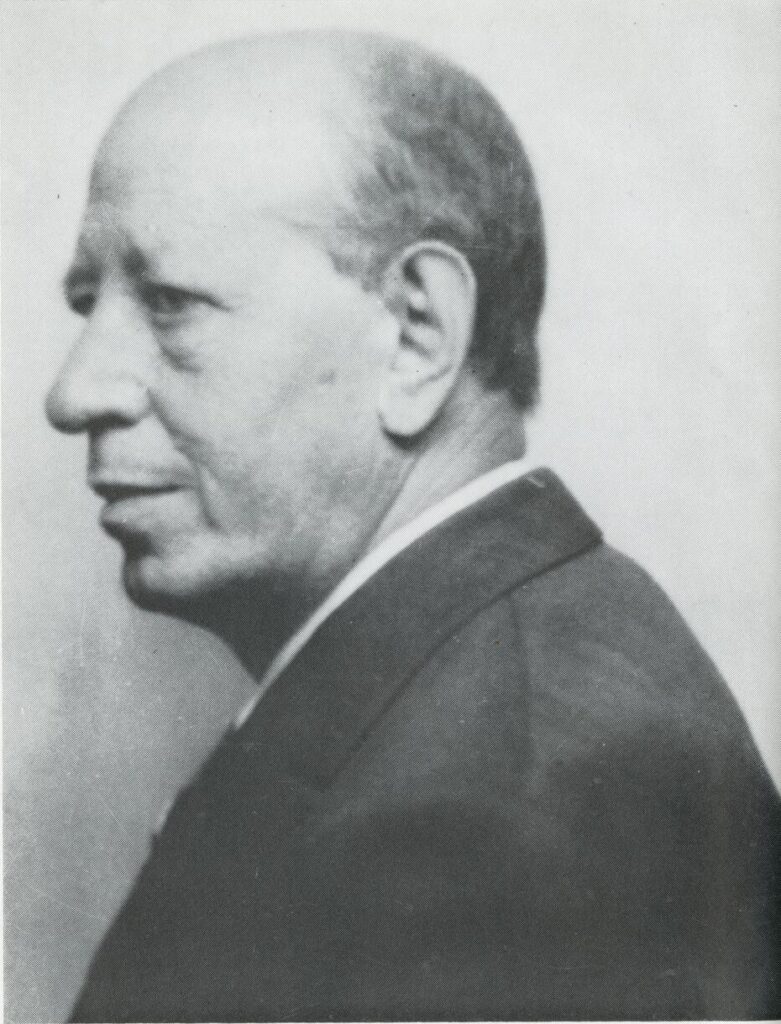
Members of Chicago’s Jewish community were not directly involved in the events of Haymarket, but as contemporaries they were profoundly influenced by them. In 1882, four years before the Haymarket Affair, Abraham Bisno and his family arrived in Chicago among the first big wave of Jewish immigrants from Eastern Europe. Born in 1866 near Wasilkow, Ukraine, then part of the Russian Empire, Bisno was the son of a poor tailor. Life in Wasilkow and the surrounding towns was bleak; it “was one stretch of sickness, great poverty, and hard labor,” Bisno recalled in his autobiography. When the young Abraham was apprenticed to a master tailor at age eleven, he was subjected to harsh beatings. Eventually, the family relocated to Kiev. When pogroms broke out in 1881, they became refugees, barely escaping the anti-Jewish violence with their lives. With the aid of the Alliance israélite universelle, a French organization dedicated to the welfare of Eastern European Jews, the Bisnos came to the United States, spending their first year in the South before settling in Chicago.
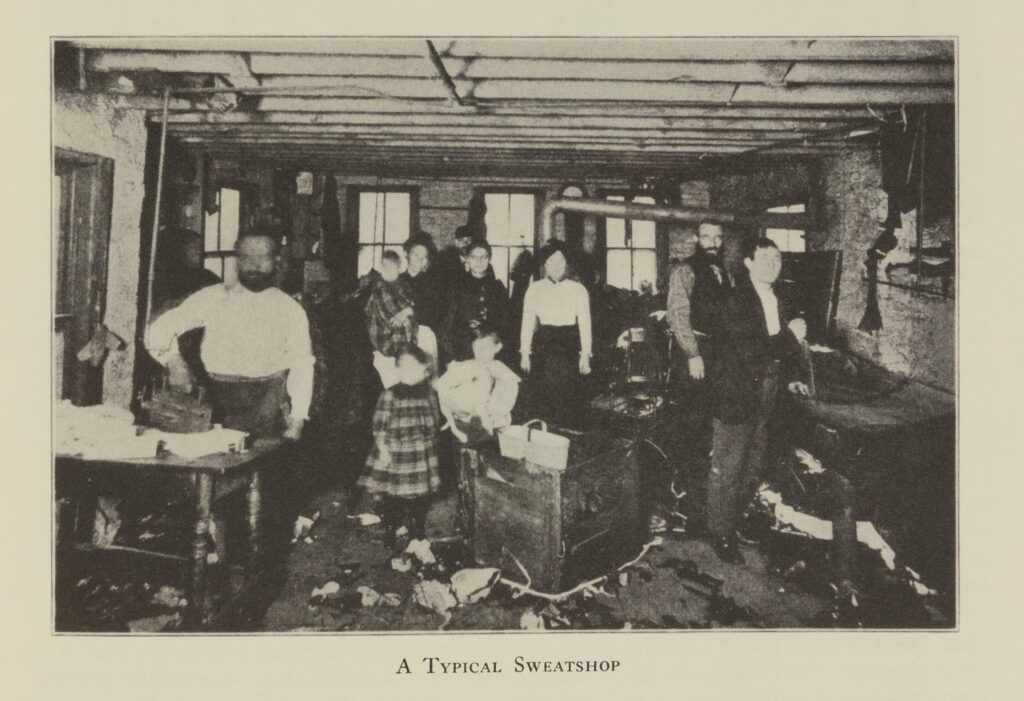
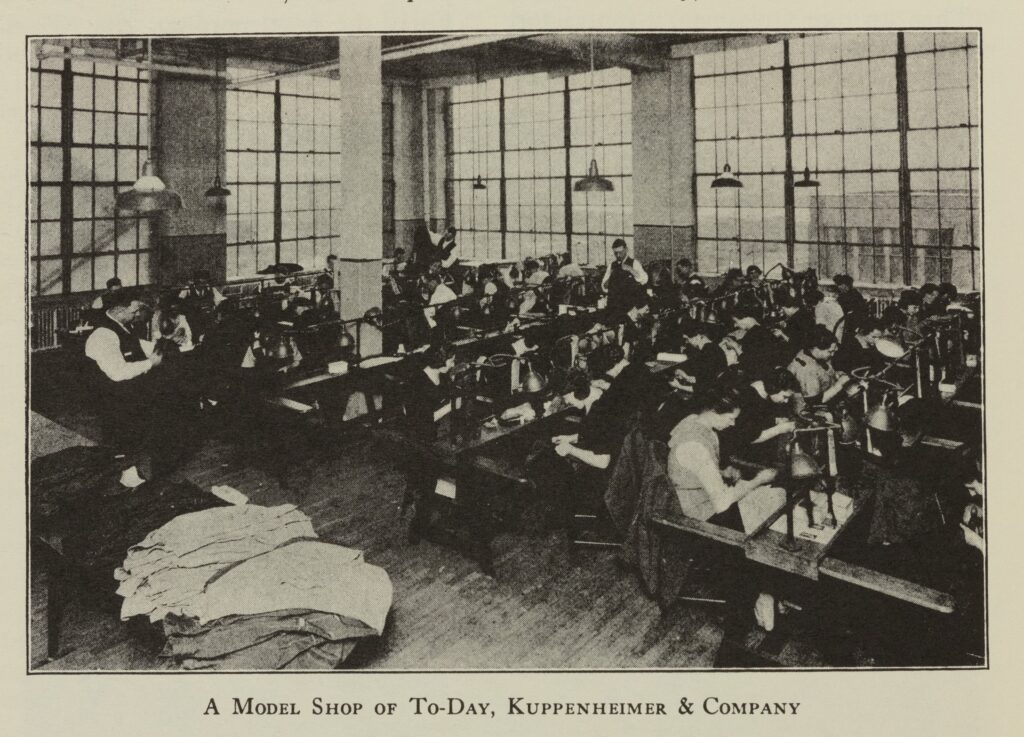
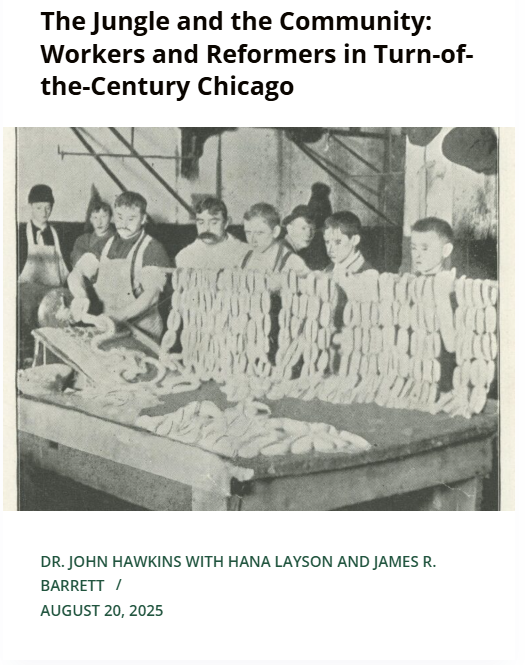
As immigrants experienced in textile production, the Bisnos found work in the city’s rapidly expanding garment industry. At the time, much of this work was performed in the home under sweatshop conditions. While Bisno’s command of English and knowledge of the trade allowed him to become a successful “contractor”—a worker who took home “bundles” of cloth from the large manufacturers and sewed them into finished garments, often by employing the labor of others—his rebellious instincts and irrepressible curiosity attracted him to the labor movement.
“Labor unions were raided, broken up, their property confiscated, the police used their clubs freely. Arrests were made without any cause, and the life of the working man was not quite safe when out on strike”
Abraham Bisno
Bisno’s participation in labor organizing brought him into contact with future Haymarket martyr August Spies, whom he heard speak one month before the fateful events of May 1886. His native Yiddish allowed Bisno to understand Spies’ German speech, and the criticisms of capitalism enumerated therein set the young Bisno “aflame.” Inspired, he joined a march of fellow Jewish cloak makers demanding better wages and working conditions on May 5. Unaware of the dramatic events that had transpired a day earlier, the marchers were brutally beaten by the police as they attempted to cross the Van Buren Street Bridge, part of the wave of repression that swept Chicago in the immediate aftermath of Haymarket. Bisno described the oppressive atmosphere in his autobiography as a state of “martial law”: “Labor unions were raided, broken up, their property confiscated, the police used their clubs freely. Arrests were made without any cause, and the life of the working man was not quite safe when out on strike” (81). Bisno and his comrades were shaken but undeterred. They persisted in their efforts to organize, and in 1890 Bisno was elected the first president of the Chicago Cloakmakers’ Union, a predecessor of the International Ladies’ Garment Workers Union (Bisno, v; Carsel, 24).
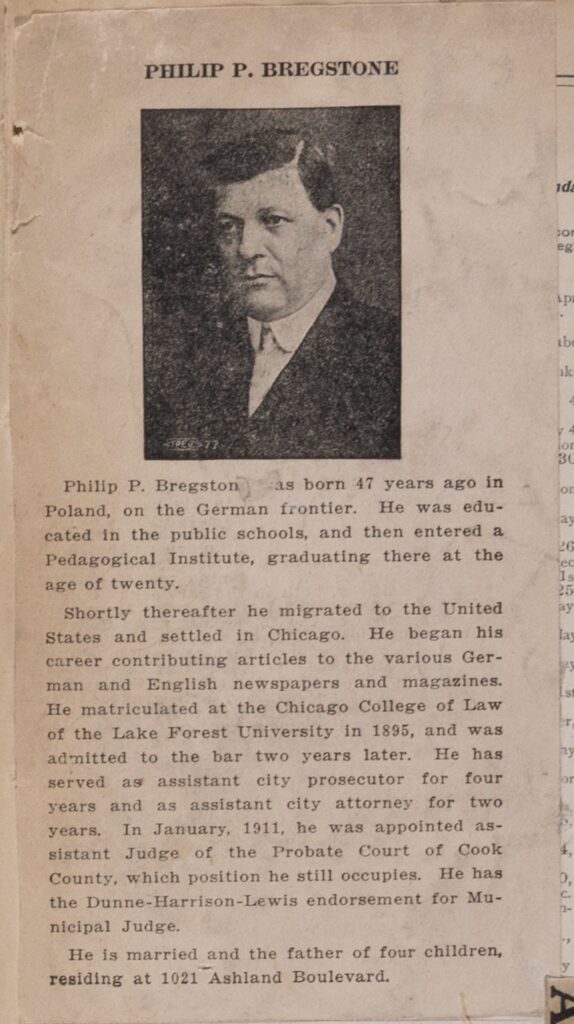
Philip Bregstone (originally Bregshtein) was born the same year as Bisno—1866—in the town of Weiwery, Lithuania (then part of Poland). He received Jewish and secular educations before immigrating to the United States in 1887 at the age of twenty. When Bregstone arrived in Chicago, the aftermath of the Haymarket drama was still playing out. In his cultural history Chicago and Its Jews, published in 1933, Bregstone recalled the tense atmosphere he encountered in the summer and fall of 1887. “The volcano upon which Chicago stood was seething and boiling, as if ready to explode at any moment,” Bregstone wrote. “Every hour brought new and fantastic rumors. … The very air was charged with foreboding” (11). Like Bisno, Bregstone was impressed by the eloquence of August Spies, whose courtroom orations captured the young Bregstone’s imagination (perhaps foreshadowing his future career as a lawyer). Spies “hurled bombs at his enemy, the capitalistic class, not made of explosive chemicals, but bombs of logic and science.” The anarchist firebrand “was an orator of dynamic force and he spoke equally well in English and German” (12).
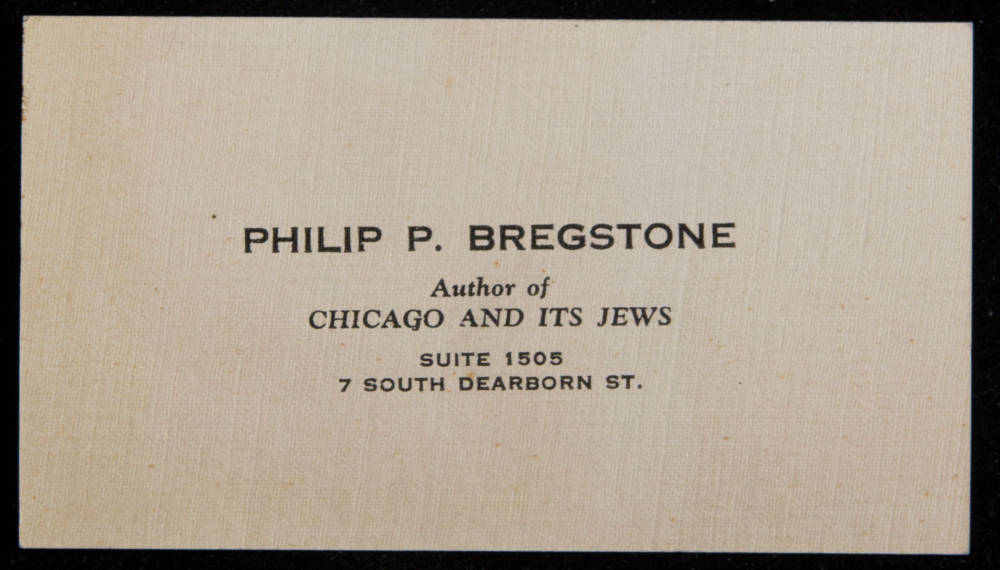
Bregstone argued that Haymarket was “the forerunner of the radical movement among the Jews of Chicago.” The movement began with the formation of the Jewish Workingmen’s Educational Society, located at 450 South Canal Street. “It was there that the Jewish labor movement, Jewish radicalism, socialism and anarchism in this city, first saw the light of the day.” The organization “established a modest library, conducted lectures and encouraged public speaking. Its leading members were Peter Sissman, Abraham Bisno, Dr. Nahin, Dr. Knopfnagel and many whose names have passed from my memory.” Bregstone himself briefly served as corresponding secretary for the Chicago Knee-Pants Makers’ Union, authoring short reports for the Yiddish labor press on meetings which took place at the Jewish Workingmen’s Educational Society.
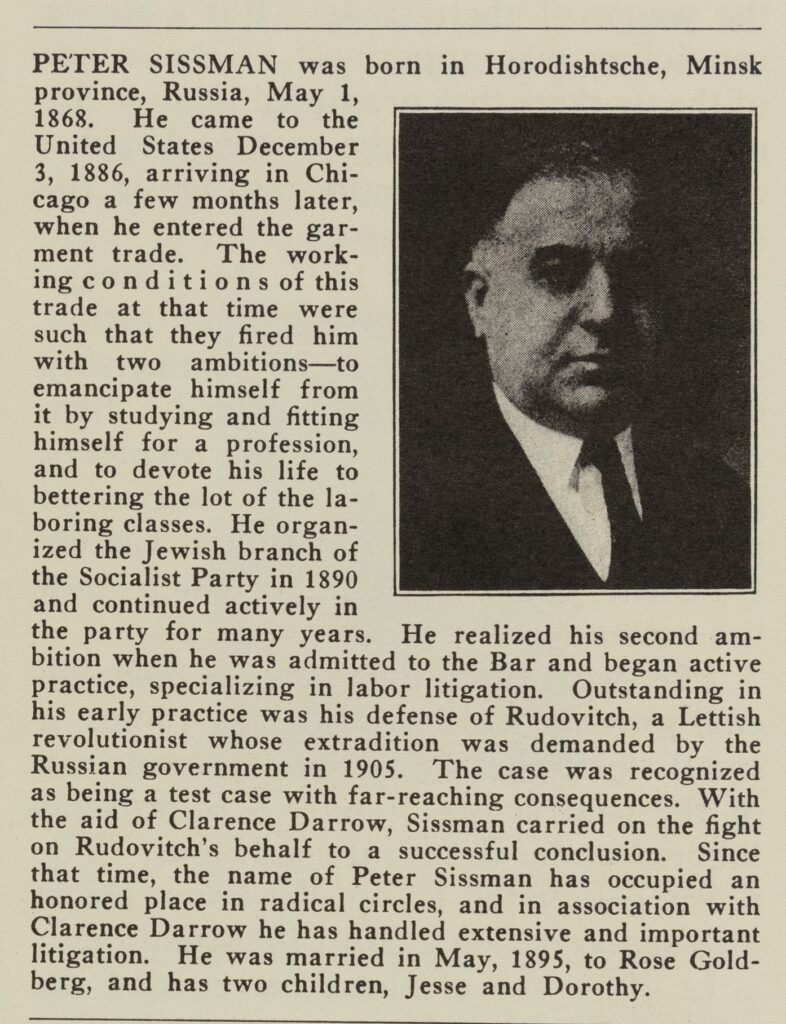
In Bregstone’s analysis, Jewish immigrants were drawn to the labor movement not only because of terrible working conditions but also because of their experience as a persecuted minority in Tsarist Russia. They had come to the United States to improve their economic conditions, but they also yearned to live in a free society. Indeed, many of the Jewish immigrants had been “engaged in a movement to free Russia from its tyrannical autocracy and those not actively participating were in sympathy with the movement.” The miscarriage of justice represented by the Haymarket trial, the execution of the martyrs, and the atmosphere of political repression “could not but disillusion them” (13).
Hilda Satt Polacheck did not reach the Windy City until 1892, several years after Haymarket. Born Hinde Satt in Wloclawek, Poland in 1882, her life in the old country differed markedly from Bisno’s travail of abject poverty. Her father Louis was a tombstone carver whose technical skills and knowledge of multiple languages allowed him to become a prosperous artisan. In her autobiography I Came a Stranger: The Story of a Hull House Girl, Polacheck recalls an idyllic childhood spent playing on the banks of the Vistula River. Her family employed a cook, and they ate sumptuous meals on the Sabbath and other Jewish holidays. The specter of anti-Jewish violence haunted the young Hilda, but she did not experience it directly. Nevertheless, the deteriorating situation for Jews, combined with the lure of Di Goldene Medine—specifically the spectacle of the 1893 World Columbian Exposition, which drew her father to Chicago—persuaded Louis to uproot the family and make a new life in the United States. When Polacheck arrived in Chicago, Louis had already been in the city a year. He continued to do good business as a tombstone carver. The Satts lived in a large, well-appointed apartment in the Jewish quarter of the city on Chicago’s near west side, commonly referred to as the “ghetto.” Polacheck attended the Jewish Training School, an important educational institution in the neighborhood. In 1893, she attended the World’s Fair with her father.
The good times did not last, however. Tragedy struck in March of 1894 when Louis died suddenly while at work, and the family was plunged into poverty. Polacheck had to leave school and take up work in a knitting factory. “We worked from seven thirty in the morning till six in the evening, six days a week,” she recalled in her memoirs. “We had a half hour for lunch, which we ate sitting in front of the machine” (57). The workplace lacked safety regulations, and workers’ hands sometimes got caught in the machines. When an informer reported Polacheck to her employer for speaking at a union organizing meeting to improve working conditions, she was fired despite having devoted four years to the job. She soon found another job in a shirtwaist factory where the labor process was subdivided down to the smallest task: “My job consisted of making cuffs. So for ten hours a day I sewed cuffs. The deadly monotony…was worse than the actual work” (63).
Her sudden change in fortune and loss of economic freedom framed Polacheck’s reaction to the events of Haymarket, which she first learned of from famed anarchist and fellow Jewish immigrant Emma Goldman at a meeting at the West 12th Street Turner Hall in 1903. In Polacheck’s telling, Goldman, an atheist, adopted a prophetic tone, and the meeting resembled a kind of anarchist Passover seder. “Emma Goldman started out by telling us that she knew that everybody in the hall knew the story of the martyred comrades, but like the story of the Exodus, it had to be told each year so that ‘we will not forget’” (82).
Polacheck related the story of Haymarket to her own experience as a garment worker, identifying with the cause of the eight-hour workday for which the Haymarket martyrs died. “As I sat there listening to the recital of these events, I kept thinking of the shirtwaist factory and the hours I worked, and I could not get myself to feel that asking for the eight-hour day was a crime,” she reflected. While she sympathized with the struggle for better working conditions, she “was horrified at the throwing of the bomb” (83). Yet she was outraged by the fact that the Haymarket martyrs were tried for their ideas, not their actions. In an echo of Bregstone’s analysis, Polacheck contrasted the treatment of the Chicago anarchists with American ideals as she understood them. Her “father had come to America … because here in this wonderful country a man was free to say what he wanted, even if he was wrong” (85). The events of Haymarket and her own experiences of economic precarity and industrial servitude revealed a gap between American ideal and American reality.
Learn More
Jewish immigrants were not the only residents of Chicago troubled by the gap between American ideals and the realities of their experiences. The leaders of Hull House, an example of the burgeoning settlement house movement, were also concerned by the effects of industrialization on democracy and the urban fabric. “It is not difficult to see that although America is pledged to the democratic ideal, the view of democracy has been partial, and that its best achievement thus far has been pushed along the line of the franchise,” Jane Addams wrote in her 1893 essay “The Subjective Necessity for Social Settlements.”
The right to vote, while valuable, was not enough, Addams argued, if vast social disparities—whether economic, racial, or national—prevented people from accessing opportunities for self-cultivation and meaningful democratic participation (Sklar, 176). By bringing cultural and educational resources to Chicago’s neediest neighborhoods, Addams hoped to build on democratic electoral procedures and empower the city’s residents in their everyday lives. Founded in 1889 by Addams and Ellen Gates Starr and following the example of Toynbee Hall in London, Hull House was conceived as a place where the educated middle classes could live among the city’s poorest residents, bridging the geographical gap that separated the classes and mending the spiritual and cultural rifts opened by urban industrial capitalism (Sklar, 172; Smith, 222).
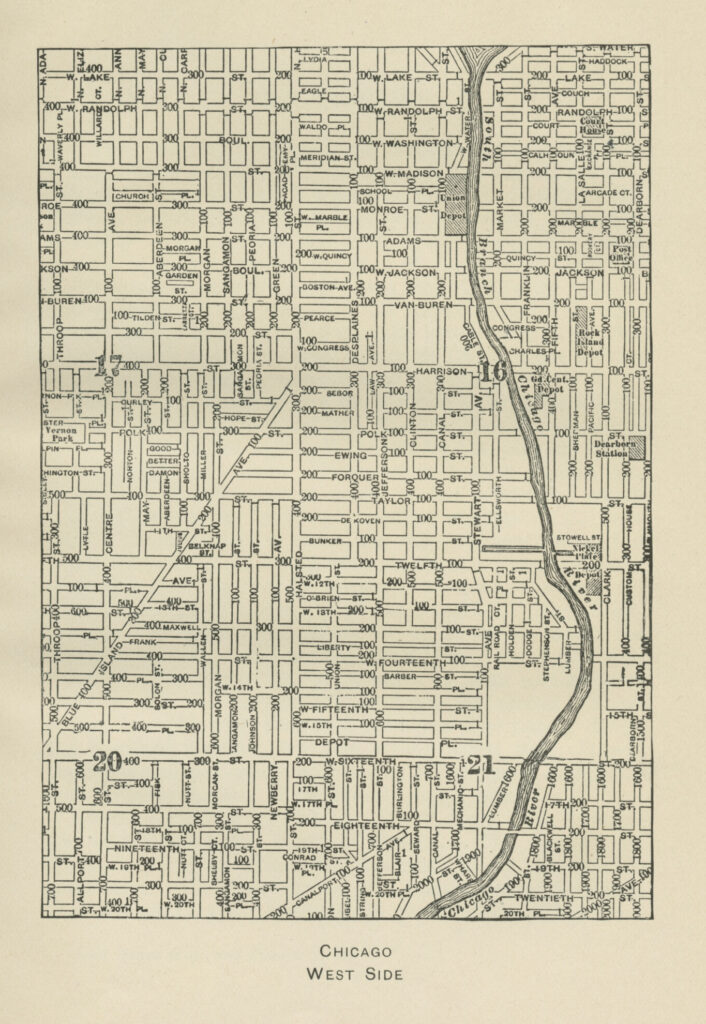
Hull House’s location at the intersection of Polk and Halsted Streets abutted the densest area of Jewish settlement in Chicago, known as the “ghetto.” Philip Bregstone described the value of the institution in Chicago and Its Jews: “The influence of Hull House on the dwellers of the ghetto cannot and must not be underestimated,” he insisted. “The young immigrants who thirsted for the knowledge which has been denied them in the land of the Czars, rushed to the new fountain to quench their thirst and drink to their heart’s content. The lecture halls, the library, the art galleries and all other branches for art and literature were crowded by these eager immigrants; they came to enrich their souls with everything that Hull House had to offer” (18).
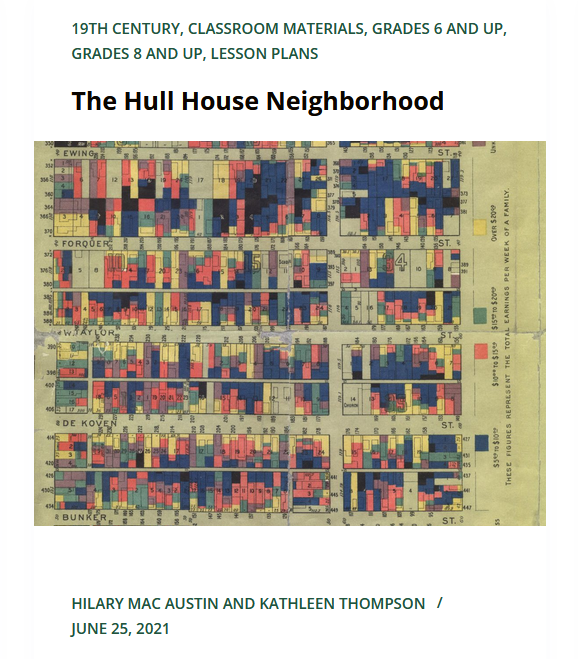
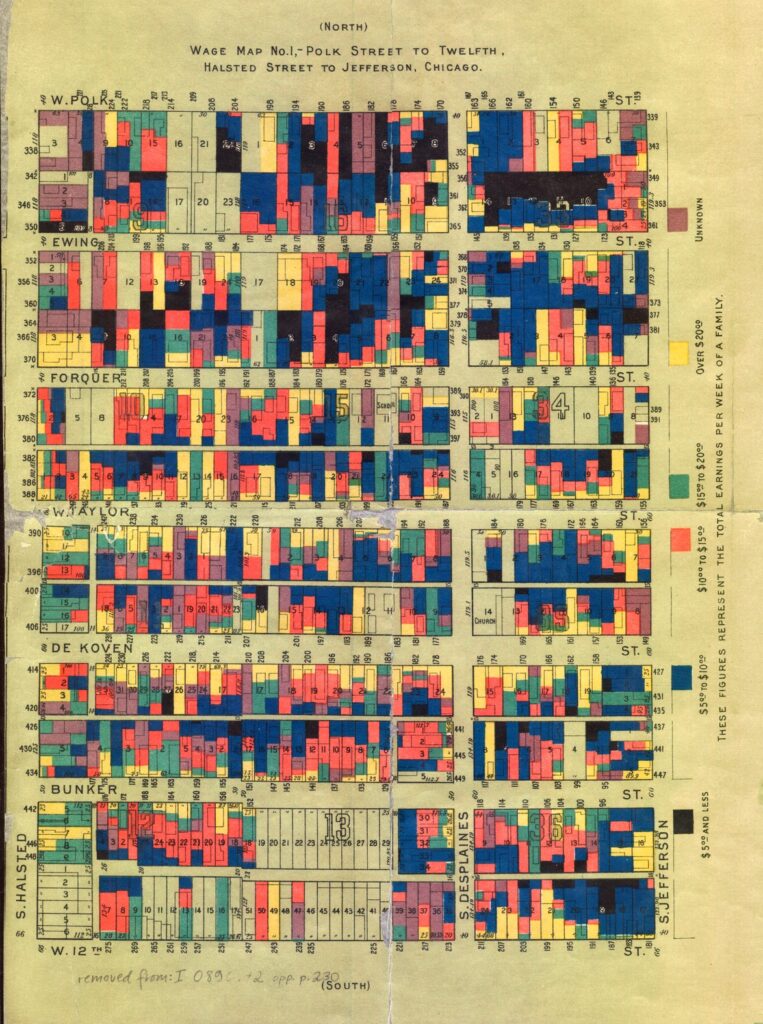
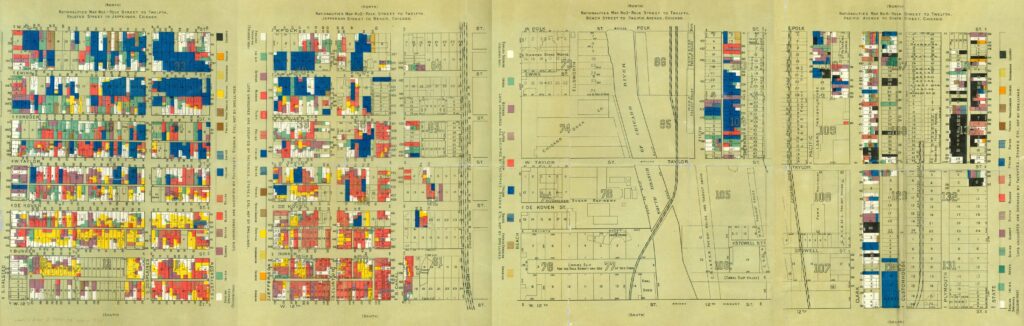
“The ghetto” also fascinated the residents and associates of Hull House, shaping their inquiries and agenda. In Hull House Maps and Papers, a collection of investigative essays by Hull House residents published in 1895, sociologist Charles Zeublin devoted a chapter to the Chicago ghetto, describing its physical and cultural characteristics. According to Zeublin, the ghetto “comprise[d] parts of the nineteenth, seventh, and eighth wards, and is bounded by Polk Street on the north, Blue Island Avenue on the west, Fifteenth on the south, and Stewart Avenue on the east” (93). Within this area lived 20,000 Jews, he reckoned. The quality of the housing was poor, although not significantly worse than the adjacent areas. Most distressing was “the deadly rear tenement,” which admitted no light, was exposed to “frightful odors” from the alleyway, and was “too often the workshop of the ‘sweater,’ as well as the home of an excessive population.”
The Jewish cultural atmosphere of the ghetto was unmistakable. “It is the religious distinction which every one notices,” Zeublin observed; “the synagogues, the Talmud schools, the ‘Kosher’ signs on the meat-markets” (94). Zeublin singled out the sweatshop as a particularly pernicious aspect of ghetto life. “The most pitiable thing about the sweat-shops in this district is the oppression of Jew by Jew,” he lamented. But he also highlighted the contributions of the Jewish labor movement to ameliorating these conditions. “The chief labor organization of the Jews are the Cigarmakers’ Union and the Cloakmakers’ Union,” he noted. “While these organizations are taxed to keep wages above starvation level, they are composed of an unusually intelligent set of men, when their wages and hours are considered” (100).
Zeublin admired the “pertinacity” of the Jewish population and predicted its future success so long as it discarded its “conservative” tendencies, which, alongside its poverty, constituted the ghetto’s chief “evils.” Notably, Zeublin took aim at Yiddish as one force hindering Jews’ ability to elevate their cultural and economic standards. For example, he lauded the quality of the theater in the ghetto, which he described as “a testimony to the latent tastes of the Jew” (102). However, this affinity for culture and the arts was “marred only by the regret that they are not hearing their old classic language”—Hebrew—“instead of the frightful jargon,” Yiddish (103). Likewise, Zeublin praised the synagogue as a positive “educational factor” among the Jews of the ghetto but once again could not resist the urge to disparage Yiddish: “the magnificent literature of the Hebrews is there brought before the people, whose literary taste is well nigh annihilated by the frightful jargon of their daily conversation” (106-7).
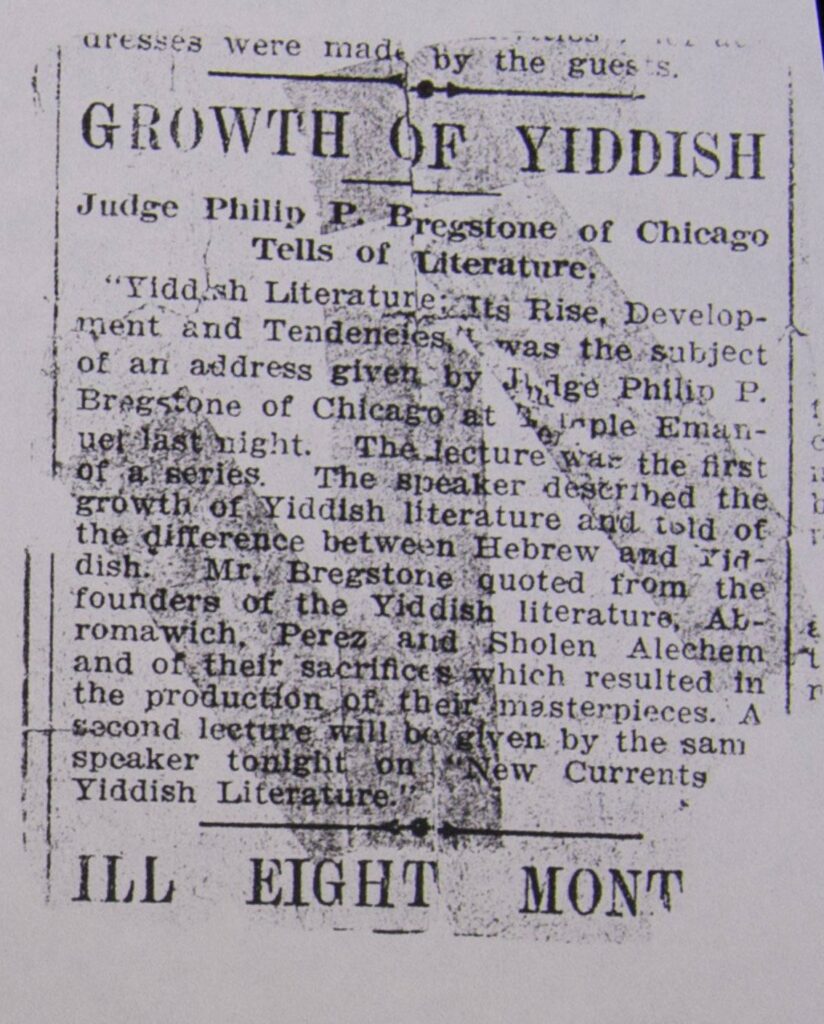
Zeublin’s attitude reflected a widespread anti-Yiddish prejudice that bore a dubious relationship with reality. Contrary to Zeublin’s derogatory description, Philip Bregstone described Chicago’s thriving Yiddish literary culture. In addition to the theater, multiple Yiddish-language newspapers represented a variety of ideological perspectives, from the more orthodox views of Der Yidisher Kurier (The Daily Jewish Courier) to the avowedly socialist Yidishe Arbayter Velt (Jewish Labor World). The Yiddish publisher L.M. Shteyn set the standard for Yiddish books, producing superb volumes that were considered “a jewel in every intelligent Jewish home” (Michels, 149-50).
“Yiddish, that much maligned and still more detested language … has … come to contain a literature that occupies a prominent position in the literatures of the world. To this literature Jews of Chicago have contributed in all its branches.”
Philip Bregstone
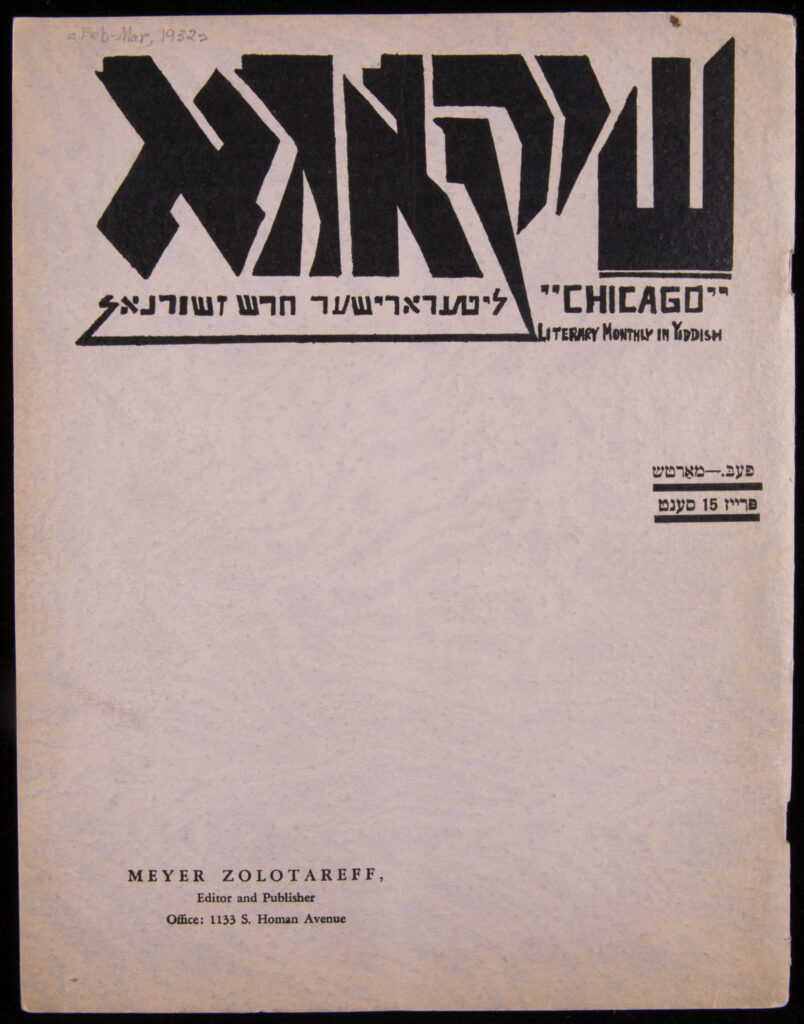
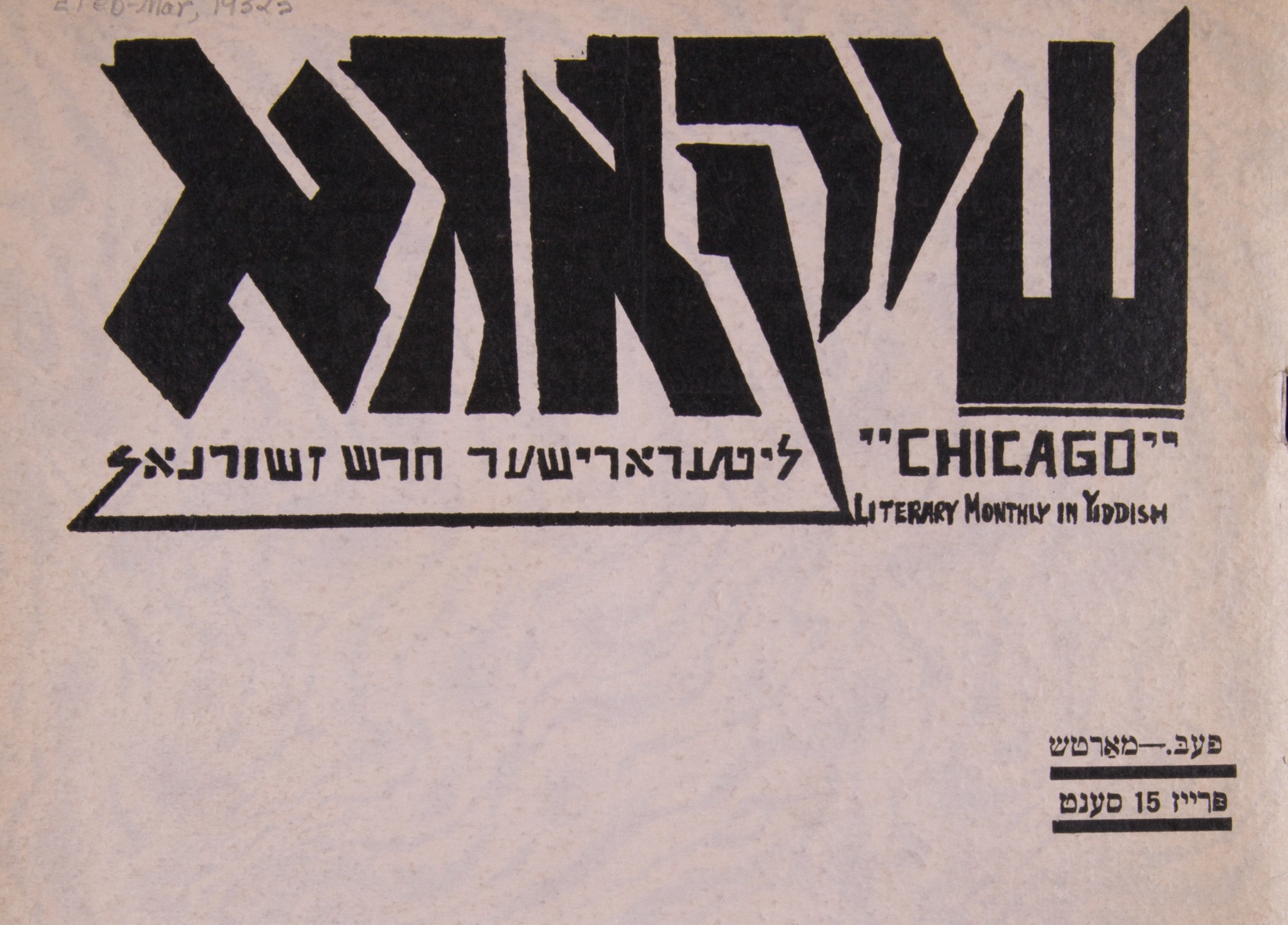
In the 1920s and 1930s, a group of Yiddish writers calling themselves Yung Shikago (Young Chicago) published an anthology of poetry and put out a flagship monthly journal, Shikago, to which Bregstone contributed substantial works of literary criticism. Bregstone himself authored a novel in Yiddish, In Shturm fun Leben (In the Storm of Life), which was published in 1924 and reviewed by distinguished Yiddish critic Shmuel Charney. While Chicago’s Yiddish literary culture never achieved the scale of New York’s, whose Jewish population dwarfed the Second City’s, it nevertheless left a rich legacy. “Yiddish,” Bregstone wrote, “that much maligned and still more detested language…has…come to contain a literature that occupies a prominent position in the literatures of the world. To this literature Jews of Chicago have contributed in all its branches” (348-9).
Zeublin’s analysis of the ghetto may have had its blind spots, but it laid a foundation for subsequent investigations. In 1928, the sociologist Louis Wirth published a significantly longer, subtler, and more psychologically acute study, The Ghetto, which quoted both Zeublin and Jane Addams at length. A Jewish immigrant from Germany, Wirth was a professor at the University of Chicago, where he represented the “Chicago School” of sociology, an approach that stressed the role of the social environment in determining human character and behavior. The Ghetto brought this approach to bear on the institution of the ghetto by placing it in social and historical context. The ghetto was both a social and spiritual condition, according to Wirth. As he stated repeatedly, the “ghetto is not only a physical fact; it is also a state of mind.”
Casting his eye back to antiquity and medieval Europe, Wirth saw the ghetto developing for multiple reasons, some voluntary—based on freely associating Jewish communities—and some involuntary—based on legal persecution that confined Jews to certain areas under penalty of law. “The ghetto arose, in the first instance, out of a body of practices and needs of the Jewish population,” Wirth argued. “Gradually it became an established institution without the Jews themselves being aware of the invisible walls that they were building around their community. Only when it became formally recognized and sanctioned by law, or, rather, decreed by law, however, did it become an object of resentment because it was a symbol of subjugation” (50-1).
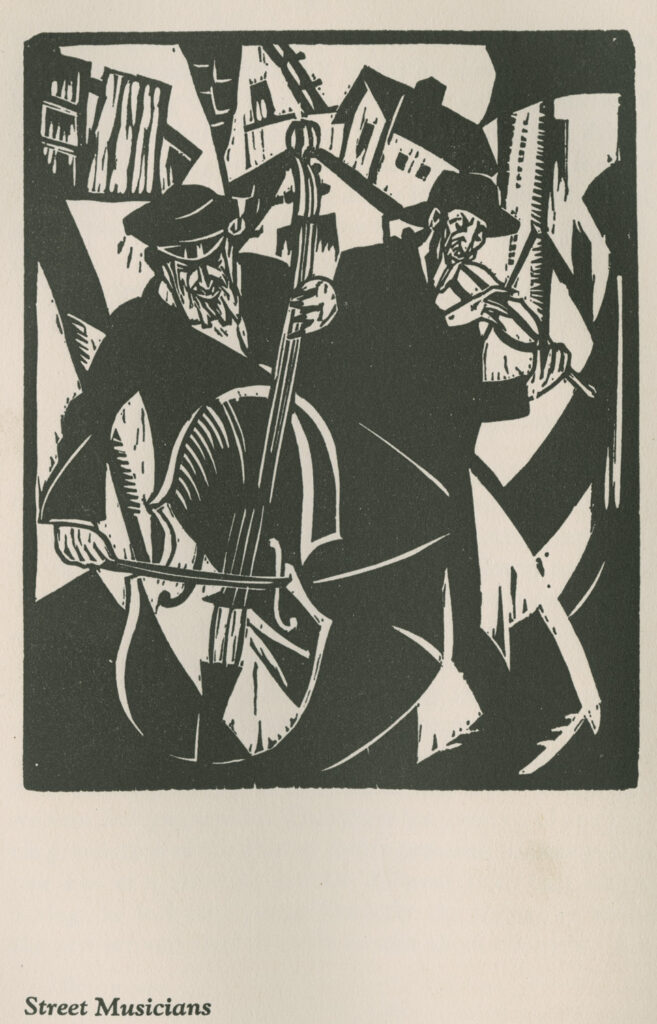
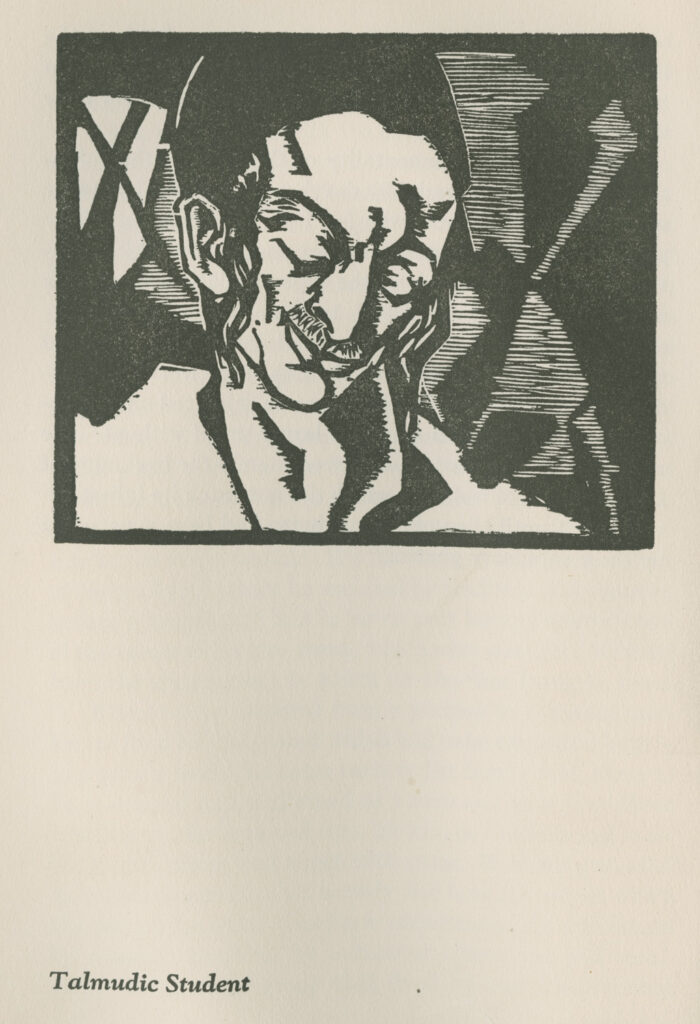
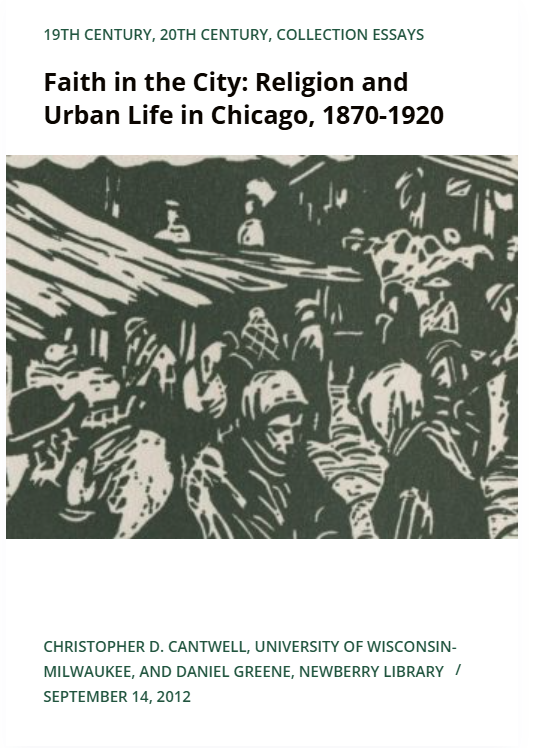
Wirth viewed the modern urban ghetto as the outgrowth of its long history as something both chosen and imposed. Unlike the medieval ghetto, with its locked gates, the modern ghetto was an enclave, a “colony” in the vocabulary of Hull House and others, based on ethnic and cultural affinities, such as shared customs and language. It bore the psychological scars of the legally imposed ghetto, but it existed in conditions that allowed residents to move beyond it, mainly through cultural assimilation. This process was not necessarily a smooth one. Rather, as Jews left the ghetto in search of wider horizons, antisemitism and other hardships that they encountered in the outside world often drove them back to its cramped yet familiar environment. This experience led to internal psychic conflicts that pitted their old identities as Jews against their new ones as aspiring Americans, Wirth argued. Strikingly illustrated by Chicago Jewish artist Todros Geller (whose series of woodcuts had first appeared in a 1926 book published by L.M. Shteyn) and drawing on a wealth of primary and secondary sources, Wirth’s book remains a unique study that places Jewish life in Chicago in the longer arc of Jewish urban history.
Learn More
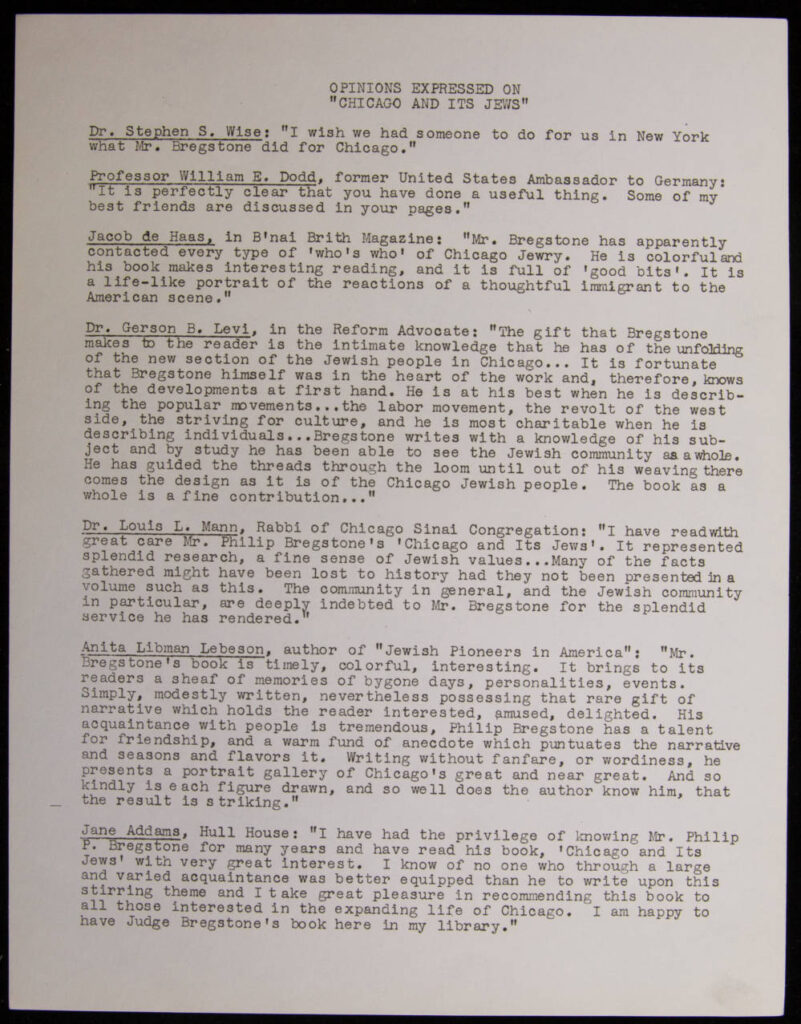
As Bregstone emphasized, Hull House offered a wealth of educational resources to the residents of the ghetto. His description coincides with a predominant image of Hull House as a middle-class project of “urban uplift.” Uncharitably, it might be described as a place where well-bred Anglo-Americans could flatter themselves that they were spreading civilization among the benighted foreign slum dwellers. As Carl Smith notes, Hull House shared some characteristics with the model factory town of Pullman, where a benign paternalism was supposed to ensure social harmony (Smith, 221-3).
The image of Hull House that emerges from the memoirs of Jewish immigrants like Abraham Bisno and Hilda Satt Polacheck, however, is of a much more radical space where the multicultural working class rubbed elbows with socialists, anarchists, and freethinkers, and engaged in spirited, even aggressive, debate. It was a place where radical solutions were not only discussed but put into practice. While aspects of Hull House’s radical spirit emerged directly from its social democratic mission, its rebellious character was also shaped by the working-class immigrants of the surrounding community, especially Jewish garment workers.
For Bisno, Hull House was a revelation. “My acquaintance with Hull House was an eye-opener to me. People who did not belong to our class took an interest in our lot in life. This was very new to me,” he recalled. Bisno’s introduction to Hull House came via Florence Kelley, who joined the settlement in 1891. Kelley was the highly educated daughter of a US congressman who had abandoned her social privileges and embraced socialism while studying in Europe. There she became romantically involved with a Jewish medical student, Lazare Wischenewetsky, whom she married (they would later divorce due to Wischnewetsky’s physically abusive behavior), and made contacts with European socialists, including Friedrich Engels, the friend and collaborator of Karl Marx. Fluent in German, Kelley wrote articles in the German social democratic press and devised grand plans to translate German socialist literature for an American audience. In 1887 she published her English translation of Engels’s 1845 book, The Condition of the Working Class in England. A pathbreaking work of urban sociology, Engels’s book documented and decried the living and working conditions of industrial Manchester, where the young Engels worked for his father’s textile firm.
Kelley’s intellectual acumen appealed to Bisno’s theoretical side. He had studied the ideas of Marx and Engels intensively in the Jewish Workingmen’s Educational Society and esteemed Kelley’s translation of Engels as well as her other intellectual gifts. Meanwhile, her pragmatic “English” vision of socialism as the progressive extension of democratic, public-spirited social reforms appealed to Bisno’s practical sensibilities. Bisno was also impressed by Kelley’s sympathy for the plight of the Jews: “The fact that she was a Yankee and I a Jew seemed to make no difference to her. When I described the poverty, suffering, and oppression of our people, she took a great deal of interest” (Bisno, 117). Kelley esteemed Bisno in turn. According to Kelley’s biographer, Kathryn Kish Sklar, Bisno “was one reason why she told Engels that ‘the most open minded workers’ seemed to her ‘the Russian Hebrew immigrants’” (Sklar, 221). Along with a group of Hull House residents and their allies, Kelley and Bisno led a movement to abolish sweatshop labor in the city. This reached a climax in several mass meetings at which Kelley and other affiliates of Hull House spoke to large crowds of Jewish and other workers (Bisno, 123).
The fruit of this collaboration—the 1893 Illinois Factory Act that banned child labor and enacted an eight-hour workday for women—led Governor Altgeld to appoint Kelley chief factory inspector for the state. Bisno was appointed one of her deputies, a position which gave him a steady income and allowed him to study the condition of Chicago’s workers firsthand. (The results of their investigations into labor conditions can be read in the series of factory reports they submitted to the governor.) The work appealed to Bisno because it brought him into contact with all sorts of people. As he put it in his memoir: “I loved to chum with the lowest portions of the community: tramps, drunks, prostitutes, etc.” He took the work seriously. “These were years when I studied the labor problem as never before,” Bisno recalled. “Not from books but from actual industry” (149). But when the labor law that empowered Bisno and Kelley was challenged in the State Supreme Court and a new governor less sympathetic to the cause of labor was elected in 1896, Bisno lost his position and was forced once more to seek work in the garment trade. This was often hard to come by, given his reputation as a militant strike leader. Despite this setback, his collaboration with Kelley and Hull House made a deep impression on Bisno’s life and philosophy.
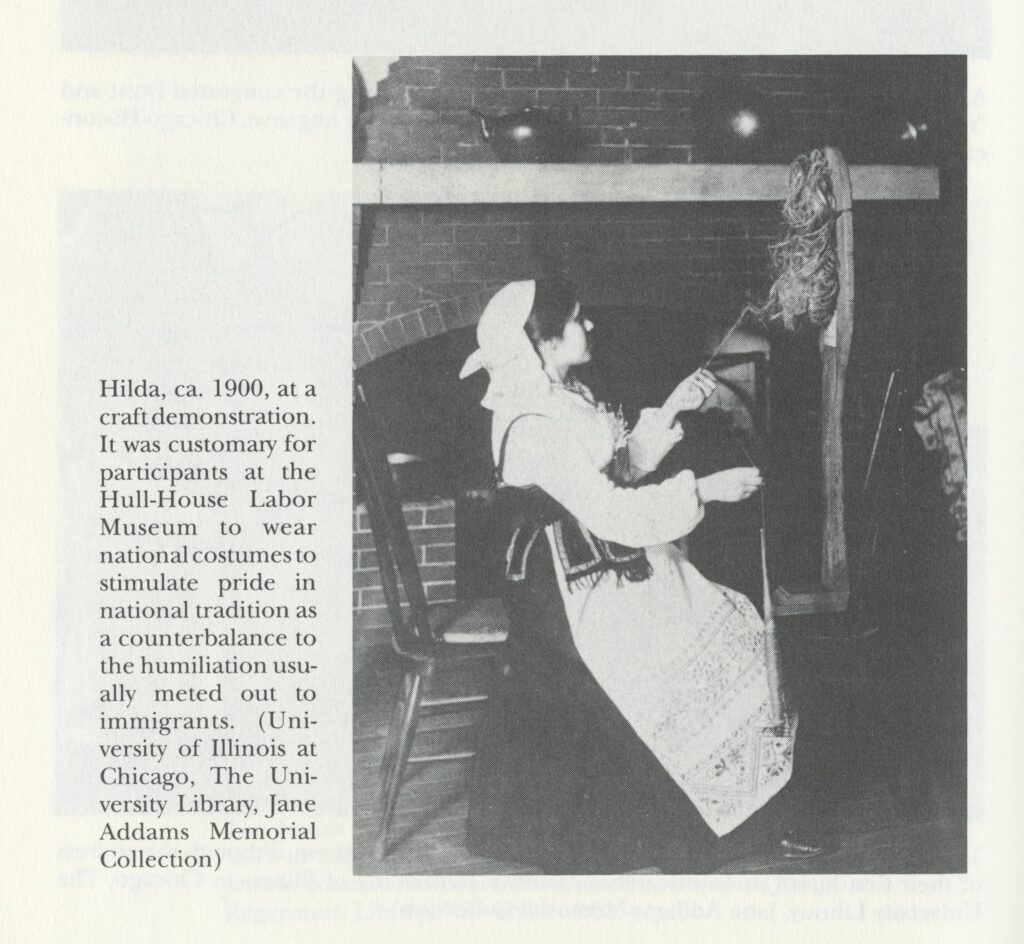
Hilda Satt Polacheck’s first substantial introduction to Hull House came via the Labor Museum. Polacheck had already been coaxed to a Hull House Christmas party when a neighborhood friend convinced her to overcome her apprehension about the event; in Poland, she had associated Christmas with anti-Jewish pogroms. But Polacheck’s lifelong relationship with Hull House did not begin in earnest until “one evening in 1900, after a particularly boring day at the factory, I decided to walk over to Hull-House three blocks away from where I lived. I had not been there since that eventful Christmas Party.” She was greeted by Jane Addams, who guided her toward the Labor Museum, which had been founded that same year. For Polacheck, the “event marked the beginning of a new life.” (63).
She remembered “how surprised I was when I discovered that cotton grew out of the ground. I had never thought just how the cotton cloth that I worked with every day was made. I could not tear myself away from the case.”
Hilda Satt Polacheck on the Hull House Labor Museum
The Hull House Labor Museum exemplifies how labor and culture intertwined to shape the experience and identity of Eastern European Jewish immigrants in Chicago. In Polacheck’s telling, the Labor Museum awakened her consciousness as a textile worker. Her “first stop” on her tour of the museum was a display that “showed the evolution of cotton, wool, silk, and linen.” (64).
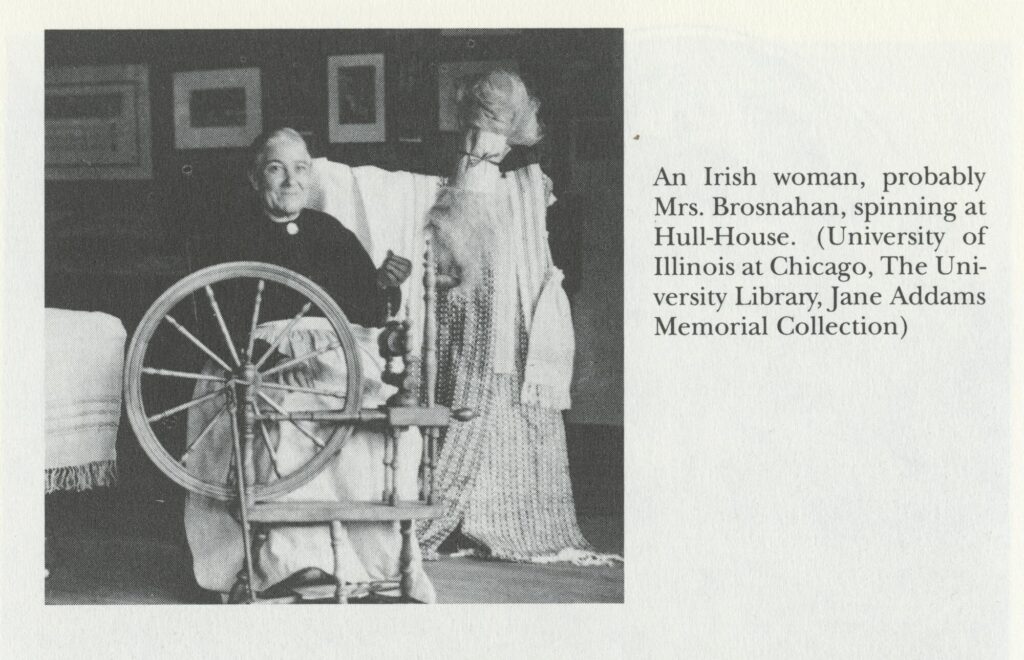
One might say that the Labor Museum helped Polacheck see through “commodity fetishism,” the impression that everyday goods are autonomous objects possessing mysterious, almost magical qualities rather than the products of human-directed material processes. By learning about the science and history of textile production, Polacheck could more consciously relate to her own work in the garment factory. Indeed, this was one of the explicit goals of the Labor Museum. As Addams wrote in a 1902 report on the museum, it was intended in part to give the “young people who earn their livings in the shops and factories … a chance to gain some idea of the material which they are constantly handling” so that they “might in time become conscious of the social connection of their work.” Further, by practicing crafts such as weaving in a non-commercial, non-industrial setting, immigrants like Polacheck could also partially overcome the alienation imposed by the minute division of labor in the garment trade and enjoy the craft on their own terms.
The Hull House Labor Museum also served a more overt cultural function, which Polacheck described as an easing of the tensions between the immigrant children and their parents. Such children, often more “Americanized” than their parents, sometimes looked down on them with shame and embarrassment because of their difficulty shedding the languages and customs of their home countries. By showcasing skills and crafts practiced by the cultures from which the immigrants of the neighborhood came, the Labor Museum helped children take pride in their parents’ heritage and see them in a more sympathetic light. It also helped instill a kind of working-class pride. Polacheck recalled visiting “a friend whose father was a tailor” who “had been attending some classes at the Labor Museum and had learned all about the making of cloth. When her father came home from work, she proudly told him what she had learned and that she was glad that her father worked with cloth” (66). In Polacheck’s view, the Hull House Labor Museum helped immigrants weave positive identities for themselves as members of a multicultural working-class community.
Hull House also played a supporting role in several major strikes of Jewish garment workers. Perhaps the most significant of these was the “uprising” of 1910, which began spontaneously when Jewish factory girls employed at Hart, Schaffner, and Marx, a large Jewish-owned textile firm, walked off the job in response to a cut in piece rates, the amount workers were paid per article that they produced. A month later, in October, thousands of workers were on strike demanding better wages and conditions. As the strike dragged into the winter, Hull House and its allies came to the relief of striking workers, who needed food and medical care. In Polacheck’s recollection, “they were able to collect about twenty thousand dollars, with which they set up milk stations and food stores.” Hull House residents, such as Ellen Gates Starr, walked the picket lines and even tangled with police (Roth Breitzer, 53). “Many doctors treated the strikers, especially those beaten by the police, without charge,” Polacheck recalled. “The strike had the complete support of the socially minded people of Chicago. The chief credit of for all this good will must go to Jane Addams” (120-1).
Learn More
This essay has dwelt on a specific period in Chicago’s history—roughly 1880-1910, with some brief forays into previous and subsequent decades—focusing on the accounts of three Eastern European Jewish immigrants. As with all types of historical evidence, there are limitations and advantages to first-person accounts. People can misremember their own experiences or embellish them, and it can be difficult to generalize from individual cases. On the other hand, to understand a historical period from the perspective of those who lived it, first-person testimony is indispensable. As historian Lucy Dawidowicz writes: “The most direct form of history, autobiography is history’s most intimate disclosure.”
The lives of Abraham Bisno, Philip Bregstone, and Hilda Satt Polacheck and the accounts they left behind reveal a set of characteristic experiences undergone by Jewish immigrants to Chicago, as well as a set of characteristic reactions. Their common reference points—Haymarket, Hull House, the Chicago “ghetto,” the garment industry, and the labor movement—speak to the shared nature of their experience, evoking the larger collective experience of the era. Their testimonies show that Eastern European Jewish immigrants to the city did not arrive with fully formed identities, nor were they blank slates upon which the city wrote its own story. Rather, they formed themselves in interaction with Chicago as they found it, helping to shape the city’s history and culture in turn.
Ben Schacht is a public humanist and independent scholar. He is a board member and program chair of the Chicago YIVO Society, an affiliate of the YIVO Institute for Jewish Research.
Fabric of Our Lives, a mural on Chicago’s North Side by Cynthia Weiss and Miriam Socoloff, lays out some of the intertwined threads that shaped Chicago’s Jewish community in the late nineteenth and early twentieth centuries. Its images depict the rich cultural and institutional life of Chicago’s Jewish immigrants, the difficult conditions many of them faced in Chicago, and the ways they fought to improve the city.
This essay weaves together the experiences of three Jewish immigrants to Chicago who left behind substantial accounts of their lives and times – Abraham Bisno, Philip Bregstone, and Hilda Satt Polacheck – and the ways they interacted with key events and issues of their time.
Members of Chicago’s Jewish community were not directly involved in the events of Haymarket, but they were profoundly influenced by them. Bisno, Bregstone, and Polacheck all saw Haymarket as related to subsequent Jewish labor activism. The images here show some of the ways that Jewish activists and artists connected faith, culture, and politics.
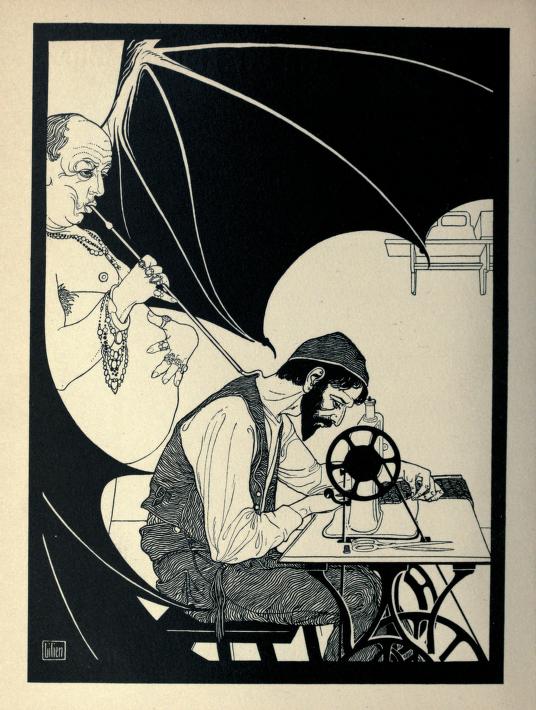
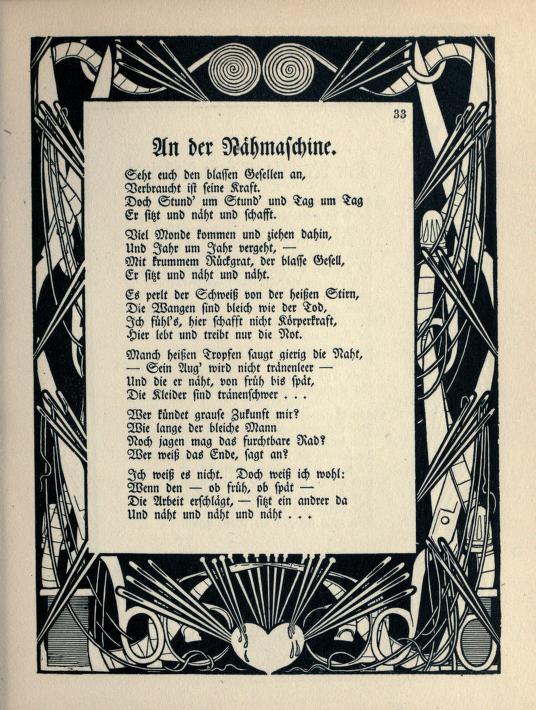
The first image is an illustration from Morris Rosenfeld’s Lieder des Ghettos and shows a wealthy industrialist in the guise of a demon feeding off a Jewish garment worker. The second is an illustration from a 1933 Yiddish translation of the speeches of the Haymarket martyrs introduced by Alexander Berkman, close friend and associate of Emma Goldman. The Yiddish text reads: “Our Martyrs. August Spies, Albert R. Parsons, Samuel Fielden, Michael Schwab, Geroge Engel, Adolph Fisher, Louis Lingg, and Oscar Neebe. The image in the center is the monument at their graves in Waldheim Cemetery.” Ideologically opposed to the Marxist-inspired communism of the Bolshevik Party, Berkman claimed Haymarket’s legacy for anarchism. Last are illustrations of Haymarket by Mitchell Siporin, a Jewish Social Realist painter raised in Chicago, for the Marxist magazine New Masses.
These sources depict Chicago’s densest Jewish neighborhoods. Some, by sociologists and activists, use data and maps to quantify the area. In contrast, Todros Geller’s woodcuts show the people and culture of the area. The settlement house Hull House, on the edge of the neighborhood, provided community, resources, and a site for community activism. The textile exhibit in its Labor Museum deepened Polacheck’s knowledge of, and respect for, the labor performed by Chicago’s immigrant workers.
Starting in the early 1900s, Jewish Chicagoans began documenting and celebrating their experiences in Chicago. Bregstone’s 1933Chicago and Its Jews: A Cultural History was one of the first important histories of Chicago’s Jewish community. Bregstone was also a prominent member of Chicago’s Yiddish literary scene.